
You are using an out of date browser. It may not display this or other websites correctly.
You should upgrade or use an alternative browser.
You should upgrade or use an alternative browser.
Gotta love ZERO RISK in the SP500 = $$$
- Thread starter makloda
- Start date

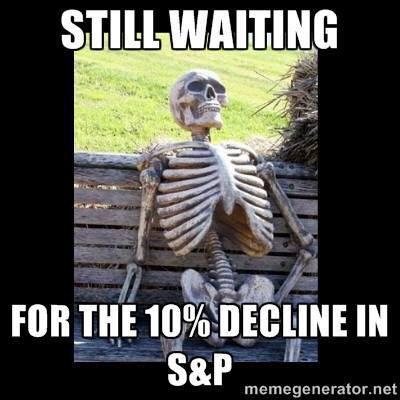
- Nothing but positive articles. ...a "blip" ....going higher....this bull market is now better than the dot Com bull market and housing bull market combined, I have finally come to that conclusion tonight that no other past bull market can compare to this one, no questions about it, this bull market is like no other bull market we have ever seen, it's unreal...
Nasdaq 5,000 a 'blip,' going higher: CEO
Michelle Fox | @MFoxCNBC
26 Mins AgoCNBC.com
3
SHARES


COMMENTS
For Craig Kanarick, CEO of Mouth and co-founder of Razorfish, Nasdaq 5,000 is a "blip." He thinks the index will go much higher, in part because the companies in the index are stronger.
"The companies that we're talking about like Apple are much more sophisticated. Steve Jobs was barely atApple in 2000. But I think also there's a difference in the way people are investing now," he said in an interview with CNBC's "Closing Bell."
Back before the dot-com bubble burst, there was a "gold rush" of IPOs where people were hoping for a 600 percent return in one day, Kanarick said. Now the market is more professional and less speculative, he said.
"We'll start to see this slow down and head up to 7,000 in the next couple of years," he said.
Getty Images
The Nasdaq in Times Square, New York.
Diane Garnick, CEO of Clear Alternatives, agrees the changed composition of the index is great for investors.
"The companies in the Nasdaq today have business plans that they are executing on. We have companies with earnings. Not only that we have companies with a lot of cash on hand," she said.
In fact, earnings are up 150 percent since the last time the Nasdaq hit 5,000, Garnick noted.
The economy is also different this time around, CNBC senior contributor Larry Kudlow pointed out.
Back then, the Federal Reserve was "tightening like crazy" and the steep inverted yield curve had recession written all over it, he said.
"I'm not saying there's no corrections, there are going to be corrections. I just think it is a totally different economic picture and I think this one's sustainable," he said.
"There is no inverted yield curve and recession and/or recession in sight for several more years. … That's why I'm not so panicked."
David Garrity, principal at GVA Research, would continue to own the Nasdaq and noted that when adjusted for inflation, it would have to hit 6,900 to match Nasdaq 5,000 from 2000.
"We're not even close," he said.

Don't worry...there is never a down day in the land of perfect....Where everyday is an up day.
- Nothing but positive articles. ...a "blip" ....going higher....this bull market is now better than the dot Com bull market and housing bull market combined, I have finally come to that conclusion tonight that no other past bull market can compare to this one, no questions about it, this bull market is like no other bull market we have ever seen, it's unreal...
Nasdaq 5,000 a 'blip,' going higher: CEO
Michelle Fox | @MFoxCNBC
26 Mins AgoCNBC.com
3
SHARES
COMMENTS
For Craig Kanarick, CEO of Mouth and co-founder of Razorfish, Nasdaq 5,000 is a "blip." He thinks the index will go much higher, in part because the companies in the index are stronger.
"The companies that we're talking about like Apple are much more sophisticated. Steve Jobs was barely atApple in 2000. But I think also there's a difference in the way people are investing now," he said in an interview with CNBC's "Closing Bell."
Back before the dot-com bubble burst, there was a "gold rush" of IPOs where people were hoping for a 600 percent return in one day, Kanarick said. Now the market is more professional and less speculative, he said.
"We'll start to see this slow down and head up to 7,000 in the next couple of years," he said.
Getty Images
The Nasdaq in Times Square, New York.
Diane Garnick, CEO of Clear Alternatives, agrees the changed composition of the index is great for investors.
"The companies in the Nasdaq today have business plans that they are executing on. We have companies with earnings. Not only that we have companies with a lot of cash on hand," she said.
In fact, earnings are up 150 percent since the last time the Nasdaq hit 5,000, Garnick noted.
The economy is also different this time around, CNBC senior contributor Larry Kudlow pointed out.
Back then, the Federal Reserve was "tightening like crazy" and the steep inverted yield curve had recession written all over it, he said.
"I'm not saying there's no corrections, there are going to be corrections. I just think it is a totally different economic picture and I think this one's sustainable," he said.
"There is no inverted yield curve and recession and/or recession in sight for several more years. … That's why I'm not so panicked."
David Garrity, principal at GVA Research, would continue to own the Nasdaq and noted that when adjusted for inflation, it would have to hit 6,900 to match Nasdaq 5,000 from 2000.
"We're not even close," he said.
It's always rosy near tops...that is a fact.
Buying opportunity of the week...buy buy buy....it's the land of perfect where markets are controlled by the central bank, they only go up. They can't let it fall....ZERO RISK
It will be up by lunch...so relax
buy the dip again, dow is rallying back as I write this, anytime there is a little set back in the markets early on in the trading day they push it straight into the green....dow off 67, was nearing a 100 point drop but we know that isn't allowed in this 6 year old bull market so the quick buys came in to save it once again, even the nasdaq was off slightly at 30 points now down about 24 points but no worries by lunch time everything will be bright GREEN!!!
This is the buying opportunity of the week especially ahead of those awesome job numbers on Friday, by Friday the dow should be nearing 18400-18500! NO RISK ALL REWARD!!!Buying opportunity of the week...buy buy buy....it's the land of perfect where markets are controlled by the central bank, they only go up. They can't let it fall....ZERO RISK
Once apple goes green all tides lift, don't forget that over 140+ points of the nasdaq rally alone are based of JUST ONE SINGLE STOCK, forget about having the whole nasdaq 100 perform well all they need is one stock to lift the market, again who needs 99 stocks to break records when all you need is one stock to do all the work, there isn't any risk in one stock doing all the record breaking or is there.............
This article below was posted last night on cnbc after I posted my post on here, I really think Peter Schiff is reading my opinions on here, he said the same exact thing I mentioned on why the nasdaq was at 5000!!! I highlighted it in blue! Peter Schiff is 10000% correct, he is only one of the handful of people who agree why the markets are where they are today because of QE and the pumping done by the fed!
This is what I posted last night:
"well the smoke and mirrors leading up to 5000 today is the central banks, it is the free money, the free bailouts here and around the world...its the QE 1, its the QE 2 the QE 3 and soon to be QE 4, its the TARP, its the ludicrous valuations on these companies that are worth 1/100th of what they are valuing them at today...its the huge stock buybacks, its the ZERO % interest rates"
Nasdaq 5,000: Bubble or not?
Leslie Shaffer | @LeslieShaffer1
10 Hours AgoCNBC.com
The Nasdaq index has rallied to levels matching its dotcom boom glory days, spawning a CNBC smackdown over whether the bubble is back too.
The bubble camp came out swinging.
"The Nasdaq wouldn't be here if not for quantitative easing. It wouldn't be here without zero percent interest rates. It wouldn't be here without unprecedented stock buybacks fueled by cheap money," Peter Schiff, CEO of Euro Pacific Capital, told CNBC. "You have all these artificial props which have lifted up the market and there's no way to sustain the market without those props."
The Nasdaq index last touched 5,000 in March of 2000, marking the peak of the dotcom bubble's euphoria -- or what some called hysteria -- before the index crashed around 80 percent to a nadir of 1108.49 in October of 2002. It's been a long climb back to its 5008.096 close on Monday.
What bubble?
But not everyone is convinced dotcom euphoria is making a revival.
"I'm not a perma-bull. I'm very interested in shorting overhyped, overvalued stocks," Wayne Kaufman, chief market analyst at Phoenix Financial, told CNBC, citing bets against GoPro and Tesla. "I don't believe we are in a bubble and I think the fundamentals bear that out," he said, citing then-and-now data.
"Back in 2000, you had no free cash flow yield, no dividend yield and no equity yield," Kaufman said, citing price-to-earnings ratios that were sometimes as high as 200. But now, the S&P information-technology sector has a price-to-earnings ratio of 19.6 times, while the semiconductor index has a dividend yield of 2.1 percent, above the 10-year U.S. Treasury yield and even the S&P 500's 1.95 percent dividend yield, he noted.
Same old story
But Schiff's bubble camp isn't convinced by argument that the Nasdaq is different this time.
"There's never a bubble where it isn't different this time. That's how bubbles work and that's the one thing they all have in common," Schiff said. "Tech is not as overvalued relative to the rest of the market as it was in 2000, but that doesn't mean it's not a bubble."
Read MoreThe market is reaching a bubble. So what?
Schiff cited concerns overvaluation of some "hot" names, such as Uber.
"The valuation is absurd. And there's a lot of companies like Uber that are sporting these billion-dollar market caps. Many of these companies haven't made any money; many of them won't make any money," Schiff said. "This time around the difference is it's not a tech bubble, the entire U.S. economy is one gigantic bubble."
The Fed will do what?
Bryan Thomas | Getty Images
To be sure, Schiff's bubble argument has some hiccups. For one, he predicts that rather than raising interest rates -- as the market widely expects will happen this year -- the Federal Reserve will actually go for more quantitative easing. But he also expects that rising interest rates will decimate tech companies' free cash flow as they try to service the "enormous" debt they've taken on.
Tech start-ups typically raise venture capital or equity, not debt, and the rates on debt issued prior to a Fed hike likely wouldn't change.
—By CNBC.Com's Leslie Shaffer; Follow her on Twitter @LeslieShaffer1
Leslie ShafferWriter
This is what I posted last night:
"well the smoke and mirrors leading up to 5000 today is the central banks, it is the free money, the free bailouts here and around the world...its the QE 1, its the QE 2 the QE 3 and soon to be QE 4, its the TARP, its the ludicrous valuations on these companies that are worth 1/100th of what they are valuing them at today...its the huge stock buybacks, its the ZERO % interest rates"
Nasdaq 5,000: Bubble or not?
Leslie Shaffer | @LeslieShaffer1
10 Hours AgoCNBC.com
The Nasdaq index has rallied to levels matching its dotcom boom glory days, spawning a CNBC smackdown over whether the bubble is back too.
The bubble camp came out swinging.
"The Nasdaq wouldn't be here if not for quantitative easing. It wouldn't be here without zero percent interest rates. It wouldn't be here without unprecedented stock buybacks fueled by cheap money," Peter Schiff, CEO of Euro Pacific Capital, told CNBC. "You have all these artificial props which have lifted up the market and there's no way to sustain the market without those props."
The Nasdaq index last touched 5,000 in March of 2000, marking the peak of the dotcom bubble's euphoria -- or what some called hysteria -- before the index crashed around 80 percent to a nadir of 1108.49 in October of 2002. It's been a long climb back to its 5008.096 close on Monday.
What bubble?
But not everyone is convinced dotcom euphoria is making a revival.
"I'm not a perma-bull. I'm very interested in shorting overhyped, overvalued stocks," Wayne Kaufman, chief market analyst at Phoenix Financial, told CNBC, citing bets against GoPro and Tesla. "I don't believe we are in a bubble and I think the fundamentals bear that out," he said, citing then-and-now data.
"Back in 2000, you had no free cash flow yield, no dividend yield and no equity yield," Kaufman said, citing price-to-earnings ratios that were sometimes as high as 200. But now, the S&P information-technology sector has a price-to-earnings ratio of 19.6 times, while the semiconductor index has a dividend yield of 2.1 percent, above the 10-year U.S. Treasury yield and even the S&P 500's 1.95 percent dividend yield, he noted.
Same old story
But Schiff's bubble camp isn't convinced by argument that the Nasdaq is different this time.
"There's never a bubble where it isn't different this time. That's how bubbles work and that's the one thing they all have in common," Schiff said. "Tech is not as overvalued relative to the rest of the market as it was in 2000, but that doesn't mean it's not a bubble."
Read MoreThe market is reaching a bubble. So what?
Schiff cited concerns overvaluation of some "hot" names, such as Uber.
"The valuation is absurd. And there's a lot of companies like Uber that are sporting these billion-dollar market caps. Many of these companies haven't made any money; many of them won't make any money," Schiff said. "This time around the difference is it's not a tech bubble, the entire U.S. economy is one gigantic bubble."
The Fed will do what?
Bryan Thomas | Getty Images
To be sure, Schiff's bubble argument has some hiccups. For one, he predicts that rather than raising interest rates -- as the market widely expects will happen this year -- the Federal Reserve will actually go for more quantitative easing. But he also expects that rising interest rates will decimate tech companies' free cash flow as they try to service the "enormous" debt they've taken on.
Tech start-ups typically raise venture capital or equity, not debt, and the rates on debt issued prior to a Fed hike likely wouldn't change.
—By CNBC.Com's Leslie Shaffer; Follow her on Twitter @LeslieShaffer1
Leslie ShafferWriter
Last edited:
buy the dip again, dow is rallying back as I write this, anytime there is a little set back in the markets early on in the trading day they push it straight into the green....dow off 67, was nearing a 100 point drop but we know that isn't allowed in this 6 year old bull market so the quick buys came in to save it once again, even the nasdaq was off slightly at 30 points now down about 24 points but no worries by lunch time everything will be bright GREEN!!!
Don't you think something changed in the past week? BTFD is not that easy anymore.