%%Explain THIS, student...
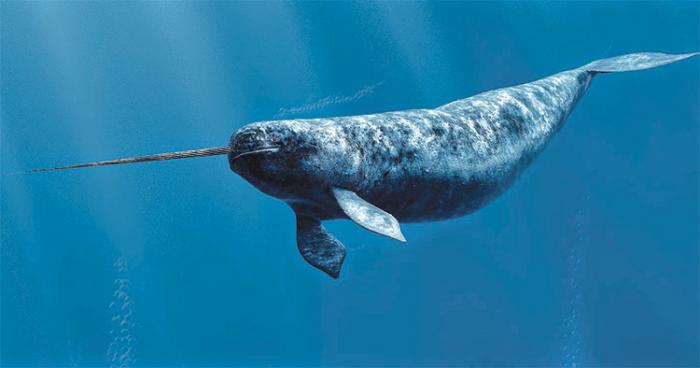
Come on. How does your God, or Jesus, explain that?
He created that/Genesis 1....................................................................................

%%Explain THIS, student...
Come on. How does your God, or Jesus, explain that?
How does evolution explain that?Explain THIS, student...
Come on. How does your God, or Jesus, explain that?
How does evolution explain that?
The Evolutionary Significance of the Narwhal’s “Tusk”
...
There has been much debate among researchers about the true function of the narwhal’s tusk. It was initially thought that the tusk was only used as an evolutionary means of self-defense and breaking the ice that covers the surface of their aquatic habitats so breaths of air can be taken. However, recent study of the anatomy of the tusk by Nweeia and colleagues revealed nerves that lead directly to the brain, giving evidence of its additional function as a sensory organ.This sensory feature serves several purposes to the narwhal by detecting changes in the external environment, such as salinity and temperature. Because these functions of the narwhal’s tusk increase its chances of survival and are retained in the population, it can be said that they are a result of natural selection.
Additionally, secondary functions of the tusk have developed due to sexual selection, which have facilitated the tusk’s persistence. Based on the discovery of broken tusk fragments and scarring, it can be inferred that male narwhals use their tusk in an aggressive fashion in order to assert sexual dominance and eventually find a mate.
While the narwhal’s tusk may seem like an obnoxious physical display, it is clear that evolutionary forces of both natural and sexual selection have driven the species to utilize its tusk in a way that enables its survival and overall individual and reproductive fitness.
The ancestors of the beluga and narwhal lived in the tropical waters of the Mediterranean
The important discovery was led by the paleontologists of the University of Pisa thanks to a fossil of 5 million years ago found in Tuscany (Italy)
The beluga or white whale (Delphinapterus leucas) and the narwhal (Monodon monoceros) are two fascinating cetaceans that live exclusively in the cold Arctic waters, never departing from them, being the only extant relatives of the Monodontidae family. Nowadays, it is impossible to see these whales in the warm Mediterranean waters and even more absurd - so it was thought - that they could have lived in this sea at the beginning of the Pliocene, when the climate of the Mediterranean area was tropical. In turn, it happened. In Arcille, a small village near Grosseto (Tuscany, Italy), in a sand quarry, the fossil skull of a monodontid of about 5 million years ago was discovered. It was named Casatia thermophila. "Casatia" is a tribute to Simone Casati, discoverer of many important fossils of Tuscany (and, in particular, of the Arcille quarry), whereas "thermophila" means "lover of heat", to emphasize that this cetacean lived in tropical waters.

The study, just published in the international Journal of Vertebrate Paleontology, was made by Giovanni Bianucci and Alberto Collareta, paleontologists from the Department of Earth Sciences of the University of Pisa, alongside with Fabio Pesci and Chiara Tinelli, who took part in the study in the framework of their thesis activities , respectively of master's degree and doctorate. The discovery occurred during a paleontological excavation that also involved the Superintendence for the Archaeological Heritage of Tuscany, the Natural History Museum of the University of Pisa, and the GAMPS geopaleontological group (of which Simone Casati is president). The fossil is now exhibited in the recently renovated Cetacean Gallery of the Natural History Museum of Pisa.
"While a great deal is known about monodontid biology - explains Giovanni Bianucci - thanks to the research carried out on living belugas and narwhals by scientists from all over the world, very little is known about the evolution of these cetaceans, because their fossil record is extremely scarce. In fact, until now only three extinct species of monodontids were known, each of them was described on the basis of a single fossil skull. Therefore, the skull that we found in Arcille is of extraordinary importance not only because it is the first of monodontid discovered in the Mediterranean area, but also because it allowed us to describe the fourth fossil species of Monodontidae worldwide ”.
"But the scientific importance of this discovery - continues Bianucci - goes beyond the rarity of the discovery. The exceptional nature of the finding lies in the fact that, apparently, this fossil was found "out of place", i.e. in an area of our planet where we never expected to find it. The reason beyond the absence of monodontids from the present-day Mediterranean is very simple: the waters are too warm and not suitable for cetaceans that have chosen the North Pole as their "home" and that never go beyond the Arctic Ocean. However, the most incredible aspect of this discovery relies in the fact that, about five million years ago, the Mediterranean was even warmer than now, with temperatures close to the tropical ones ”.
"The fact that the Mediterranean was a warm sea during the lower Pliocene has been known for some time - says Alberto Collareta - but other extraordinary fossils that we found in the quarry of Arcille support the hypothesis that Casatia thermophila swam together with marine animals of tropical waters, such as the fearsome Zambesi shark (Carcharhinus leucas), the voracious tiger shark (Galeocerdo cuvier) and the enormous marlin (Makaira nigricans)", all forms now absent from the Mediterranean.
“During monitoring of the Arcille quarry - adds Chiara Tinelli - we also recovered numerous sirenian skeletons referred to the fossil species Metaxytherium subapenninum, an ancestor of the dugong, a marine mammal that inhabits tropical coastal waters ”.
"Overall - Collareta continues - this fossil assemblage is indicative of a frankly tropical paleoenvironment, without analogues in the extant Mediterranean Sea. The discovery of Casatia thermophila within a similar paleoenvironment represents therefore the definitive confirmation that the narwhal and the beluga derive from forms of warm, tropical seas. It is probable that the two extant species of monodontids have evolved their extraordinary adaptations to cold waters in a very recent time, during the Quaternary (from about 2.6 million years ago to today), when the northern hemisphere was affected by repeated glaciations and a trend of progressive climatic degradation".
"Studying the Arcille monodontid was really an important and formative experience for me" - says Fabio Pesci - Morphometric study and phylogenetic analysis were quite complex, at least for a student who experimented himself for the very first time in a research of this type. But it was exciting to find the data to support the fact that this fossil belonged to a monodontid species new to science ".
"The research we conducted in the Arcille quarry - concludes Bianucci - allowed us to discover only a small part of the extraordinary fossil heritage that is hidden in the Tuscan territory. The Tuscan hills represent, in fact, one of the areas with the highest concentration of fossils of marine vertebrates in the world. During the Pliocene, a large part of the Tuscan territory was submerged by a sea populated by a great variety of organisms. The deep geological and climatic changes that have occurred since then have reshaped the
the territory, making it a true "open-air mine" full of clues that, if properly interpreted, can reveal many other unexpected aspects of the marine fauna of the past ".
- 27 August 2019
Now, if it could have originated randomly, with time; then it could have also originated via intelligent design.
Nothing in the first article offered any evidence explaining the evolutionary process. The logic was simply: because it is, it must have happened according to natural selection.
Nothing in the first article offered any evidence explaining the evolutionary process. The logic was simply: because it is, it must have happened according to natural selection.
The second article goes beyond the inability of the first article to offer evidence, by admitting the evidence doesn't actually exist.
...
fossil skull

%%LOL.
It's called "The Theory of Evolution."
 ,
,%%
With respect to internet trolls, I like:%%
Regardless if his 2060 time , hits or doesn't hit, still amazingly wise.
Samuel Morse, Werner Heisenberg, William Thomson [Lord Kelvin], B Paschal, Earnest Walton, George Washington Carver. Gregory Mendol , King Solomon, Francis Collins .........These were /are Christian or God respecting.
Personally, i like the Forbes family/magazine +goals; ''with all they getting , get understanding'' Proverbs 4

