Indian creation myths
The Genesis of Native American creation stories
by Calvin Smith
Is
Genesis real
history or just another attempt primitive mankind invented to explain his existence, prior to our enlightenment via “
science” about evolutionary theory? If biblical creation is simply a myth that spread from the Middle East’s “cradle of modern civilization” that became diluted over time, what about the stories from peoples far removed, living on the vast continents across the seas?
‘Indian’ creation myths?
Columbus’ error in believing he had circumnavigated the globe and arrived in India produced the generic name ‘Indians’ given thereafter to most Native Americans (NA). This persisted long after his discrepancy was realized and considerable knowledge about the peoples of north (and south) America was subsequently discovered.
The controversy as to the
origins of these (and all) people has been hotly debated. The standard evolutionary explanation that has primitive man coming ‘
out of Africa’ and then up and over the Bering Strait over hundreds of thousands of years is the most commonly accepted explanation amongst modern western scholars. But what do these people say about themselves without the bias of modern academic speculations?
The history of the world as my Blackfeet Elders told it …
“My name is Percy Bullchild. I’m sixty-seven years of age. I’m a Blackfeet Indian from Browning, Montana. With what little education I have I am going to try to write the version of our own true ways in our history and in our legends … ”
So starts
The Sun Came Down, a retelling of the BlackfeetThe Sun Came Down (The history of the world as my Blackfeet Elders toldiIt), 1st edition, Harper & Row, Publishers Inc., New York, NY, 1985, pp. 64, 65 (Original territory stretching almost from North Saskatchewan river, Canada, to the southern headstreams of the Missouri in Montana, USA, and from about long.105° to the base of the Rocky Mountains.)" style="box-sizing: inherit; color: rgb(34, 139, 246); background-color: transparent; border-bottom: none; cursor: pointer; margin-bottom: 4px;">1 tribe’s history. What was Percy’s motivation for writing these stories down? “Most written history of us Indians … has been written by non-Indians … . Most of these are so false and smearing that it gets me very mad.”2 “But this is our history and our legends of our beginnings, the very beginning of all life … ”3
Percy describes his people’s beginnings like this:
“This story is about a lone spirit that lived in this spiritual place before there was a world of any kind of life … He has been alive from ever and will continue to live forever … Life is given to all of us humans and to all the creations of the earth … ”4
The Blackfeet describe the Creator God as “Creator Sun”, who’s first living beings were snakes that rebelled against their creator and were punished for their transgressions. He then decided to make “ … something that will look like my image.”5 This creation was a woman (Creator Sun’s wife), animated when, “He had blown in the nostrils of the mud figure, which gave it life”.6
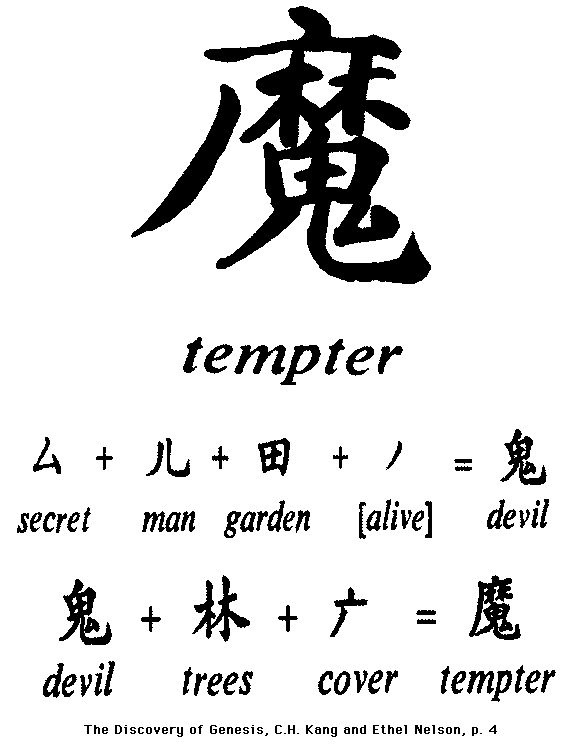
This woman was looking for food one day when she was tempted by a “snakeman” who told her a half-truth7 and caused her to betray her husband. The Creator “ … knew what was going on … but, as always, he is so forgiving to all his creations.”
“Nevertheless, all of us are to pay for whatever sins we commit … ”
The first creation of humans
“From the mud Creator Sun molded a form in his own shape, his own image … This mud figure came to life as Creator Sun blew into his nostrils.8
“ … he wanted to do for the mudman … Some way to help him overcome that loneliness. Using that strange power, Creator Sun put the mudman into a deeper sleep so he wouldn’t know what was going on.
“Kneeling down beside him, Creator Sun took out the mudman’s lowest, smallest left rib. With this rib he made an image after the mudman and himself … To bear fruit, to bear offspring.”
Coincidence?
Such striking similarities between creation stories from numerous cultures worldwide and the Genesis account have been hard to explain for evolutionists. They typically dismiss them as resulting from ‘Christian influence’. However, despite the fact that this may have occurred in some instances, this has been flatly denied from many indigenous people (including the above), many of whom are hostile to a biblical view. Furthermore, the deviations in the stories from the biblical account support their originality.
In his book Red Earth, White Lies, Vine Deloria9 (no friend of Christianity) makes some interesting statements regarding flood tales that show up in virtually all NA creation stories.
“Flood stories are almost always linked with the concerns of fundamentalist Christians, who believe that Indian accounts of a great flood will provide additional proof of the accuracy of the Old Testament. With their cultural blinders in place, it never occurs to them that the Old Testament may very well provide evidence of the basic accuracy of the Indian story.”Red Earth, White Lies (Native Americans and the myth of scientific fact), Scribner, 1230 Avenue of the Americas, New York, NY 10020, 1995, p. 207." style="box-sizing: inherit; color: rgb(34, 139, 246); background-color: transparent; margin-bottom: 4px; border-bottom: none; cursor: pointer;">10
Of course the reverse argument (that the ‘Indian story’ may very well provide evidence of the basic accuracy of the OT) could be used as well, and the OT contains provable geographical locations, dates and events as well as prophecies like those leading up to the coming Messiah and His resurrection, the most verifiable event in ancient history. Most NA stories begin with familiar biblical themes and eventually wander off into fanciful stories with no verifiable way to support them, unlike the OT which becomes more and more testable as it progresses.
Anti-evolutionist (but Bible skeptic) Deloria points out some obvious reasons why evolutionists avoid or downplay most references to flood stories:
“Scholars in comparative religion, anthropology, psychology, and folklore usually steer well clear of using flood stories for anything except demonstrating that all societies have these kinds of traditions … Accepting that these flood stories speak of a planetary event, not so long ago, involving significant psychological trauma, would free minds to make progress in all sciences.”11
As to their frequency he says, “When we reach Washington State we discover that hardly an Indian group exists that does not have a flood story … ”12
Deloria is highlighting that evolutionists cannot afford to entertain the concept of a global flood as a real historical event because to do so would upset the time scale on which they have built their own secular creation myth, millions of years (MOY). Evolution needs MOY and if there were no MOY it points to creation rather than evolution.
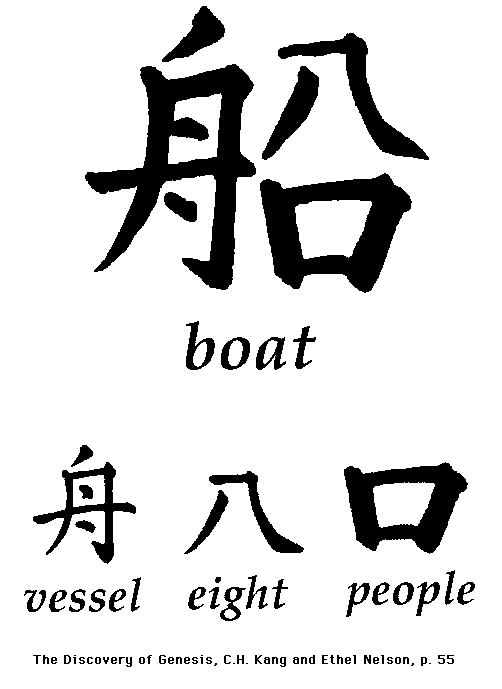
Evolutionists have been hard pressed to explain away the abundance of flood stories (which indicate a common history amongst people groups of the world) other than ‘missionary contamination’. Some have suggested that local floods were common experiences for all people groups and therefore these incredibly similar tales (flood sent as punishment for sin, favoured survivor(s), wooden vessel, animals on board, etc.) must have appeared by happenstance.
David Leeming’s The Children’s Book of MythologyThe Children’s Dictionary of Mythology, Franklin Watts (a division of Grolier Publishing) USA, 1999, back cover." style="box-sizing: inherit; color: rgb(34, 139, 246); background-color: transparent; border-bottom: none; cursor: pointer; margin-bottom: 4px;">13 lists common “themes of mythology” on its back cover with the following: Quest, Flood, Creation, Fertility, Afterlife …
Certainly answers to where we came from and the quest for knowledge about life and the afterlife are common to all of humanity, but why would ‘Flood’ be a common theme of mythology? Bastion and Mitchell point out, “Mythological narratives regarding a great deluge abound worldwide. In North America, flood stories are found not only where people lived near large bodies of water, but also in the drier interior of the continent.”Handbook of Native American Mythology, Oxford University Press, 198 Madison Ave, New York, NY 10016, 2008, p. 97." style="box-sizing: inherit; color: rgb(34, 139, 246); background-color: transparent; border-bottom: none; cursor: pointer; margin-bottom: 4px;">14
Why wouldn’t a common mythology of a gigantic earthquake, plague or a worldwide hurricane be common amongst all people groups if the stories simply came from a common natural experience of local catastrophes rather than knowledge of a common historical event? The reasoning seems desperate.