Global Warming: For Experts Only

interesting... perhaps you are correct... but that does not make me a liar.
let me findout if you criticism of that chart is correct.


And you wonder why we call you intellectually dishonest/a liar.

Another lie. And you call yourself a Christian?

"the difference is almost entirely because NOAA presents their temperature anomalies relative to a 1901-2000 baseline, while HadCRUT4 presents theirs relative to a 1961-1990 baseline. If you shift them to have the same baseline, the discrepancy goes away. The immediate conclusion one might draw is that the figure below is intentionally misleading, but I wouldn’t rule out the possibility that David Rose simply does not understand the concept of a temperature anomaly, despite have written many articles about them."

https://andthentheresphysics.wordpr...ose-david-rose-does-not-understand-baselines/
 
Today's news - From strength to strength:

Does have to be Micro-Plastics, or CO2!

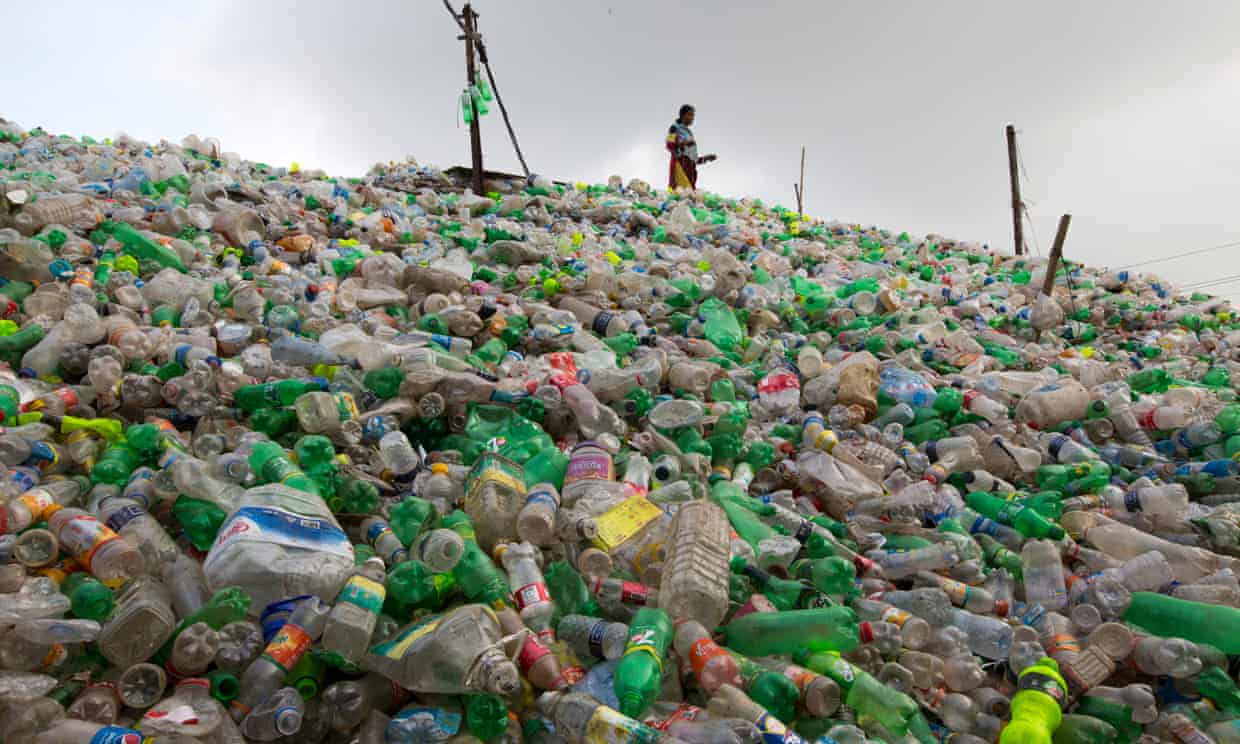
"One million plastic bottles are bought around the world every minute, with most ending up in landfill or in the sea. Photograph: Zakir Chowdhury/Barcroft Images "

5760.jpg


$180bn investment in plastic factories feeds global packaging binge

Colossal funding in manufacturing plants by fossil fuel companies will increase plastic production by 40%, risking permanent pollution of the earth


Tue 26 Dec ‘17
https://www.theguardian.com/environ...lastic-factories-feeds-global-packaging-binge

The huge investment in plastic production has been driven by the shale gas boom in the US. This has resulted in one of the raw materials used to produce plastic resin – natural gas liquids – dropping dramatically in price.

The American Chemistry Council says that since 2010 this has led to $186bn dollars being invested in 318 new projects. Almost half of them are already under construction or have been completed. The rest are at the planning stage.


"In one recent survey, an international team reported more than 5 trillion pieces of plastic are floating in the world’s oceans, collectively weighing nearly 269,000 tonnes."


Coastal communities dumping 8m tonnes of plastic in oceans every year

China ranked top polluter as figures suggest total plastic litter ending up in the seas could rise tenfold by 2025

Fri 13 Feb ‘15
https://www.theguardian.com/science...ing-8m-tonnes-of-plastic-in-oceans-every-year

The figures suggest that about 10 to 30 times more plastic debris ends up in the oceans than surveys have found floating about on the surface. In one recent survey, an international team reported more than 5 trillion pieces of plastic are floating in the world’s oceans, collectively weighing nearly 269,000 tonnes.

In the latest study, researchers at the University of Georgia and the Sea Education Association in Massachusetts calculated the amount of waste plastic generated in 192 countries with coastlines on the Atlantic, Pacific and Indian Oceans, and the Mediterranean and Black seas. From data on regional manufacturing and waste management practices, they worked out that 4.8m to 12.7m tonnes of plastic rubbish wound up as ocean debris in 2010.

79b5b1e1-e5ea-4eed-8b31-b26bc73a3416-2060x1236.jpeg
Coastal pollution, viewed from underwater, in Philippines. Photograph: Jurgen Freund/Corbis
 
Last edited:
I am tracking this down...
but so far I have learned...
Karl the guy whose changed the data which resulted in more warming said this...

"Last night Mr Karl admitted the data had not been archived when the paper was published. Asked why he had not waited, he said: 'John Bates is talking about a formal process that takes a long time.' He denied he was rushing to get the paper out in time for Paris, saying: 'There was no discussion about Paris.'

They played fast and loose with the figures
He also admitted that the final, approved and 'operational' edition of the GHCN land data would be 'different' from that used in the paper'."


Read more: http://www.dailymail.co.uk/sciencet...ulated-global-warming-data.html#ixzz52OYZ7HKq
Follow us: @MailOnline on Twitter | DailyMail on Facebook

---
So now I am wondering whether the final data graph has come out.

interesting... perhaps you are correct... but that does not make me a liar.
let me findout if you criticism of that chart is correct.
 
Last edited:
https://climatethetruth.com/2016/02/21/karl-et-al-pause-buster-paper-debunked-again/comment-page-1/

Pause-buster’ Paper Debunked Again


In June 2015, NOAA NCEI Director Thomas R. Karl published a paper “Possible artifacts of data biases in the recent global surface warming hiatus” that concludes

Here we present an updated global surface temperature analysis that reveals that global trends are higher than reported by the IPCC, especially in recent decades, and that the central estimate for the rate of warming during the first 15 years of the 21st century is at least as great as the last half of the 20th century. These results do not support the notion of a “slowdown” in the increase of global surface temperature.

In addition to the several problems with the questionable data adjustments made by Karl et al that have been thoroughly documented and analyzed by Bob Tisdale, Anthony Watts, Judith Curry, Richard S. Lindzen, Arno Arrak, Ross McKitrick, Patrick J. Michaels, Paul C. Knappenberger, Christopher Monckton of Brenchley, S. Fred Singer, and others in the following articles to name a few:

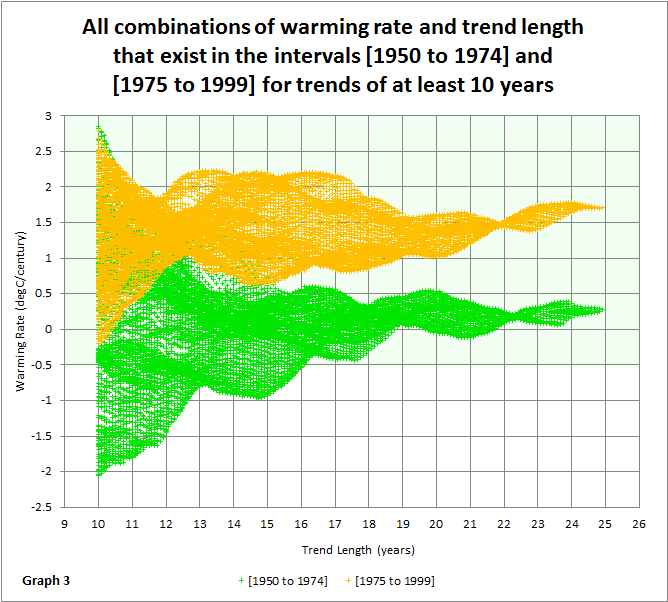
Sheldon Walker has published a stunningly simple and brilliant analysis that blows a gaping whole in Karl’s outlier conclusions, and it succeeds in doing so even while using Karl’s highly questionable data-warming adjustments—which were nearly instantaneously incorporated into several of the alarmist-managed datasets around the world (NOAA, NASA, and others) in time for the Paris affair. Walker uses a very illustrative scatter plot graphing technique showing all temperature trends of various lengths.

graph-3.png


The gist of Karl et al is that the decadal warming rate from 1950 to 1999 (using their cooked data) of 0.113ºC is nearly identical to the rate of 0.116ºC from 2000 to 2014, and therefore there is no pause. The problem with this simplistic argument is that these are cherry-picked endpoints for trend analysis, and the anthropogenic warming rate was by no means constant during this period. Indeed, from 1950 to 1974, there was very little anthropogenic warming, whereas from 1975 to 1999 there was significant anthropogenic warming. By erroneously conflating those two very different time periods, Karl et al concludes there is no ‘pause’ or ‘slowdown’. In fact, when one looks at the trends in decadal temperature change from 1975 to 1999 versus 2000 to 2014 even using Karl’s cooked data, there is a substantial slowdown aka hiatus aka pause.
 
I am tracking this down...
but so far I have learned...
Karl the guy whose changed the data which resulted in more warming said this...

"Last night Mr Karl admitted the data had not been archived when the paper was published. Asked why he had not waited, he said: 'John Bates is talking about a formal process that takes a long time.' He denied he was rushing to get the paper out in time for Paris, saying: 'There was no discussion about Paris.'

They played fast and loose with the figures
He also admitted that the final, approved and 'operational' edition of the GHCN land data would be 'different' from that used in the paper'."


Read more: http://www.dailymail.co.uk/sciencet...ulated-global-warming-data.html#ixzz52OYZ7HKq
Follow us: @MailOnline on Twitter | DailyMail on Facebook

---
So now I am wondering whether the final data graph has come out.


I love the fake attempts at honesty and truth. You have no interest in the truth. If you did you would not use "Climatethetruthdotcom" LOL. You would use NOAA and NASA and similar authoritative trustworthy sources. Here, track this down...

various_temp_500.jpg
 
If the data has been changed by noaa to create warming...do you think NOAA chart is going to show otherwise.

What you have to do is compare NOAA chart after the data change to a chart using noaa warming before the data change.

If the changes shows a lot of upward drift.
Then you have to decide of the change was done for real scientific reasons or for more nefarious reasons.

There is no argument about the fact NOAA data was adjusted up and it show more warming.
The only question is whether it was legitimately done for science or more nefarious reasons.

The articles I have read are leading me to believe that Karl made a lot a arbitrary upward revisions. But I am sure you say they were all done in the name of good science.

I love the fake attempts at honesty and truth. You have no interest in the truth. If you did you would not use "Climatethetruthdotcom" LOL. You would use NOAA and NASA and similar authoritative trustworthy sources. Here, track this down...

various_temp_500.jpg
 
https://wattsupwiththat.com/2017/04/17/new-karl-buster-paper-confirms-the-pause-and-models-failure/


here is more info on the paper...


New ‘Karl-buster’ paper confirms ‘the pause’, and climate models failure

Anthony Watts / April 17, 2017


The “uncertainty monster” strikes again

We’ve been highly critical for some time of the paper in summer 2015 by Karl et al. that claimed “the pause” or hiatus went away once “properly adjusted” ocean surface temperature data was applied to the global surface temperature dataset. Virtually everyone in the climate skeptic community considers Karl et al. little more than a sleight of hand.

No matter, this paper published today in Nature Climate Change by Hedemann et al. not only confirms the existence of “the pause” in global temperature, but suggests a cause, saying “…the hiatus could also have been caused by internal variability in the top-of-atmosphere energy imbalance“.

That’s an important sentence, because it demonstrates that despite many claims to the contrary, CO2 induced forcing of the planetary temperature is not the control knob, and natural variability remains in force.

more at link...
 
Toxic time bomb: Here's the science that explains why microbeads are a disaster

They're tiny, there's trillions of them and they're getting everywhere – cosmetic microbeads are bad news for everyone

Thursday 25 August 2016

The distinction between microbeads and microplastics is important, but the problem they cause is ultimately the same. It is estimated that between 15 and 51 trillion microplastic particles have accumulated in the ocean, with Europe alone flushing between 80,000 and 219,000 tonnes of microplastics into the sea each year.

http://www.wired.co.uk/article/microbeads-international-ban-damage-marine-life-plastic

A microbead is defined by its size: typically 0.5 to 500 micrometres in diameter. But the environmental impact of tiny plastics isn’t limited to manufactured spheres: microplastics, the breakdown of larger plastics covering everything from bottles and fishing equipment to car tyres and synthetic cloths, are also hugely problematic.

This week, an environmental audit committee called for a worldwide ban on cosmetic microbeads. While their value to science is without question, the use of microbeads in face scrubs, body washes and even toothpastes is having a ruinous impact on the natural world. To understand why they're bad news for marine life, you need to look back to back to Ugelstad.

Microbeads are designed to get into hard to reach places. In science they are primarily used to separate biological materials. Once magnetically charged, for example, they can be attracted to the surface of certain types of cell or bacteria. In home pregnancy tests, specially treated and coloured microbeads react to hormones in urine to form the telltale blue line. Their size, their surface area and the sheer number of them makes microbeads a huge problem once they make it into marine ecosystems.

405
A plankton sample collected in Libyan waters by a Greenpeace vessel also contained significant quantities of microplastics
Greenpeace/Gavin Parsons

405
Microplastics found in the gut of a fish in May 2015
The 5 Gyres Institute

405
It is estimated that between 15 and 51 trillion microplastic particles have accumulated in the ocean
The 5 Gyres Institute
 
China Is Building World's Biggest Trash Incinerator

It generates energy--and C02--but its builders say it's better environmentally than burying the garbage. Continue reading →

By Patrick J Kiger
Published On 03/21/2016

https://www.seeker.com/china-is-building-worlds-biggest-trash-incinerator-1771091940.html

Schlaich Bergermann Partners, one of several German design firms who are working on the project, posted images of the plant on its website. The plant, which will be nearly a mile in diameter, will burn 5,000 tons of trash each day, which is about a third of what Shenzhen's 20 million inhabitants generate.

Here's a video about the facility.

Burning trash might not seem like the best solution for a nation that's already grappling with nasty air pollution. But Chris Hardie, partner at Schmidt Hammer Lassen Architects, told Fastcoexist.com that while the plant will produce a metric ton of C02 per metric ton of waste, the trash actually will contribute less to the greenhouse effect that way than it would if it was buried in a landfill and giving off gigantic quantities of methane, an even more potent greenhouse gas than CO2.

"One metric ton of waste will ultimately produce somewhere in the region of 60 cubic meters of methane as it decomposes - and this has more than twice the negative effect on global warming," Hardie told the publication.

sk-2017_04_article_main_desktop.jpg
China is building the world's biggest trash incinerator, which will be solar powered and generate a small amount of electricity. | Gottlieb Paludan Architects, via Standard YouTube License
 
Back
Top