Global Warming: For Experts Only

Let's not forget the population growth of farm animals following the human population growth? The waste issue?

livestock_table_1_575.jpg

Personally I think this Green Tax would be a good direction!

Most likely, however, my guess is CO2 could be just part of the whole problem/issue?

* [PDF] Green consumption taxes on meat in Sweden - SLU
https://pub.epsilon.slu.se/9294/1/sall_s_121214.pdf - Cached - Similar
This paper designs and evaluates the environmental impacts of a tax on meat consumption in. Sweden which reflects environmental damage at the margin. Three meat products are included, cattle, chicken and pork, and three pollutants generating environmental damages; green house gases, nitrogen, and phosphorus.

* Tax meat and dairy to cut emissions and save lives, study urges ...
https://www.theguardian.com/.../tax-meat-and-dairy-to-cut-emissions-and-save-lives-study-urges - Similar
7 Nov 2016 ... Surcharges of 40% on beef and 20% on milk would compensate for climate damage and deter people from consuming as much unhealthy food.

* Meat tax far less unpalatable than government thinks, research finds ...
https://www.theguardian.com/.../meat-tax-far-less-unpalatable-than-government-thinks-research-finds - Similar
23 Nov 2015 ... People are more likely to back policies to curb meat eating for health and climate reasons, Chatham House survey suggests.

* A global tax on meat and milk would reduce greenhouse emissions ...
https://www.cnbc.com/.../a-global-tax-on-meat-and-milk-would-reduce-greenhouse-emissions-report.html - Cached
9 Nov 2016 ... A new report has called for taxes to be added to food prices in order to reduce greenhouse gas emissions and prevent obesity-related deaths by cutting consumption. The team of researchers from the Oxford Martin Programme on the Future of Food in the U.K. and the International Food Policy Research ...
 
Personally I think this Green Tax would be a good direction!

Most likely, however, my guess is CO2 could be just part of the whole problem/issue?

I am Not against reducing CO2 at all!

I just think we should even do much more to protect the environment!

Ensuring in the right direction?


* CO2 is not the only cause of climate change | Achim Steiner ...
https://www.theguardian.com/.../co2-other-cause-climate-change - Cached - Similar
11 Sep 2009 ... Twenty years ago, governments adopted the Montreal protocol, a treaty to protect the Earth's ozone layer from emissions of destructive chemicals. ... Scientists now estimate that somewhere close to 50% of climate change is being caused by gases and pollutants other than C02, including ...

* CO2 is not the only greenhouse gas, and greenhouse effects are not ...
www.realclimate.org/index.php/archives/.../co2-is-not-the-only-ghg/ - Cached - Similar
7 Jul 2008 ... I think this goal implicitly assumes that (a) methane clathrates will not be problem, (b) CO2 & methane release from melting permafrost will not be a problem, and (c) a melting of 50% or more of the Greenland Ice Sheet is something we can adapt to. While it's still possible that these three assumptions will ...

* Can't we just remove carbon dioxide from the air to fix climate ...
theconversation.com/cant-we-just-remove-carbon-dioxide-from-the-air-to-fix-climate-change-not-yet-45621 - Cached - Similar
3 Aug 2015 ... Carbon removal could potentially help to reduce problems such as ocean acidification. So a second paper in Nature Climate Change is also discouraging because it shows that even massive and sustained carbon removal at rates of five billion tonnes a year or more would not be enough to restore anything ...

* CO2 is main driver of climate change - Skeptical Science
https://www.skepticalscience.com/CO2-is-not-the-only-driver-of-climate.htm - Similar
Climate Myth... CO2 is not the only driver of climate. CO2 is not the only driver of climate. There are a myriad of other radiative forcings that affect the planet's energy imbalance. Volcanoes, solar variations, clouds, methane, aerosols - these all change the way energy enters and/or leaves our climate. Natural processes have ...

* Why does CO2 get most of the attention when there are so many ...
https://www.ucsusa.org/global.../CO2-and-global-warming-faq.html - Cached
3 Aug 2017 ... (In 2013, atmospheric CO2 levels surpassed 400 million parts per million for the first time in human history.) Half of human-related CO2 emissions occurred only in the last 40 years. CO2 (and other gases emitted from industrial and agricultural sources) trap heat in the atmosphere, so it is no surprise that we ...

* Important paper strongly suggests man-made CO2 is not the driver ...
https://wattsupwiththat.com/.../imp...made-co2-is-not-the-driver-of-global-warming/ - Similar
30 Aug 2012 ... Instead, just as in the ice cores, CO2 levels are found to be a lagging effect ocean warming, not significantly related to man-made emissions, and not the driver of warming. Prior research has shown infrared radiation from greenhouse gases is incapable of warming the oceans, only shortwave radiation from ...
 
Pictures (Then vs Now) - The Earth is Dying

Discussion in 'Science and Technology' started by OddTrader, Jul 9, 2017.
https://elitetrader.com/et/threads/pictures-then-vs-now-the-earth-is-dying.311030/

???

* It's Water Vapor, Not the CO2 - American Chemical Society
https://www.acs.org/content/acs/.../its-water-vapor-not-the-co2.html - Cached - Similar
1 Mar 2016 ... It's true that water vapor is the largest contributor to the Earth's greenhouse effect. On average, it probably accounts for about 60% of the warming effect. However, water vapor does not control the Earth's temperature, but is instead controlled by the temperature. This is because the temperature of the ...
 
1. Contrary to your fantasy. Warming is not leading the next cycle up. Change in ocean temps is.
how many times will it take before you read this peer reviewed paper or the many others we present which contradicts your 1980s viewpoint.


2. And also contrary to your fantasy... temperature leads co2 down...

1-s2.0-S0921818112001658-gr7.jpg


http://www.sciencedirect.com/science/article/pii/S0921818112001658

Highlights
► Changes in global atmospheric CO2 are lagging 11–12 months behind changes in global sea surface temperature. ► Changes in global atmospheric CO2 are lagging 9.5–10 months behind changes in global air surface temperature. ► Changes in global atmospheric CO2are lagging about 9 months behind changes in global lower troposphere temperature. ► Changes in ocean temperatures explain a substantial part of the observed changes in atmospheric CO2 since January 1980. ► Changes in atmospheric CO2 are not tracking changes in human emissions.


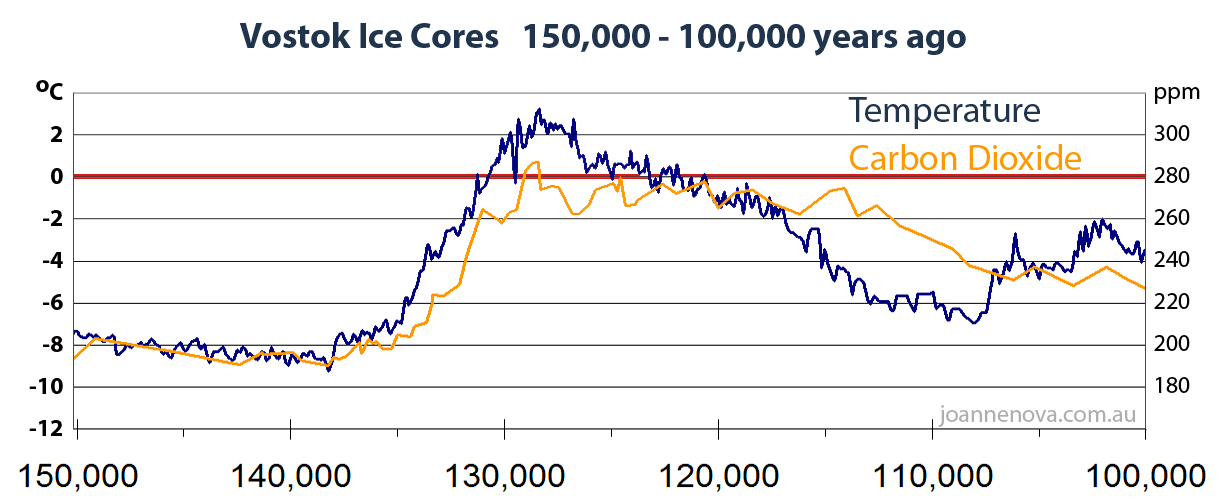
and now here is a long term chart. Again showing temperature leads co2 up and down.


vostok-ice-cores-150000.jpg


Already done. It's a basic scientific principle .


You are, otherwise you wouldn't be saying "show us peer reviewed science stating man made co2 is causing warming" when it is a part of that basic scientific principle.


CO2 cools the upper atmosphere not the lower.

Science does not show 'us' CO2 will cool the lower atmosphere.
Science does show excessive artificial man made CO2 is not good for the upper atmosphere. Too cool is not good like too warm is not good.
The whole of your denial argument is based upon misunderstandings misinterpretations misconceptions and fake information held in comments like "co2 can cool".


Next you'll tell me it is.


Yup thought so.

CO2 is warming due to basic scientific principles, leads atmospheric levels up.
That's exactly what leading the next cycle is!

What do you imagine is leading in the cycle warming here: - man made CO2 - warming - man made CO2 - warming - man made CO2 - warming.
Which leads which now:rolleyes:


Cooling can only lead to 1/3 at best of - "atmospheric levels of co2 down".
You have to rely on other things to do the rest which won't happen because the temperature is being disproportionately raised due to gigatons of man made CO2 being artificially pumped continuously into the atmosphere.


Yes, and taking into account changing levels of natural co2, negative feedbacks, positive feedbacks and sinks and probably off gassing,, the scientific evidence clearly shows they cannot account for the sudden steep rise in global temperatures since the start of the Industrial Revolution, when coincidentally, man made CO2 started getting pumped into the atmosphere.
 
???

Pros and Cons on spending on climate change

Discussion in 'Politics' started by OddTrader, May 13, 2015.

https://elitetrader.com/et/threads/...-on-climate-change.291493/page-2#post-4122391

Just found this interesting page:

Q
http://en.wikipedia.org/wiki/Economics_of_global_warming

Cost-benefit analysis

Standard cost-benefit analysis (CBA)[68] (also referred to as a monetized cost-benefit framework)[69] can be applied to the problem of climate change.[70] This requires (1) the valuation of costs and benefits using willingness to pay (WTP) or willingness to accept (WTA) compensation[69][71][72][73] as a measure of value,[68] and (2) a criterion for accepting or rejecting proposals:[68]

For (1), in CBA where WTP/WTA is used, climate change impacts are aggregated into a monetary value,[69] with environmental impacts converted into consumption equivalents,[74] and risk accounted for using certainty equivalents.[74][75] Values over time are then discounted to produce their equivalent present values.[76]

The valuation of costs and benefits of climate change can be controversial[77] because some climate change impacts are difficult to assign a value to, e.g., ecosystems and human health.[6][78] It is also impossible to know the preferences of future generations, which affects the valuation of costs and benefits.[79]:4 Another difficulty is quantifying the risks of future climate change.[80]

For (2), the standard criterion is the (Kaldor-Hicks)[79]:3 compensation principle.[68] According to the compensation principle, so long as those benefiting from a particular project compensate the losers, and there is still something left over, then the result is an unambiguous gain in welfare.[68] If there are no mechanisms allowing compensation to be paid, then it is necessary to assign weights to particular individuals.[68]

One of the mechanisms for compensation is impossible for this problem: mitigation might benefit future generations at the expense of current generations, but there is no way that future generations can compensate current generations for the costs of mitigation.[79]:4 On the other hand, should future generations bear most of the costs of climate change, compensation to them would not be possible.[70] Another transfer for compensation exists between regions and populations. If, for example, some countries were to benefit from future climate change but others lose out, there is no guarantee that the winners would compensate the losers;[70] similarly, if some countries were to benefit from reducing climate change but others lose out, there would likewise be no guarantee that the winners would compensate the losers.[citation needed]

Cost-benefit analysis and risk

In a cost-benefit analysis, an acceptable risk means that the benefits of a climate policy outweigh the costs of the policy.[80] The standard rule used by public and private decision makers is that a risk will be acceptable if the expected net present value is positive.[80] The expected value is the mean of the distribution of expected outcomes.[81]:25 In other words, it is the average expected outcome for a particular decision. This criterion has been justified on the basis that:

a policy's benefits and costs have known probabilities[80]
economic agents (people and organizations) can diversify their own risk through insurance and other markets.[80]

On the first point, probabilities for climate change are difficult to calculate.[80] Also, some impacts, such as those on human health and biodiversity, are difficult to value.[80] On the second point, it has been suggested that insurance could be bought against climate change risks.[80] In practice, however, there are difficulties in implementing the necessary policies to diversify climate change risks.[80]

Risk

One of the problems of climate change are the large uncertainties over the potential impacts of climate change, and the costs and benefits of actions taken in response to climate change, e.g., in reducing GHG emissions.[84] Two related ways of thinking about the problem of climate change decision-making in the presence of uncertainty are iterative risk management[85][86] and sequential decision making[87] Considerations in a risk-based approach might include, for example, the potential for low-probability, worst-case climate change impacts.[88]

An approach based on sequential decision making recognises that, over time, decisions related to climate change can be revised in the light of improved information.[8] This is particularly important with respect to climate change, due to the long-term nature of the problem. A near-term hedging strategy concerned with reducing future climate impacts might favour stringent, near-term emissions reductions.[87] As stated earlier, carbon dioxide accumulates in the atmosphere, and to stabilize the atmospheric concentration of CO2, emissions would need to be drastically reduced from their present level (refer to diagram opposite).[82] Stringent near-term emissions reductions allow for greater future flexibility with regard to a low stabilization target, e.g., 450 parts-per-million (ppm) CO2. To put it differently, stringent near-term emissions abatement can be seen as having an option value in allowing for lower, long-term stabilization targets. This option may be lost if near-term emissions abatement is less stringent.[89]

On the other hand, a view may be taken that points to the benefits of improved information over time. This may suggest an approach where near-term emissions abatement is more modest. [90] Another way of viewing the problem is to look at the potential irreversibility of future climate change impacts (e.g., damages to ecosystems) against the irreversibility of making investments in efforts to reduce emissions (see also Economics of climate change mitigation#Irreversible impacts and policy).[8] Overall, a range of arguments can be made in favour of policies where emissions are reduced stringently or modestly in the near-term (see: Economics of climate change mitigation#The mitigation portfolio).[91]
UQ

 
Our selective blindness is lethal to the living world
George Monbiot
Wed 20 Dec ‘17

Each generation is normalising the erosion of our environment, and the devastating losses to fragile ecosystems mount up

https://www.theguardian.com/comment...natural-world-open-eyes-environment-ecosystem

So we forget that the default state of almost all ecosystems – on land and at sea – is domination by a megafauna. We are unaware that there is something deeply weird about British waters; they are not thronged with great whales, vast shoals of bluefin tuna, two-metre cod and halibut the size of doors, as they were until a few centuries ago. We are unaware that the absence of elephants, rhinos, lions, scimitar cats, hyenas and hippos, that lived in this country during the last interglacial period (when the climate was almost identical to today’s), is also an artefact of human activity.

https://en.wikipedia.org/wiki/Megafauna

Effect on methane emissions

Large populations of megaherbivores have the potential to contribute greatly to the atmospheric concentration of methane, which is an important greenhouse gas. Modern ruminant herbivores produce methane as a byproduct of foregut fermentation in digestion, and release it through belching or flatulence. Today, around 20% of annual methane emissions come from livestock methane release. In the Mesozoic, it has been estimated that sauropods could have emitted 520 million tons of methane to the atmosphere annually,[70] contributing to the warmer climate of the time (up to 10 °C warmer than at present).[70][71] This large emission follows from the enormous estimated biomass of sauropods, and because methane production of individual herbivores is believed to be almost proportional to their mass.[70]

Recent studies have indicated that the extinction of megafaunal herbivores may have caused a reduction in atmospheric methane. This hypothesis is relatively new.[72] One study examined the methane emissions from the bison that occupied the Great Plains of North America before contact with European settlers. The study estimated that the removal of the bison caused a decrease of as much as 2.2 million tons per year.[73] Another study examined the change in the methane concentration in the atmosphere at the end of the Pleistocene epoch after the extinction of megafauna in the Americas. After early humans migrated to the Americas about 13,000 BP, their hunting and other associated ecological impacts led to the extinction of many megafaunal species there. Calculations suggest that this extinction decreased methane production by about 9.6 million tons per year. This suggests that the absence of megafaunal methane emissions may have contributed to the abrupt climatic cooling at the onset of the Younger Dryas.[72] The decrease in atmospheric methane that occurred at that time, as recorded in ice cores, was 2-4 times more rapid than any other decrease in the last half million years, suggesting that an unusual mechanism was at work.[72]
 
Diagram_of_sustainable_methane_fuel_production.PNG
https://en.wikipedia.org/wiki/Methane

Q
Industrial routes

There are many technological methane production methods. Methane created from biomass in industrial plants via biological route is called biogas. A more synthetic method to produce methane is hydrogenating carbon dioxide through the Sabatier process. Methane is also a side product of the hydrogenation of carbon monoxide in the Fischer–Tropsch process, which is practiced on a large scale to produce longer-chain molecules than methane. Example of large-scale coal-to-methane gasification is the Great Plains Synfuels plant, started in 1984 in Beulah, North Dakota as a way to develop abundant local resources of low-grade lignite, a resource that is otherwise very hard to transport for its weight, ash content, low calorific value and propensity to spontaneous combustion during storage and transport.

Methane as natural gas has been so abundant that synthetic production of it has been limited to special cases and as of 2016 covers only minor fraction of the methane used.
UQ

Methane is an important greenhouse gas with a global warming potential of 34 compared to CO2 over a 100-year period, and 72 over a 20-year period.[68][69][70]???

Mlo_ch4_ts_obs_03437.png


Q
Atmospheric methane

Main article: Atmospheric methane
Methane concentrations up to June 2017 (Mauna Loa)

Methane is created near the Earth's surface, primarily by microorganisms by the process of methanogenesis. It is carried into the stratosphere by rising air in the tropics. Uncontrolled build-up of methane in the atmosphere is naturally checked – although human influence can upset this natural regulation – by methane's reaction with hydroxyl radicals formed from singlet oxygen atoms and with water vapor. It has a net lifetime of about 10 years,[66] and is primarily removed by conversion to carbon dioxide and water.

In addition, there is a large (but unknown) amount of methane in methane clathrates in the ocean floors as well as the Earth's crust.

In 2010, methane levels in the Arctic were measured at 1850 nmol/mol, a level over twice as high as at any time in the 400,000 years prior to the industrial revolution. Historically, methane concentrations in the world's atmosphere have ranged between 300 and 400 nmol/mol during glacial periods commonly known as ice ages, and between 600 and 700 nmol/mol during the warm interglacial periods. Recent research suggests that the Earth's oceans are a potentially important new source of Arctic methane.[67]

Methane is an important greenhouse gas with a global warming potential of 34 compared to CO2 over a 100-year period, and 72 over a 20-year period.[68][69][70]

The Earth's atmospheric methane concentration has increased by about 150% since 1750, and it accounts for 20% of the total radiative forcing from all of the long-lived and globally mixed greenhouse gases (these gases don't include water vapor which is by far the largest component of the greenhouse effect).[6]
UQ
 
Last edited:
1. Contrary to your fantasy. Warming is not leading the next cycle up. Change in ocean temps is.
how many times will it take before you read this peer reviewed paper or the many others we present which contradicts your 1980s viewpoint.


2. And also contrary to your fantasy... temperature leads co2 down...

1-s2.0-S0921818112001658-gr7.jpg


http://www.sciencedirect.com/science/article/pii/S0921818112001658

Highlights
► Changes in global atmospheric CO2 are lagging 11–12 months behind changes in global sea surface temperature. ► Changes in global atmospheric CO2 are lagging 9.5–10 months behind changes in global air surface temperature. ► Changes in global atmospheric CO2are lagging about 9 months behind changes in global lower troposphere temperature. ► Changes in ocean temperatures explain a substantial part of the observed changes in atmospheric CO2 since January 1980. ► Changes in atmospheric CO2 are not tracking changes in human emissions.


and now here is a long term chart. Again showing temperature leads co2 up and down.


vostok-ice-cores-150000.jpg

So it should be easy to be easy to find ONE publishing scientist that denies man made global warming.

The consensus is essentially 100%. https://climate.nasa.gov/scientific-consensus/


Still waiting.
 
Back
Top