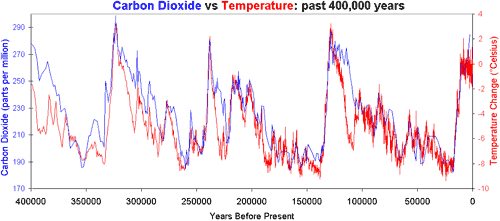
the data shows that co2 levels follow change in ocean temps.
ocean temps are rising so we expect co2 levels to follow and they have.
so given that every scientist in the world knows that the data shows co2 trials change in ocean temps and air temps. How is that that co2 causes the thing it trails?
Please show us the exact science and link to it.
This is a basic explanation. Have you read this?
"When the Earth comes out of an ice age, the warming is not initiated by CO2 but by changes in the Earth's orbit. The warming causes the oceans to release CO2. The CO2 amplifies the warming and mixes through the atmosphere, spreading warming throughout the planet. So CO2 causes warming
AND rising temperature causes CO2 rise. Overall, about 90% of the global warming occurs
after the CO2 increase."
https://skepticalscience.com/co2-lags-temperature-intermediate.htm
Over the last half million years, our climate has experienced long ice ages regularly punctuated by brief warm periods called interglacials. Atmospheric carbon dioxide closely matches the cycle, increasing by around 80 to 100 parts per million as Antarctic temperatures warm up to 10°C. However, when you look closer, CO2 actually lags Antarctic temperature changes by around 1,000 years. While this result was predicted two decades ago (
Lorius 1990), it still surprises and confuses many. Does warming cause CO2 rise or the other way around? In actuality, the answer is both.
Figure 1: Vostok Antarctic ice core records for carbon dioxide concentration (Petit 2000) and temperature change (Barnola 2003).
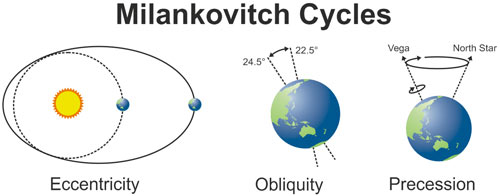
Interglacials come along approximately every 100,000 years. This is called the Milankovitch cycle, brought on by changes in the Earth's orbit. There are three main changes to the earth's orbit. The shape of the Earth's orbit around the sun (eccentricity) varies between an ellipse to a more circular shape. The earth's axis is tilted relative to the sun at around 23°. This tilt oscillates between 22.5° and 24.5° (obliquity). As the earth spins around it's axis, the axis wobbles from pointing towards the North Star to pointing at the star Vega (precession).
Figure 2: The three main orbital variations. Eccentricity: changes in the shape of the Earth’s orbit.Obliquity: changes in the tilt of the Earth’s rotational axis. Precession: wobbles in the Earth’s rotational axis.
The combined effect of these orbital cycles causes long term changes in the amount of sunlight hitting the earth at different seasons, particularly at high latitudes. For example, the orbital cycles triggered warming at high latittudes approximately 19,000 years ago, causing large amounts of ice to melt, flooding the oceans with fresh water. This influx of fresh water then disrupted the Atlantic meridional overturning circulation (AMOC), in turn causing a seesawing of heat between the hemispheres (
Shakun 2012). The Southern Hemisphere and its oceans warmed first, starting about 18,000 years ago. As the Southern Ocean warms, the solubility of CO2 in water falls (
Martin 2005). This causes the oceans to give up more CO2, emitting it into the atmosphere. The exact mechanism of how the deep ocean gives up its CO2 is not fully understood but believed to be related to vertical ocean mixing (
Toggweiler 1999).
The outgassing of CO2 from the ocean has several effects. The increased CO2 in the atmosphere amplifies the original warming. The relatively weak forcing from Milankovitch cycles is insufficient to cause the dramatic temperature change taking our climate out of an ice age (this period is called a deglaciation). However, the amplifying effect of CO2 is consistent with the observed warming.
CO2 from the Southern Ocean also mixes through the atmosphere, spreading the warming north (
Cuffey 2001). Tropical marine sediments record warming in the tropics around 1000 years after Antarctic warming, around the same time as the CO2 rise (
Stott 2007). Ice cores in Greenland find that warming in the Northern Hemisphere lags the Antarctic CO2 rise (
Caillon 2003).
To claim that the CO2 lag disproves the warming effect of CO2 displays a lack of understanding of the processes that drive Milankovitch cycles. A review of the peer reviewed research into past periods of deglaciation tells us several things:
- Deglaciation is not initiated by CO2 but by orbital cycles
- CO2 amplifies the warming which cannot be explained by orbital cycles alone
- CO2 spreads warming throughout the planet
Overall, more than 90% of the glacial-interglacial warming occurs
after the atmospheric CO2 increase (Figure 3).
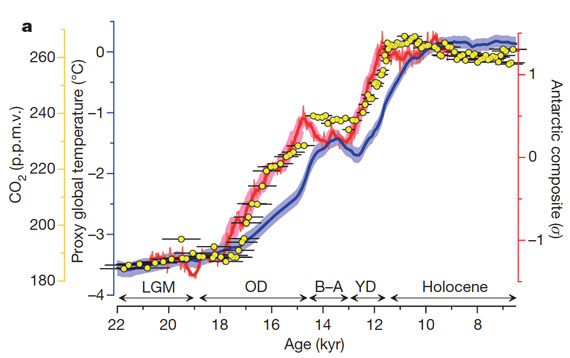 Figure 3: The global proxy temperature stack (blue) as deviations from the early Holocene (11.5–6.5 kyr ago) mean, an Antarctic ice-core composite temperature record (red), and atmospheric CO2 concentration (yellow dots). The Holocene, Younger Dryas (YD), Bølling–Allerød (B–A), Oldest Dryas (OD) and Last Glacial Maximum (LGM) intervals are indicated. Error bars, 1-sigma; p.p.m.v. = parts per million by volume. Shakun et al. Figure 2a.