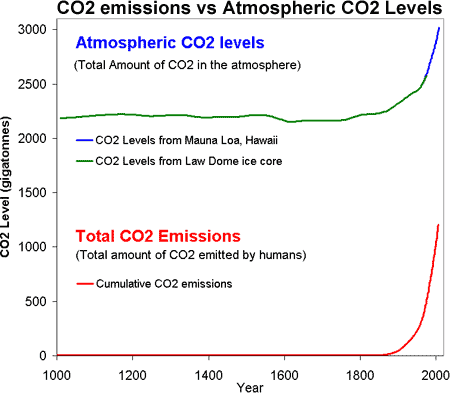
point to the science in peer reviewed papers that proves your statement and then using that paper and others I will explain why we are currently unsure what adding more co2 does in our environment.
We might actually get somewhere if you start producing peer reviewed science to establish your statements.
Here you go you fucking lying piece of shit. Knock yourself out. Permanently.
Revolution. (Credit: Vostok ice core data/J.R. Petit et al.; NOAA Mauna Loa CO2 record.) Find out more about ice cores (external site).
- IPCC Fifth Assessment Report, Summary for Policymakers
B.D. Santer et.al., “A search for human influences on the thermal structure of the atmosphere,” Nature vol 382, 4 July 1996, 39-46
Gabriele C. Hegerl, “Detecting Greenhouse-Gas-Induced Climate Change with an Optimal Fingerprint Method,” Journal of Climate, v. 9, October 1996, 2281-2306
V. Ramaswamy et.al., “Anthropogenic and Natural Influences in the Evolution of Lower Stratospheric Cooling,” Science 311 (24 February 2006), 1138-1141
B.D. Santer et.al., “Contributions of Anthropogenic and Natural Forcing to Recent Tropopause Height Changes,” Science vol. 301 (25 July 2003), 479-483.
- In the 1860s, physicist John Tyndall recognized the Earth's natural greenhouse effect and suggested that slight changes in the atmospheric composition could bring about climatic variations. In 1896, a seminal paper by Swedish scientist Svante Arrhenius first predicted that changes in the levels of carbon dioxide in the atmosphere could substantially alter the surface temperature through the greenhouse effect.
- National Research Council (NRC), 2006. Surface Temperature Reconstructions For the Last 2,000 Years. National Academy Press, Washington, D.C.
http://earthobservatory.nasa.gov/Features/GlobalWarming/page3.php
- https://www.ipcc.ch/pdf/assessment-report/ar5/syr/AR5_SYR_FINAL_SPM.pdf
Church, J. A. and N.J. White (2006), A 20th century acceleration in global sea level rise, Geophysical Research Letters, 33, L01602, doi:10.1029/2005GL024826.
The global sea level estimate described in this work can be downloaded from the CSIRO website.
- https://www.ncdc.noaa.gov/indicators/
http://www.cru.uea.ac.uk/cru/data/temperature
http://data.giss.nasa.gov/gistemp
- https://www.giss.nasa.gov/research/news/20170118/)
- Levitus, et al, "Global ocean heat content 1955–2008 in light of recently revealed instrumentation problems," Geophys. Res. Lett. 36, L07608 (2009).
- L. Polyak, et.al., “History of Sea Ice in the Arctic,” in Past Climate Variability and Change in the Arctic and at High Latitudes, U.S. Geological Survey, Climate Change Science Program Synthesis and Assessment Product 1.2, January 2009, chapter 7
R. Kwok and D. A. Rothrock, “Decline in Arctic sea ice thickness from submarine and ICESAT records: 1958-2008,” Geophysical Research Letters, v. 36, paper no. L15501, 2009
http://nsidc.org/sotc/sea_ice.html
- National Snow and Ice Data Center
World Glacier Monitoring Service
- "Attribution of Extreme Weather Events in the Context of Climate Change," National Academies Press, 2016
https://www.nap.edu/read/21852/chapter/1
Kunkel, K. et al, "Probable maximum precipitation and climate change," Geophysical Research Letters, (12 April 2013) DOI: 10.1002/grl.50334
Kunkel, K. et al, "Monitoring and Understanding Trends in Extreme Storms: State of the Knowledge," Bulletin of the American Meteorological Society, 2012.
http://lwf.ncdc.noaa.gov/extremes/cei.html
- http://www.pmel.noaa.gov/co2/story/What+is+Ocean+Acidification?
- http://www.pmel.noaa.gov/co2/story/Ocean+Acidification
- C. L. Sabine et.al., “The Oceanic Sink for Anthropogenic CO2,” Science vol. 305 (16 July 2004), 367-371
- Copenhagen Diagnosis, p. 36.
- National Snow and Ice Data Center
C. Derksen and R. Brown, "Spring snow cover extent reductions in the 2008-2012 period exceeding climate model projections," GRL, 39:L19504
http://nsidc.org/cryosphere/sotc/snow_extent.html
Rutgers University Global Snow Lab, Data History Accessed August 29, 2011.
Last edited: