
You are using an out of date browser. It may not display this or other websites correctly.
You should upgrade or use an alternative browser.
You should upgrade or use an alternative browser.
Global Macro Trading Journal
- Thread starter Daal
- Start date
I hear conflicting stories - on one hand, seems like people want to pick up some cheap protection. On the other hand, I hear of some large(r) guys getting squeezed out of short-risk trades.Quote from Martinghoul:
My one question about this is if mkts are truly this difficult, why are the biggest macro funds, like Bridgewater or Brevan Howard, not throwing the towel? Just sayin'...
PS. My P/A trade has been (since early this year) to be short Spooz Dec 1500 calls... Every structured desk out there is long gamma from 1450 to 1600 because of massive amounts of up and out calls (I reckon there is about 20-30 yards around the street), as you can see any time we get to 1400ish, vol dies.
Here:Quote from zkf:
where could get the iron core spot price chart? Tried to use bloomberg, but it's not available for free users.

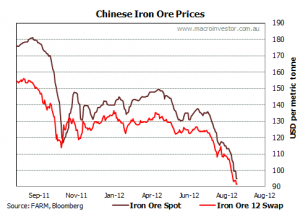
Long term charts (for some price series) can be found here:
http://www.indexmundi.com/commodities/?commodity=iron-ore&months=360
These blogs cover the various commodity stories quite well:
http://www.macrobusiness.com.au/2012/08/iron-ore-price-falls-threaten-an-income-recession/
http://www.alsosprachanalyst.com/markets/steel-and-iron-ore-prices-in-china-make-new-low.html
Quote from ralph00:
JOY Global earnings a disaster (though it has to have been expected, wouldn't be surprised to see a ton of shorts cover and the stock close green today). Getting really itchy to short aussies but must force myself to wait for something akin to a rate cut out of China.
http://seekingalpha.com/currents/post/512471
take your time. i am waiting for your shorts to buy

Quote from Martinghoul:
Here:
Long term charts (for some price series) can be found here:
http://www.indexmundi.com/commodities/?commodity=iron-ore&months=360
.......
Thank you Martinghoul,
Is there real time or semi-real time chart? hehe, I demand here too much.
p.s for the aussie bear, I suggest wait until ECB 6th Sep's meeting.
Real time is a bit difficult and I doubt such data exists, tbh. The source of for all of this is Platts (as part of the their Steel Business Briefing service here: http://www.steelbb.com/), so if anyone has it, it will be them.Quote from zkf:
Thank you Martinghoul,
Is there real time or semi-real time chart? hehe, I demand here too much.
p.s for the aussie bear, I suggest wait until ECB 6th Sep's meeting.
Quote from zkf:
where could get the iron core spot price chart? Tried to use bloomberg, but it's not available for free users.
Dude.
http://www.bloomberg.com/quote/MBIO62DA:IND/chart
Quote from Butterball:
Sure, but you put in 1% premium every month/quarter/year because 'sooner or later' the idea will work -- hey it's a bubble after all so it's guaranteed to pop. This can turn into a costly waiting game no matter how cheap the premium may seem.
As always, timing matters and the bubble vision interviews of Bass don't care to mention that.
No it can't turn into a costly waiting game, because you control how much you pay while you wait. If you limit the risk to what you can comfortably wait/burn, then there is no issue. And since all bubbles in history have eventually popped spectacularly, you will get paid.
Example, let's say you were early on the housing bubble and started paying 1% per annum (when Treasuries were paying 4-5% per annum) to own CDS exposure from 2003. So, your fund performance is 1% per annum worse in 2003, 2004, 2005, 2006. Then you make 100% in 2007-2008.
So, with no timing ability whatsoever, and being 4-5 years too early, and not adding to your positions at all in 2007-2008 when it became obvious the timing was right, you had a 100% gain at a risk of 4-5%. Everyone who says you need timing to profit from bubbles is utterly wrong.
The only way you can lose shorting a bubble is if you risk more than your staying power/conviction and capitulate before it pops, or if you are wrong that it's a bubble. You cannot lose by maintaining modest asymmetric positions each year until the crash occurs, even if your timing is horrible.
Finally, the timing issue is not hard anyway. You can either wait until the fundamentals start turning down, or wait until the key price drops below the 200 day moving average, or both, and only then put on your bets. This takes about 1 minute of analysis per month.
Quote from Ghost of Cutten:
No it can't turn into a costly waiting game, because you control how much you pay while you wait. If you limit the risk to what you can comfortably wait/burn, then there is no issue. And since all bubbles in history have eventually popped spectacularly, you will get paid.
Example, let's say you were early on the housing bubble and started paying 1% per annum (when Treasuries were paying 4-5% per annum) to own CDS exposure from 2003. So, your fund performance is 1% per annum worse in 2003, 2004, 2005, 2006. Then you make 100% in 2007-2008.
So, with no timing ability whatsoever, and being 4-5 years too early, and not adding to your positions at all in 2007-2008 when it became obvious the timing was right, you had a 100% gain at a risk of 4-5%. Everyone who says you need timing to profit from bubbles is utterly wrong.
The only way you can lose shorting a bubble is if you risk more than your staying power/conviction and capitulate before it pops, or if you are wrong that it's a bubble. You cannot lose by maintaining modest asymmetric positions each year until the crash occurs, even if your timing is horrible.
Finally, the timing issue is not hard anyway. You can either wait until the fundamentals start turning down, or wait until the key price drops below the 200 day moving average, or both, and only then put on your bets. This takes about 1 minute of analysis per month.
I agree with this. The reason most people got killed shorting Japanese bonds was because their thesis was flat out wrong, inflation there is frequently negative or barely positive. Economic growth weak, the fiscal situation has worsened but a lot of those people were shorting in the 90's and early 2000's when fiscally they weren't as bad, they deserved to lose money because they misunderstood the situation not because the trade mechanics was flawed