German Nuclear Plants to Close.

  • Thread starter Thread starter morganist
  • Start date Start date
Quote from bigdavediode:

It's difficult to compare costs, especially with nuclear, since the cost-estimates per kWh never include the $38 billion in loan guarantees that the nuclear industry received per annum in the US alone (half of which they default on), and rarely include true build costs (US DOE estimates a plant costs something like only $3 billion, which is wildly underestimated), long term disposal costs (which they stopped paying), nor owner's costs, nor inflation, nor fuel cost increases, and never full insurance because they never carry full insurance as they just dump this cost on to the public in case of an accident.

You are just telling a story without any attempt to get a comprehensive view of all the facts. If you look at authoritative sources (not solar energy trade bodies etc) they pretty much all put the cost of nuclear at among (and probably the cheapest) of the lowest cost low emission technologies.

Try IEA 2010 Project Costs of Electricity Generation: http://www.iea.org/Textbase/npsum/ElecCost2010SUM.pdf

or the UK Climate Change Committee's Renewable Energy Review http://hmccc.s3.amazonaws.com/Renewables Review/The renewable energy review_Printout.pdf

This study puts nuclear as comparable to on-shore wind (perhaps a little cheaper) from today right through to 2040. All other renewables are more expensive and some staggeringly more expensive.

It is quite striking that this review of renewable energy found it necessary to include large amounts of new nuclear power in all it's scenarios to make the whole thing hang together. They considered solar in the UK to be unimportant.

Actually the UK (rainy UK), which is similar in latitude to Germany, receives 60% as much sunlight as the equator receives. Solar panels generate electricity even on cloudy days, and some of the newest designs generate at night from infra-red.


See above CCC document for UK analysis of solar. The infra red stuff is certainly interesting. From what I understand they make nano-scale antennas on some substrate tuned to some part of the IR spectrum. But it is strictly laboratory stuff at this time and for quite a few years into the future. In cannot be factored into energy planning until proved.

b]Meanwhile, spot prices on nuclear fuel tripled from $20 a pound in 2004 to, what, $60 in a disinterested market.
[/b]

Fuel is only a small part of the cost of nuclear power. For nuclear LCOE is relatively fuel cost insensitive. Furthermore, uranium price is only part of fuel cost - enrichment and fuel fabrication are very significant and not affected by uranium price.

So whether or not you agree, the economics is simply inevitable.

Indeed it is and probably economics is the most important factor. But there are others including energy security which I reckon dooms the Desertec dreamers for the foreseeable future. If you want to look at the economics, German PV has cost what? Maybe 50 - 70 billion euros. This is staggeringly expensive. Even if you priced Areva EPR nuclear power plants based on the cost of the Finnish first of a kind project with big costs overruns, a pair of EPRs would generate more electricity at less than 20% of the cost of all that PV.

But here is the real bottom line. The Australian Governments Climate Change Commission's new report suggests that to keep global temperature rise to 2C, emissions must start to drop by 5% per year from 2015 onwards. Leave it to 2020 and it becomes 9% which is quite impossible to achieve.

In OECD countries nuclear supplies over 21% of electricity and solar, wind, geothermal etc less than 4%. Stop nuclear and it really is game over. So what is - climate change or nuclear (plus renewables)?
 
Quote from Random.Capital:

Nuclear is the past. It can't provide for an energy-rich long term future anymore than oil can.
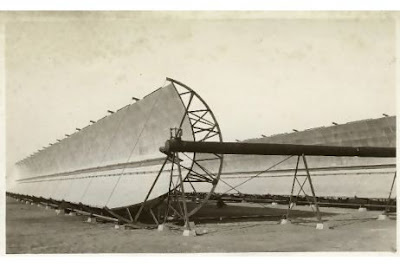
163730_10150387413195603_873810602_16851649_517532_n.jpg


Is this Andasol CSP power station in Spain? No it's Eqypt in 1913 where the first concentrating solar power plant was built - tracking parabolic mirrors no less!

There is actually very little new in energy options. They have all been known for quite a long time. In that sense solar PV, solar CSP, windmills are also the past.

There is more than enough uranium and/or thorium to meet any conceivable energy need for many thousands of years if utilized in a closed fuel cycle. In this respect nuclear is just as sustainable as renewabes.
 
Quote from bigdavediode:

I can't speak for Germany, but actually the expansion potential for hydro in the US is quite massive and is currently being developed. According to Energy Secretary Stephen Chu, total hydro output can be doubled in the US without building a single new damn -- just by upgrading turbines to more modern ones and exploiting run-of-river. Your statement is therefore likely false.

Hydropower or Hydroelectric Power
...As a result of increased environmental regulation, the National Hydropower Association forecasts a decline in large-scale hydropower use through 2020.
http://www.energysavers.gov/your_home/electricity/index.cfm/mytopic=10480

Hydroelectric power's dirty secret revealed
Hydroelectric dams produce significant amounts of carbon dioxide and methane, and in some cases produce more of these greenhouse gases than power plants running on fossil fuels.
http://www.newscientist.com/article/dn7046-hydroelectric-powers-dirty-secret-revealed.html

It's difficult to compare costs, especially with nuclear, since the cost-estimates per kWh never include the $38 billion in loan guarantees that the nuclear industry received...

Here's a comparison of non-US power plants. A PV in Spain vs. a nuke in Korea:

Direct comparison of a solar PV plant with a nuclear reactor
Cost / Watt of actual power generation
PV: $53.77/W
Nuclear: $1.91/W

http://uvdiv.blogspot.com/2009/07/test.html

Solar panels generate electricity even on cloudy days

Infrared Photovoltaic Solar Cells
For cells covered in non infrared glass, they will only produce energy when the sun is shining directly upon them, when sunlight is in the 400 to 800nm range. This means if the sun goes behind a cloud, they stop producing power. When the sun goes behind a cloud the only light that can be converted into energy is infrared sunlight.

So why aren’t all solar cells covered with infrared low ironed tempered glass, surely it is more eco friendly? Well there is only one reason and that is cost. As the glass needs additional materials and complex production methods being applied to it, this pushes up the cost considerably.


and some of the newest designs generate at night from infra-red.

Infrared solar panels even work at night, but can't output energy
...The grid collects its oscillating IR energy at ten thousand billion times per second, which is proving to be a challenge to the nerds behind the tech, who are working on a way to convert that to the 50-60Hz power that the world uses. So yeah, it might be a few more years before this one pans out (if it does pan out).
http://www.engadget.com/2008/02/02/infrared-solar-panels-even-work-at-night-but-cant-output-energ/
 
Quote from dcraig:


There is more than enough uranium and/or thorium to meet any conceivable energy need for many thousands of years if utilized in a closed fuel cycle. In this respect nuclear is just as sustainable as renewabes.

I'm no physicist, but how are you so sure?
 
Quote from Random.Capital:

Nuclear is the past. It can't provide for an energy-rich long term future anymore than oil can.

The problems with nuclear energy are not technology, it's management in the commercial sector and the government's continuing inability to address the problem of spent fuel disposal.

With proper engineering, nuclear technology works, works well and is safe. All you need to do is look at is the US Navy's 60+ year zero incident safety record when it comes to nuclear powered propulsion.

But, the sad reality of the situation in the US as well as the rest of the world is that there are simply no better options when it comes to satisfying the increasing demand for electricity.

We are eventually going to have to bite the nuclear bullet in a big way or we're going to have to learn to live with intermittently available electricity at the residential level within the decade.
 
Quote from soldsoldsold:

I'm no physicist, but how are you so sure?

What a lot of people don't realize is that a "spent" fuel rod has only used up 3% of the fissionable material present in the rod.

He's arguing for fuel reprocessing, which would be great except for one problem -- it's both politically and commercially unrealistic.
 
Quote from soldsoldsold:

I'm no physicist, but how are you so sure?

I'll try to be brief. Fission power required fissionable material (ie capable of sustaining a chain reaction) and pretty much the only usable naturally occurring substance is Uranium-235. If that was all we had to rely on, then yes eventually it would run out, though there are untapped sources such as the estimated 4.5 billion tonnes of uranium in sea water. More generally uranium is more common than once thought.

However there are substances that can be transmuted to fissionable materials by neutron absorption. Principally:

Thorium 232 -> Uranium 233
Uranium 238 -> Plutonium 239 (and other stuff)

There are known as fertile materials. "Breeding" fissionable materials allows for orders of magnitude more usable nuclear fuel than just relying on the small percentage of U-235 in natural uranium.

Under such circumstances about 1kg of thorium or uranium would provide all the energy of one individual for a lifetime at consumption rates current in wealthy nations.

Assuming 10 billion people on the planet all consuming at that rate, then 4.5 billion tonnes of uranium would last 36,000 years (if I haven't screwed up the calculation). Which should be long enough to sort out more exotic options such as fusion or something else we can even guess at as yet.

Also see here: http://bravenewclimate.com/2010/04/22/ifr-fad-4/
 
Back
Top
