Last thing on the copper EV connection-- recycling. As that drastically picks up copper is recovered and re used.
Volkswagen is doing the same, but has also recently opened its first recycling plant, in Salzgitter, Germany, and plans to
recycle up to 3,600 battery systems per year during the pilot phase.
"As a result of the recycling process, many different materials are recovered.
As a first step we focus on cathode metals like cobalt, nickel, lithium and manganese," says Thomas Tiedje, head of planning for recycling at Volkswagen Group Components.
"
Dismantled parts of the battery systems such as aluminium and copper are given into established recycling streams."
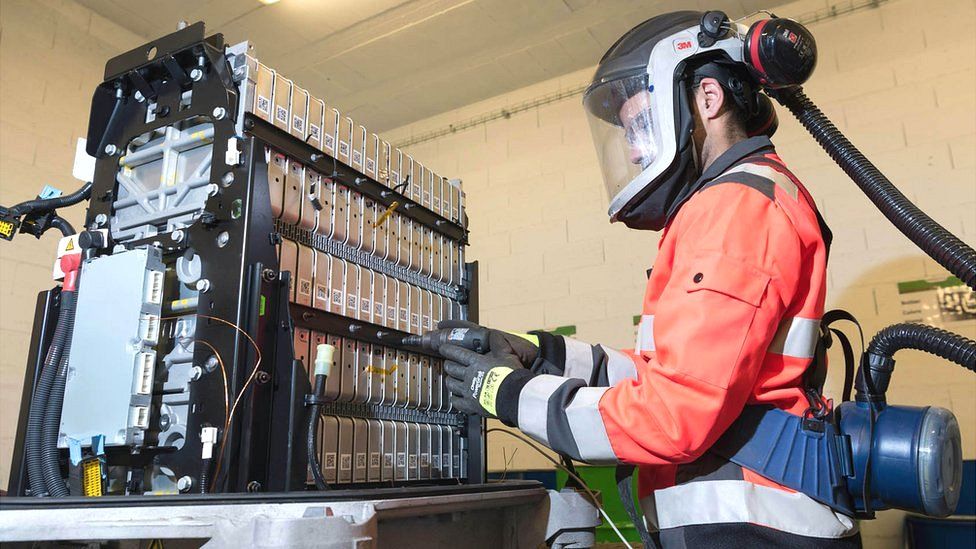
Renault, meanwhile, is now recycling all its electric car batteries - although as things stand, that only amounts to a couple of hundred a year. It does this through a consortium with French waste management company
Veolia and Belgian chemical firm Solvay.
"We are aiming at being able to address 25% of the recycling market. We want to maintain this level of coverage, and of course this would cover by far the needs of Renault," says Jean-Philippe Hermine, Renault's VP for strategic environmental planning.
"It's a very open project - it's not to recycle only Renault batteries but all batteries, and also including production waste from the battery manufacturing plants."
Image
The issue is also receiving attention from scientific bodies such as the Faraday Institution, whose ReLiB project aims to optimise the recycling of EV batteries and make it as streamlined as possible.
"We imagine a more efficient, more cost-effective industry in future, instead of going through some of the processes that are available - and can be scaled up now - but are not terribly efficient," says Dr Anderson, who is principal investigator for the project.
Currently, for example, much of the substance of a battery is reduced during the recycling process to what is called
black mass - a mixture of lithium, manganese, cobalt and nickel - which needs further, energy-intensive processing to recover the materials in a usable form.
Manually dismantling fuel cells allows for more of these materials to be efficiently recovered, but brings problems of its own.
"In some markets, such as China, health and safety regulation and environmental regulation is much more lax, and working conditions wouldn't be accepted in a Western context," says Gavin Harper, Faraday Institution research fellow.
"Also, because labour is more expensive, the whole economics of it make it difficult to make it a good proposition in the UK."
The answer, he says, is automation and robotics: "If you can automate that, we can pull some of the danger out of it and make it more economically efficient."
THUS->
Li-Cycle Holdings Corp. (LICY)
$11.09+0.09 (+0.82%)
As of 1:43PM EDT.