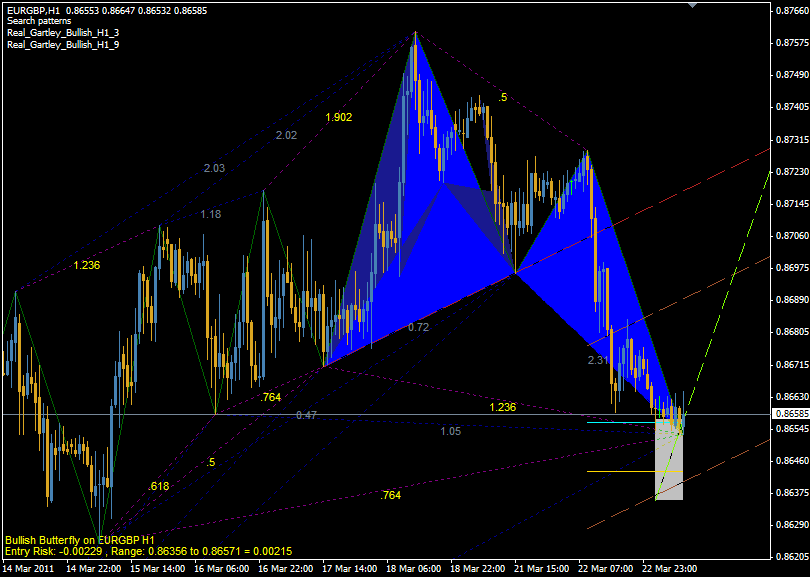
Not a single Harmonics thread in the FX section of EliteTrader - Wow!
Certainly, a subject worth exploring. All the major pairs seem to do, is produce harmonic patterns. All day, all the time - they don't seem to do much else, really.
I think one of the long standing issues surrounding harmonics in FX has been, which set of ratios to use and which patterns are the most valid - that is - have the highest probability for success.
I'm in the process of building a real-time harmonic scanner in Excel, my prototype platform of choice. I've also seen one developed using either Oracle, or Microsoft SQL Server, though I'm not sure that it was real-time. As opposed to using ZUP in MT4, I can use Excel to collect data as well as scan for patterns. Something ZUP cannot do. This will give me the ability to conduct analysis of the patterns, their ratios, optimal ratio configurations and optimal trading ranges with MAE/MFE brackets.
If the scanner prototype and the resulting analysis proves worthy, I'll then work on an integration path into my existing Excel based trading system, which is now a real-time trade execution system. Of course, first things first - I need to generate a Harmonic POC with empirical/historical significance, before including such a module into the existing system.
In the meantime, let's talk FX Harmonics.
I've ignored them for quite some time, since moving to FX. Primarily, because the development of my trading system took priority and it is based on non-conventional TA that I developed from scratch. So, I really considered Harmonics "conventional" and thus, did not want to include that research. Since completing my system, I've had some time to explore other areas that once interested me.
I found Elliot to be a bit too fragmented in its logic and open to wide ranging interpretation, so I basically left that alone, to those more capable of dealing with Elliot properly. Of course, that left Harmonic Patterns and of course, that lead me to Gartley & Pesavento, primarily. Larry, likes to focus on specific ratios, but what I plan to do is, rather than only focus on specific ratios, I'm going to allow the market to produce whatever it wants and then conduct analysis on the full range of ratios the market produces, to determine if a sweet spot exists or not.
Working with real-time data in Excel, can be a pain in the rear sometimes, but with Excel, I also get maximum design freedom - something I can't get with MQL. Of course, the optimal solution would be OOP (probably C-Sharp), but I don't want to prototype in OOP, because it would be a slower process. Excel is raw, and I get maximum creativity. The problem is that these harmonic patterns are really three dimensional and Excel uses a two-dimensional Row/Column framework. So, you have to get creative in simulating a three dimensional environment in Excel - and there are (logical) ways to accomplish that.
Anyway - what's been some of your experience with FX Harmonic Patterns? I can open up almost any FX chart and see them naked, without any scanning system. Of course, keeping track of all of them with my bare eyes is not possible, but it seems as if the FX market does nothing but produce Harmonic Patterns all the time.
In fact, its kind of scary when you look closely at an M1 chart in FX, and start to see just how many the market naturally produces them. They key, is going to be synthesizing and linking these patterns together, to form a probability for a trading range. Of course, in order to do this, I know that I'm going to have to synthesize across a unique set of time-frames that I'm not yet ready to talk about in public.
Whoop! There goes another one on the M1 EURUSD. These things are happening all the time.
- What if the entire FX market were one giant Harmonic Pattern in continuous transformation from one set of ratios to another?
That's a freaky and funky thought.
Certainly, a subject worth exploring. All the major pairs seem to do, is produce harmonic patterns. All day, all the time - they don't seem to do much else, really.
I think one of the long standing issues surrounding harmonics in FX has been, which set of ratios to use and which patterns are the most valid - that is - have the highest probability for success.
I'm in the process of building a real-time harmonic scanner in Excel, my prototype platform of choice. I've also seen one developed using either Oracle, or Microsoft SQL Server, though I'm not sure that it was real-time. As opposed to using ZUP in MT4, I can use Excel to collect data as well as scan for patterns. Something ZUP cannot do. This will give me the ability to conduct analysis of the patterns, their ratios, optimal ratio configurations and optimal trading ranges with MAE/MFE brackets.
If the scanner prototype and the resulting analysis proves worthy, I'll then work on an integration path into my existing Excel based trading system, which is now a real-time trade execution system. Of course, first things first - I need to generate a Harmonic POC with empirical/historical significance, before including such a module into the existing system.
In the meantime, let's talk FX Harmonics.
I've ignored them for quite some time, since moving to FX. Primarily, because the development of my trading system took priority and it is based on non-conventional TA that I developed from scratch. So, I really considered Harmonics "conventional" and thus, did not want to include that research. Since completing my system, I've had some time to explore other areas that once interested me.
I found Elliot to be a bit too fragmented in its logic and open to wide ranging interpretation, so I basically left that alone, to those more capable of dealing with Elliot properly. Of course, that left Harmonic Patterns and of course, that lead me to Gartley & Pesavento, primarily. Larry, likes to focus on specific ratios, but what I plan to do is, rather than only focus on specific ratios, I'm going to allow the market to produce whatever it wants and then conduct analysis on the full range of ratios the market produces, to determine if a sweet spot exists or not.
Working with real-time data in Excel, can be a pain in the rear sometimes, but with Excel, I also get maximum design freedom - something I can't get with MQL. Of course, the optimal solution would be OOP (probably C-Sharp), but I don't want to prototype in OOP, because it would be a slower process. Excel is raw, and I get maximum creativity. The problem is that these harmonic patterns are really three dimensional and Excel uses a two-dimensional Row/Column framework. So, you have to get creative in simulating a three dimensional environment in Excel - and there are (logical) ways to accomplish that.
Anyway - what's been some of your experience with FX Harmonic Patterns? I can open up almost any FX chart and see them naked, without any scanning system. Of course, keeping track of all of them with my bare eyes is not possible, but it seems as if the FX market does nothing but produce Harmonic Patterns all the time.
In fact, its kind of scary when you look closely at an M1 chart in FX, and start to see just how many the market naturally produces them. They key, is going to be synthesizing and linking these patterns together, to form a probability for a trading range. Of course, in order to do this, I know that I'm going to have to synthesize across a unique set of time-frames that I'm not yet ready to talk about in public.
Whoop! There goes another one on the M1 EURUSD. These things are happening all the time.
- What if the entire FX market were one giant Harmonic Pattern in continuous transformation from one set of ratios to another?
That's a freaky and funky thought.