Yes, that makes perfect sense. Thank you v much for taking the time.I think your maths /logic is mostly right, but you've laid out the problem slightly different than on page 162 (print edition), so to be clear:
portfolio value: £4M (based on 25% vol)
annual cash vol target: £1M
daily cash vol target = £62,500
Price vol: 1.33%
block value: $750
ICV: $997.50
fx: 0.67
IVV: £668.325
VOl scalar: 62500/668.325 = 93.52 contracts
subsystem position with a forecast of 20: 20 x 93.52 / 10 = 187 contracts
With an IDM of 2.5 this would be 187 * 2.5 = 468 contracts
Eithier (a) we're trading this crude oil with a bunch of other things, in which case we'd be multiplying by an instrument weight as well as the IDM; or (b) we're trading it by itself in which case the instrument weight is 100% and the IDM is 1.
For now let's assume it's (b) - a system with only crude oil. So the position is 187 contracts.
Now: Risk (at least in my world) shouldn't be confounded with margin
The daily risk of this position is 187 * 997.50 [IVV: expected daily risk in $ per contract) * 0.67 (fx) = £124,977 [the margin doesn't come into it]. This is almost exactly twice the daily cash vol target - by construction.
What about margin? Well the margin, as you say, is $4100*187 = $766,700 or £513,689. This is around 12.8% of the capital at risk (£4m).
Let's bring the IDM back in again. In other words I'm pretending we have loads of things trading, all exactly like crude with margins around 12.8% of capital with a forecast of 20. Now the peak margin usage will be around 2.5*12.8% = 32%. The average margin usage (forecast of 10) will be 16%. This is around half of what I use myself (around 30%, from page 18). Reason: (and this is the crux of your question) Crude oil is relatively margin friendly. Many other instruments require more margin than this.
Hope this makes more sense now.
GAT

You are using an out of date browser. It may not display this or other websites correctly.
You should upgrade or use an alternative browser.
You should upgrade or use an alternative browser.
Fully automated futures trading
- Thread starter globalarbtrader
- Start date
Easy to work out. If the VIX goes from 10 to 40 and you can't sell out of your position and you don't get auto liquidated then you'd lose 30 x $1,000 = $30,000 per contract. A big VIX position for me would be 5 contracts. On my notional of around $500K that's a loss of $150/500 = 30%. If your portfolio is less diversified,with a larger VIX position, then you perhaps should be concerned.
But frankly, with an unexpected nuclear war, this would be the last of my worries!!!
GAT
I was short 5 VX contracts the other day with a max forecast of -20, when I had my worst daily loss, when VX spiked. I am less diversified than GAT, trading only 8 markets, but my account is much smaller at $130K. My volatility is at 30%. Something tells me I have a mistake in my system somewhere, since I will be wiped out by a 30 point move in the VX. (I only trade once a day at the open). Or is this to be expected, and simply the price of admission to 30% volatility?

I was short 5 VX contracts the other day with a max forecast of -20, when I had my worst daily loss, when VX spiked. I am less diversified than GAT, trading only 8 markets, but my account is much smaller at $130K. My volatility is at 30%. Something tells me I have a mistake in my system somewhere, since I will be wiped out by a 30 point move in the VX. (I only trade once a day at the open). Or is this to be expected, and simply the price of admission to 30% volatility?
It's the price of admission to trading the VIX; a negative skew asset which means in Gaussian space it has non stationary vol, and then targeting 30% vol. If you think a 30 point move in the VIX is plausible, you really ought to reduce your allocation to the VIX.
GAT
On that day when the VIX spiked, which parameter changed the most in your system? The forecast (went from -20 to xxx) or the value volatility?I was short 5 VX contracts the other day with a max forecast of -20, when I had my worst daily loss, when VX spiked. I am less diversified than GAT, trading only 8 markets, but my account is much smaller at $130K. My volatility is at 30%. Something tells me I have a mistake in my system somewhere, since I will be wiped out by a 30 point move in the VX. (I only trade once a day at the open). Or is this to be expected, and simply the price of admission to 30% volatility?
To be honest: having 5 VIX contracts in a 130 kUSD account where you trade 8 markets seems rather high to me.
I surfed the web a bit and it appears that the biggest daily spike in VX history is 64%. That would be a 37% hit to my account, assuming a max forecast. I could handle that, but maybe not much more. Or maybe I'm being naive. Maybe I should cut my VX exposure in half to be safe.It's the price of admission to trading the VIX; a negative skew asset which means in Gaussian space it has non stationary vol, and then targeting 30% vol. If you think a 30 point move in the VIX is plausible, you really ought to reduce your allocation to the VIX.
GAT
I surfed the web a bit and it appears that the biggest daily spike in VX history is 64%. That would be a 37% hit to my account, assuming a max forecast. I could handle that, but maybe not much more. Or maybe I'm being naive. Maybe I should cut my VX exposure in half to be safe.
http://www.asxmarketwatch.com/2011/...rom-jesse-livermore-on-trading-and-investing/
Jesse Livermore Quote 8:
“I can’t sleep” answered the nervous one.
“Why not?” asked the friend.
“I am carrying so much cotton that I can’t sleep thinking about. It is wearing me out. What can I do?”
“Sell down to the sleeping point”, answered the friend.
GAT

Top Traders Round Table – Adam | Harding | Lueck #11
Top Traders is bringing you Top Traders Round Table, a series of conversations with industry leaders on the subject of Managed Futures. On this special episode, my guests are the founders of AHL: Michael Adam who later co-founded Aspect Capital, David Harding also known as founder and CEO of Winton Capital and Marty Lueck also one of the co-founders of Aspect Capital.
We sat down in the famous Abbey Road Studios in London to talk about AHL’s beginnings, the revolutionary discoveries that AHL made, how MAN Group became the owner of AHL, as well as all the great things that Michael, David and Marty went on to create.
Top Traders is bringing you Top Traders Round Table, a series of conversations with industry leaders on the subject of Managed Futures. On this special episode, my guests are the founders of AHL: Michael Adam who later co-founded Aspect Capital, David Harding also known as founder and CEO of Winton Capital and Marty Lueck also one of the co-founders of Aspect Capital.
We sat down in the famous Abbey Road Studios in London to talk about AHL’s beginnings, the revolutionary discoveries that AHL made, how MAN Group became the owner of AHL, as well as all the great things that Michael, David and Marty went on to create.
On that day when the VIX spiked, which parameter changed the most in your system? The forecast (went from -20 to xxx) or the value volatility?
To be honest: having 5 VIX contracts in a 130 kUSD account where you trade 8 markets seems rather high to me.
If I recall correctly, the forecast went from -20 to -12, dropping my position from -5 to -2. I think the position was so large since there hadn't been big spikes lately in the VIX, so the system was interpreting VIX as a low volatility instrument. I don't know if the VIX is workable in my system if these spikes are common. It seems like there's a spike, where I lose money, then my system decreases my allocation, but then the spike almost always reverses very quickly, so I win back some of my money, but on a much smaller position.
Attachments
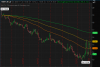
I see. I would have expected that the value volatility would show the greatest change. But that depends on how sensitive your forecast calculation is, versus the value volatility calculation.If I recall correctly, the forecast went from -20 to -12, dropping my position from -5 to -2. I think the position was so large since there hadn't been big spikes lately in the VIX, so the system was interpreting VIX as a low volatility instrument. I don't know if the VIX is workable in my system if these spikes are common. It seems like there's a spike, where I lose money, then my system decreases my allocation, but then the spike almost always reverses very quickly, so I win back some of my money, but on a much smaller position.
I am not using the VIX but the European V2TX. That one also spiked on the same day. The forecast changed somewhat in my system, but the largest influencer was the value volatility. Thus my position size got reduced.
I wonder if it would make sense for us to delay ingestion of prices by a few days on the volatility indices since they have these large spikes that quickly reverse.
For example, if I were short 5 contracts, then the Vix spikes by 10% on day n, my system does not react since the latest price it has is from three days ago. Then the Vix completely reverses its spike on day n+1 or n+2 (this seems to happen nearly every time it spikes). I would gain back whatever I lost on day n, since I am still short 5 contracts, since my system hasn't reacted to the spike. Then, on day n+3, my system reacts to the spike by reducing exposure, but at that point we are back to normal volatility. Is this type of system-tinkering a no-no?
For example, if I were short 5 contracts, then the Vix spikes by 10% on day n, my system does not react since the latest price it has is from three days ago. Then the Vix completely reverses its spike on day n+1 or n+2 (this seems to happen nearly every time it spikes). I would gain back whatever I lost on day n, since I am still short 5 contracts, since my system hasn't reacted to the spike. Then, on day n+3, my system reacts to the spike by reducing exposure, but at that point we are back to normal volatility. Is this type of system-tinkering a no-no?