Fully automated futures trading

How does your system cope when the carry signal vanishes due to no next contract?

For example, on 2-Year T-Note, March is in play but there's no activity/price for June.

FYI Everything I've built is now integrated with IB, just fixing up all these little glitches in the simulated account.
 
How does your system cope when the carry signal vanishes due to no next contract?

For example, on 2-Year T-Note, March is in play but there's no activity/price for June.

FYI Everything I've built is now integrated with IB, just fixing up all these little glitches in the simulated account.

The raw carry signal is carried forward from the last valid value. That might have been the previous days close (note in many contracts such as equities you get a 'spread marked to model' closing price even if there has been no actual trading), a few days before, or in an extreme case like Korea bonds, the last roll date. In fact I use this approach with all my trading rules, although it's fair to say that it's more likely to happen with carry.

Note it's important this is done after any volatility calculation or forecast scaling, otherwise the standard deviation will be downwardly biased.

GAT
 
1/ Why have the results been stopped?


2/ In broad terms, what are Winton, Systematica & others doing differently from you?

Is it just that they are using higher statistics instead of your rough & ready approximations (MA)?

Trying to find lead-lags for predictive power?

What about the way they size their bets & risk management?

What else is there?
 
1/ Why have the results been stopped?


2/ In broad terms, what are Winton, Systematica & others doing differently from you?

Is it just that they are using higher statistics instead of your rough & ready approximations (MA)?

Trying to find lead-lags for predictive power?

What about the way they size their bets & risk management?

What else is there?

1. I was too busy to update as regularly, but I did update on January 5th. If you're a member of fundseeder you can keep an eye on me there as well

Screenshot%2Bfrom%2B2017-01-24%2B19-52-46.png


Screenshot%2Bfrom%2B2017-01-24%2B19-51-06.png

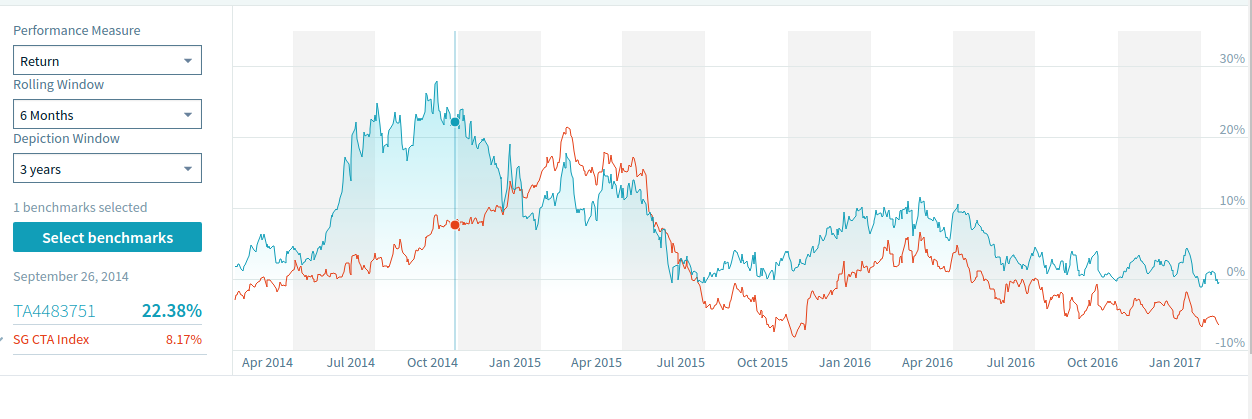
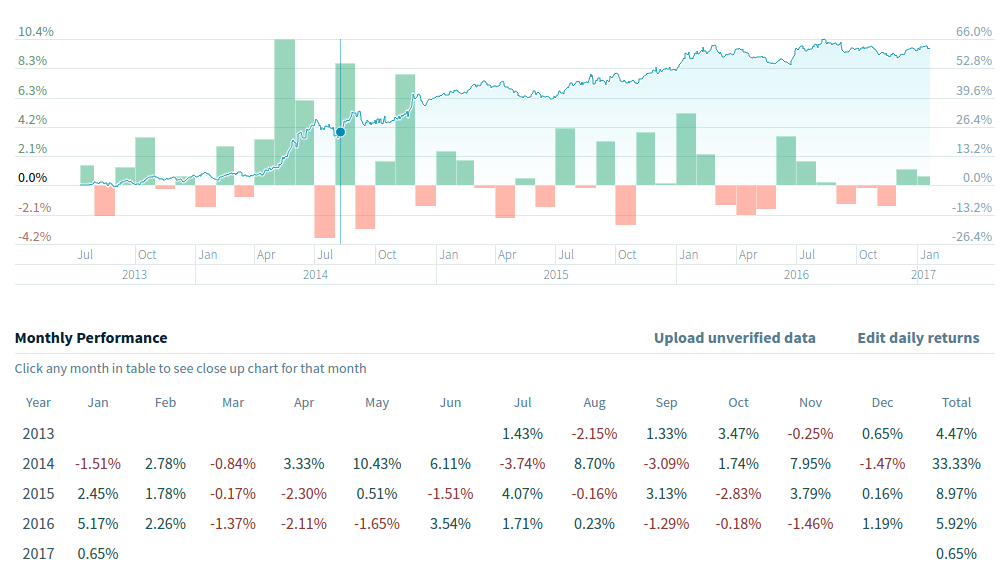
The second plot shows that I am reasonably well correlated with the CTA index, but since mid 2015 I've outperformed it by around 8% annualised.

2.

Answer 1: http://qoppac.blogspot.co.uk/2015/11/david-versus-goliath.html

Answer 2:

Is it just that they are using higher statistics instead of your rough & ready approximations (MA)?

Possibly but it probably wouldn't make much difference.

Trying to find lead-lags for predictive power?

I don't even know that that means.

What about the way they size their bets & risk management?

That is likely to be very similar

Answer 3: I don't actually know, this is all speculation...

GAT
 
Hi GAT,
How do you decide if a live model is deviating from the distribution of returns in a backtest? Is there a standard test to apply to the realised returns with comparison to the backtested returns to decide if market has changed / backtest was overfitted?
Many thanks!
 
Hi GAT,
How do you decide if a live model is deviating from the distribution of returns in a backtest? Is there a standard test to apply to the realised returns with comparison to the backtested returns to decide if market has changed / backtest was overfitted?
Many thanks!

You can use the tables in chapter 3 which tell you if one trading strategy is better than another for this purpose.

Warning: You're unlikely to live long enough to get a statistically significant result, unless you're trading very fast and have an extremely high Sharpe Ratio.

GAT
 
2/ In broad terms, what are Winton, Systematica & others doing differently from you?
Interesting that you should mention these two. Harding has been blowing his own trumpet lately, more so than usual. Read into this whatever you like.

The other mob I wouldn't touch with a 20 foot pole.
 
Back
Top