Fully automated futures trading

Great, that makes sense, thank you. I did not know that there was a German bond effect that needed to be smoothed.

Do you know why this is? Is it some sort of "seasonality" effect that is unique to German bonds?

It's the interaction of the auction calendar and the futures rolls.

GAT
 
Sincerely not trying to threadjack, but if @FCT is interested in crafting strategies around macro data releases, he might look to an intraday holding period. There's stuff to be done, but not for the faint of heart.
 
  • Like
Reactions: FCT
Sincerely not trying to threadjack, but if @FCT is interested in crafting strategies around macro data releases, he might look to an intraday holding period. There's stuff to be done, but not for the faint of heart.

Absolutely fine to post sensible and helpful comments like that on this thread.

GAT
 
Hi GAT, a discussion on nuclearphynance about data snooping bias mitigation using Cross-Validation vs block bootstrapping caught my attention...wondered if you'd comment on the comparison of them, since you discuss non-parametric bootstrapping on your blog. Bolded text below is my mod, to indicate particular items of interest.

"Both approaches are estimating the magnitude of generalization error from test-set variance. Cross-validation is doing it by training with real data, then comparing that to error round in real, but unfitted data. The random-bootstrap approach is doing it by training with real data than comparing to training with random data. The former approach is superior for a number of reasons:

1) You need a way to reliably produce random data that's sufficiently similar to real data. The source blog suggests bootstrap, but that's not robust. There may be inter-temporal structure to the data that isn't due to training set variance, yet still causes overfitting. E.g. imagine at short time horizons returns tend to mean-revert in real data. You could overfit on this data by finding a signal that buys securities with consistently >X% mean-reversion. This could purely be noise in the training data, producing positive returns in sample. Yet the random bootstrapping could still show much lower performance because at any given time there'd be much different distribution for recent mean-reversion in randomly shuffled data.

2) Comparing real to random only tells you if your system did better than one based on totally pure randomness. That's all well and good, but there's a world of difference from knowing that your system isn't 100% data-mining bias, and knowing how much of your backtested performance is attributable to it. That's important not only for setting risk-tolerances and transaction cost thresholds, but also for comparing different parameterizations of a strategy. If Strategy A uses fewer free-parameters than Strategy B, but has lower performance, knowing that they both out-performed random doesn't help you pick. With cross-validation you can directly compare in out-sample space.

3) If you're dealing with any-sort of non-convexity in training, then the random-real comparison is vulnerable to multiple equilibrium. Say it's completely data-mining, how do you know the real-parameterization didn't just stumble into a better than average optimization basin? In that case it will look a lot better than most of the random comparisons. Yet the system is still junk. For K>=10, CV, all the in-sample parameterizations are highly likely to be very similar. That makes it easy to reason about their out-sample performance. Moreover, even if they're not, cross-validation will still reveal data-mining bias even if there are highly-biased but infrequent basins.

4) NFL theorem tells us that we have to be giving up something for cross-validation over real-random comparison. It's true that CV requires us to "sacrifice" 1/K of the training data. In this case CV overestimates generalization error because it trains on less data than we would when training on the entire set. But if you're using K>=10, its most likely that your learning curve if basically flat at 0.9N samples for any sensible system.

 
Last edited:
Hi GAT, a discussion on nuclearphynance about data snooping bias mitigation using Cross-Validation vs block bootstrapping caught my attention...wondered if you'd comment on the comparison of them, since you discuss non-parametric bootstrapping on your blog. Bolded text below is my mod, to indicate particular items of interest.

"Both approaches are estimating the magnitude of generalization error from test-set variance. Cross-validation is doing it by training with real data, then comparing that to error round in real, but unfitted data. The random-bootstrap approach is doing it by training with real data than comparing to training with random data. The former approach is superior for a number of reasons:

1) You need a way to reliably produce random data that's sufficiently similar to real data. The source blog suggests bootstrap, but that's not robust. There may be inter-temporal structure to the data that isn't due to training set variance, yet still causes overfitting. E.g. imagine at short time horizons returns tend to mean-revert in real data. You could overfit on this data by finding a signal that buys securities with consistently >X% mean-reversion. This could purely be noise in the training data, producing positive returns in sample. Yet the random bootstrapping could still show much lower performance because at any given time there'd be much different distribution for recent mean-reversion in randomly shuffled data.

2) Comparing real to random only tells you if your system did better than one based on totally pure randomness. That's all well and good, but there's a world of difference from knowing that your system isn't 100% data-mining bias, and knowing how much of your backtested performance is attributable to it. That's important not only for setting risk-tolerances and transaction cost thresholds, but also for comparing different parameterizations of a strategy. If Strategy A uses fewer free-parameters than Strategy B, but has lower performance, knowing that they both out-performed random doesn't help you pick. With cross-validation you can directly compare in out-sample space.

3) If you're dealing with any-sort of non-convexity in training, then the random-real comparison is vulnerable to multiple equilibrium. Say it's completely data-mining, how do you know the real-parameterization didn't just stumble into a better than average optimization basin? In that case it will look a lot better than most of the random comparisons. Yet the system is still junk. For K>=10, CV, all the in-sample parameterizations are highly likely to be very similar. That makes it easy to reason about their out-sample performance. Moreover, even if they're not, cross-validation will still reveal data-mining bias even if there are highly-biased but infrequent basins.

4) NFL theorem tells us that we have to be giving up something for cross-validation over real-random comparison. It's true that CV requires us to "sacrifice" 1/K of the training data. In this case CV overestimates generalization error because it trains on less data than we would when training on the entire set. But if you're using K>=10, its most likely that your learning curve if basically flat at 0.9N samples for any sensible system.

I don't fit system parameters, only capital allocation. You can design systems on completely random data but you can't really fit them. That's the difference between finding desirable parameters and finding optimal parameters.

GAT
 
Hi GAT,
What is the rationale behind not fitting system parameters, but fitting capital allocation? Is fitting capital allocations not similar to fitting system parameters as it involves the same data snooping biases?
How precisely does your methodology differ in determining the capital allocations?
 
Hi GAT,
What is the rationale behind not fitting system parameters, but fitting capital allocation? Is fitting capital allocations not similar to fitting system parameters as it involves the same data snooping biases?
How precisely does your methodology differ in determining the capital allocations?

The logic is to design trading rules that "ought" to work, and then through capital allocation make sure we don't give capital to rules which are really terrible (and statistically significantly terrible) or 99% correlated with something we already have.

Essentially we get away from explicit (through formal parameter search) and implicit (through trying multiple options i.e. data snooping) overfitting and are left with tacit overfitting (we only ever try rules we know will work before we even sit down at the computer).

You can't really data snoop with capital allocations assuming you only fit on a backward looking basis AND you're not tempted to drop rules which have a very low allocation because they're rubbish. Although tactit overfitting will still be present, and you can't really ever get away from this.

The parameter space is much smaller. Given n trading rules there are only n-1 parameters. OK we over compensate by having more trading rules than we'd probably do if if we fitted them, but still...

Portfolio weights are much more amenable to bootstrapping, because it makes more sense to have an average, whereas in a parameter space you often have multiple peaks; and the average might be the worse possible value [to get technical in portfolio optimisation assuming there is a stable but unobservable mean, variance and correlation matrix then there is only one peak of the utility function and everything slopes monotonically away from that in n-dimensional space; no local maxima exist].

Portfolio weights can be fitted using simple heuristics like the "hand crafting" method I describe in my book(s) [a simple clustering technique] which reduce the degrees of freedom considerably.

Hope that makes sense. By the way this is what I'm talking about in NYC in April (why you shouldn't fit) so this is a very useful discussion for me to have right now...

GAT
 
It's been nearly 4 months since I updated this thread on performance. I've been really busy trying to finish the initial draft of my second book, which is why there have also been no blog posts or commits to pysystemtrade. There are some other house keeping things I need to do like getting a new spare computer running and getting my network backup working.

Since it's pretty much the end of the year (and in fact today is my last "working" day before the holidays begin) it seems appropriate to do a "one calendar year" update. This will be brief since I will do a full update at the end of the UK tax year, which is when I normally do this kind of stuff.

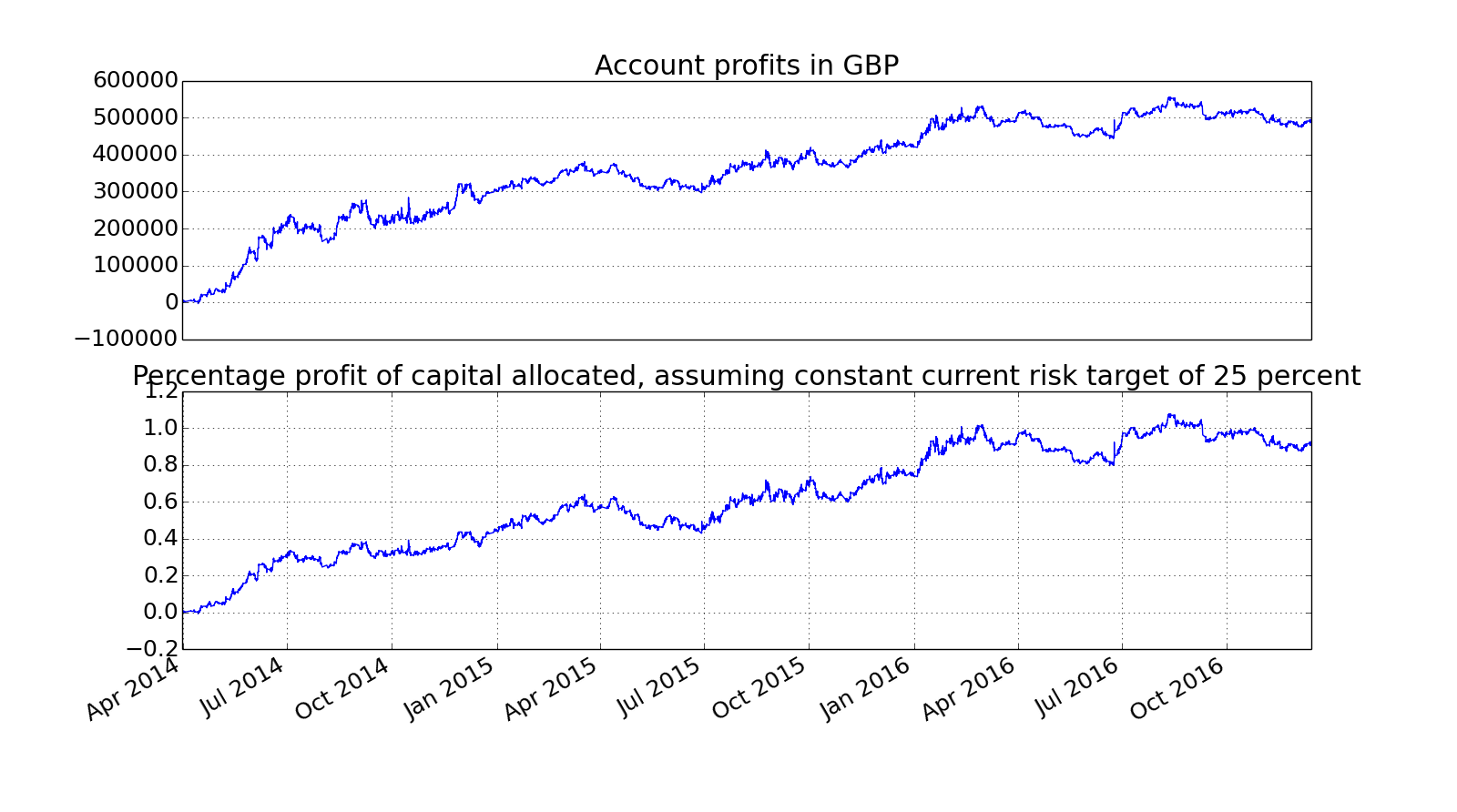
P&L to date: 96.4%
(graphs are a week out of date)

figure_1.png

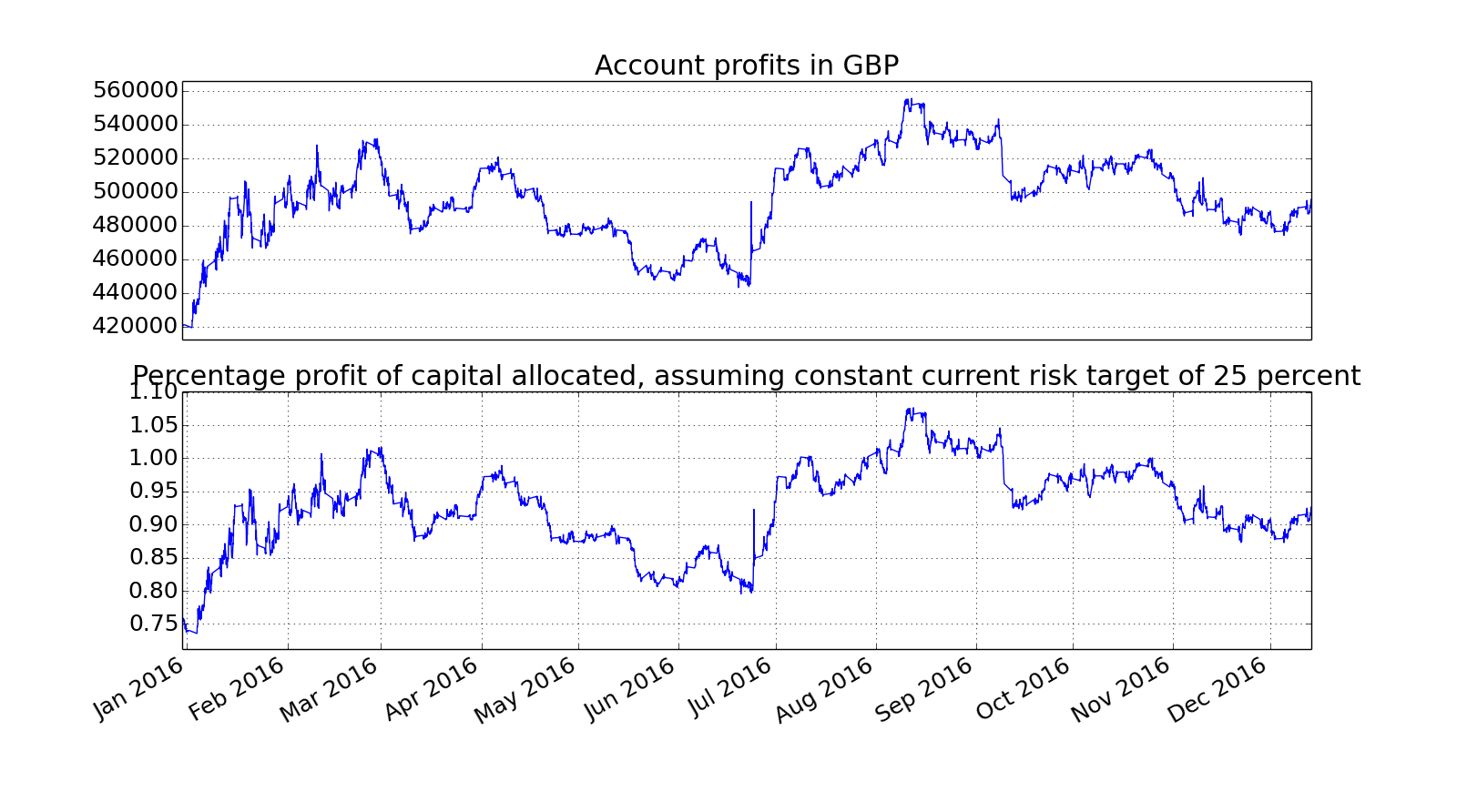
P&L last 4 months: -6%
P&L last 12 months: 22% of which stocks+hedge was 16%
figure_2.png


Drawdown (HWM set in August): 11.2%

Well it's been a lousy year for CTA's generally (the SG CTA index is down about 3.7%, also see here) so I should probably be happy with my small positive return in the futures part of my portfolio; on top of which the stocks+hedge is just a bit of extra gravy. With a volatility target of 25% that isn't far off a Sharpe Ratio of 1.0 for the year.

The record so far is 2014 (part year): 43%, 2015: 31%, 2016 (most of it): 22%.

For the financial year that I track more closely the figure to date from April 5th is a small loss of around -1%.

Positions (current):
Code:
       code contractid  positions   Lock WrongContract InFwdNotRoll
13      AEX     201701          1  False         False        False
7       AUD     201703         -2  False         False        False
19      BTP     201703          1  False         False        False
10      CAC     201701          2  False         False        False
2      CORN     201712         -3  False         False        False
20  CRUDE_W     201712          1  False         False        False
17  EDOLLAR     202006         -3  False         False        False
9       EUR     201703         -2  False         False        False
5   EUROSTX     201703         -9  False         False        False   (equity hedge)
18      GBP     201703         -2  False         False        False
11     GOLD     201702         -2  False         False        False
16      JPY     201703         -2  False         False        False
14    KOSPI     201703          1  False         False        False
0   LEANHOG     201706          1  False         False        False
8       MXP     201703         -2  False         False        False
15   NASDAQ     201703          1  False         False        False
3       OAT     201703          1  False         False        False
1       SMI     201703          2  False         False        False
22  SOYBEAN     201711          1  False         False        False
6     SP500     201703          2  False         False        False
12      V2X     201702        -16  False         False        False
4       VIX     201702         -3  False         False        False
21    WHEAT     201712         -6  False         False        False

Risk (current):

Code:
       code  multisignal  expected_annual_risk  expected_annual_risk_per_contract  position  expected_annual_risk_rounded_pos
28      MXP         -8.0                  6491                               3805        -1                              3805
2   LIVECOW         -1.7                  1384                               4356        -1                              4356
26      GBP        -10.7                  8653                               6153        -1                              6153
36  EDOLLAR         -5.8                  4691                               2161        -3                              6484
0      CORN         -8.1                  6544                               2339        -3                              7017
16      V2X        -13.9                 11256                                670       -16                             10721
24      AUD        -13.1                 10622                               5656        -2                             11313
17      VIX        -17.6                 14178                               4938        -3                             14813
4     WHEAT        -22.3                 17990                               2818        -6                             16906
25      EUR        -26.1                 21078                               9877        -2                             19754
27      JPY        -23.1                 18626                               9954        -2                             19907
31     GOLD        -24.3                 19668                              11915        -2                             23830
37  EUROSTX          0.0                     0                               3796        -9                             34163

1   LEANHOG          5.1                  4107                               3891         1                              3891
3   SOYBEAN          7.7                  6227                               5704         1                              5704
10      OAT          6.1                  4928                               8002         1                              8002
18    KOSPI         12.8                 10321                               8812         1                              8812
22   NASDAQ         12.4                 10010                               9596         1                              9596
8       BTP         11.4                  9174                               9607         1                              9607
19      AEX         18.1                 14612                              10374         1                             10374
20      CAC         14.5                 11735                               5546         2                             11092
34  CRUDE_W          9.4                  7621                              11233         1                             11233
23    SP500         17.2                 13900                               7468         2                             14936
21      SMI         18.1                 14612                               9058         2                             18116

Some interesting numbers there: short Eurodollar isn't something you see very often for a start. Risk is running a little higher than average.

I won't include a list of trades as 4 months worth is far too many, but expected slippage was £1,810 and actual was £685.

Merry Christmas and a happy new year; best of luck to all in 2017.

GAT
 
Back
Top