
Fully automated futures trading

I'm just doing the last bit now, connecting the whole lot to IB. Thanks so much for all of this, I've learnt so much from you, and genuinely enjoyed every minute of it.

I have a few q's:
  • Do you make use of IB's streaming data? My current working plan was to calculate positions based on Quandl data and just perform executions on IB. (tbc).
  • Despite the fact that IB is 'realtime', I assume you run your scripts periodically, perhaps daily. How often do you schedule recalculation of desired positions? What time do you schedule orders, relative to trading hours?
  • You mentioned on your blog that you manage the equities/hedges systematically; can you elaborate?

Yes I use IB data. I wouldn't advise doing automated executions without it. So it would be fine to use daily quandl to calculate positions and then do the executions manually on IB.

I recalculate positions and then potentially trade hourly during trading hours. More here http://qoppac.blogspot.co.uk/2015/07/systems-building-execution.html

As I've said before my equities in my IB account are just a legacy thing with an approximate hedge on. Not really a strategy, let alone a systematic one

GAT
 
Yes I use IB data. I wouldn't advise doing automated executions without it. So it would be fine to use daily quandl to calculate positions and then do the executions manually on IB.

I recalculate positions and then potentially trade hourly during trading hours. More here http://qoppac.blogspot.co.uk/2015/07/systems-building-execution.html

As I've said before my equities in my IB account are just a legacy thing with an approximate hedge on. Not really a strategy, let alone a systematic one

GAT
Hi GAT - question on your intra day trading: I am assuming that you do this in order to not get left behind during large and fast moves i.e. not let your positions get too far out of whack from target. However, I am also guessing that with large intraday whiplash moves (flash crash, Brexit etc) you may end up doing worse than just waiting for the next day. How do you quantify this? Do you ever backtest the effect that intraday trading can have on your results? Or just assume that large intraday whiplash moves are the exception, therefore better to recalculate intraday.
Thanks as always.
 
Hi GAT - question on your intra day trading: I am assuming that you do this in order to not get left behind during large and fast moves i.e. not let your positions get too far out of whack from target. However, I am also guessing that with large intraday whiplash moves (flash crash, Brexit etc) you may end up doing worse than just waiting for the next day. How do you quantify this? Do you ever backtest the effect that intraday trading can have on your results? Or just assume that large intraday whiplash moves are the exception, therefore better to recalculate intraday.
Thanks as always.

I don't quantify it as I don't have enough intraday data. To be honest it makes no practical difference, as what I have quantified is running the system at 0 days delay and +1 day delay and it has no effect on the performance. I don't have a preference for eithier.

Actually I am going to drop the intra day trading, at least for my current trading system. My long term plan is to change it to once a day, with a faster system overlaid on top of it.

GAT
 
Hi all, the carry trade has proven quite profitable over recent years. GAT, and any other thread followers: do you have any views on how carry trades in particular will perform if rates rise? Higher rates mean higher carry, but could there be some principal losses as rates rise? I think of e.g., AUDJPY: let's say USD rates rise, in this instance the USD carry increases and the USD itself would appreciate. If I think of bonds, I see the opposite: if rates rise, bond prices must fall. So if your carry component is long bonds, the signal may increase as prices move against you. Does anyone agree/disagree?

Separately, what does everyone think the term structure of US interest rate futures will do if rates begin to rise? Trend following works well if bond prices are trending up and curves are backwardated. I think trend following could work well if bond prices are trending down and curves are contangoed, but is there any evidence that curves will move into contango? Since bond futures came into existence we've only had a few instances where rates rose in 1994 and 2006/07. I haven't got the data yet but did curves move into contango (not yield curves but like-for-like futures term structure curves)?
 
Hi all, the carry trade has proven quite profitable over recent years. GAT, and any other thread followers: do you have any views on how carry trades in particular will perform if rates rise? Higher rates mean higher carry, but could there be some principal losses as rates rise? I think of e.g., AUDJPY: let's say USD rates rise, in this instance the USD carry increases and the USD itself would appreciate. If I think of bonds, I see the opposite: if rates rise, bond prices must fall. So if your carry component is long bonds, the signal may increase as prices move against you. Does anyone agree/disagree?

I don't agree or disagree but frankly I don't worry about this kind of stuff. There are just too many variables going into why a price may or may not move, or why a particular system may or may not make money. I've never found strong evidence that the performance of a particular system can be predicted systematically and I'm strongly against trying to predict them in a hand waving discretionary way.

Sorry if that sounds harsh, but maybe some other posters will have some ideas, or maybe you should try posting a new thread on the appropriate forum.

Separately, what does everyone think the term structure of US interest rate futures will do if rates begin to rise? Trend following works well if bond prices are trending up and curves are backwardated. I think trend following could work well if bond prices are trending down and curves are contangoed, but is there any evidence that curves will move into contango? Since bond futures came into existence we've only had a few instances where rates rose in 1994 and 2006/07. I haven't got the data yet but did curves move into contango (not yield curves but like-for-like futures term structure curves)?

This is a more interesting question. I agree that you'd expect trend following to work well when the carry and spot aren't fighting each other.

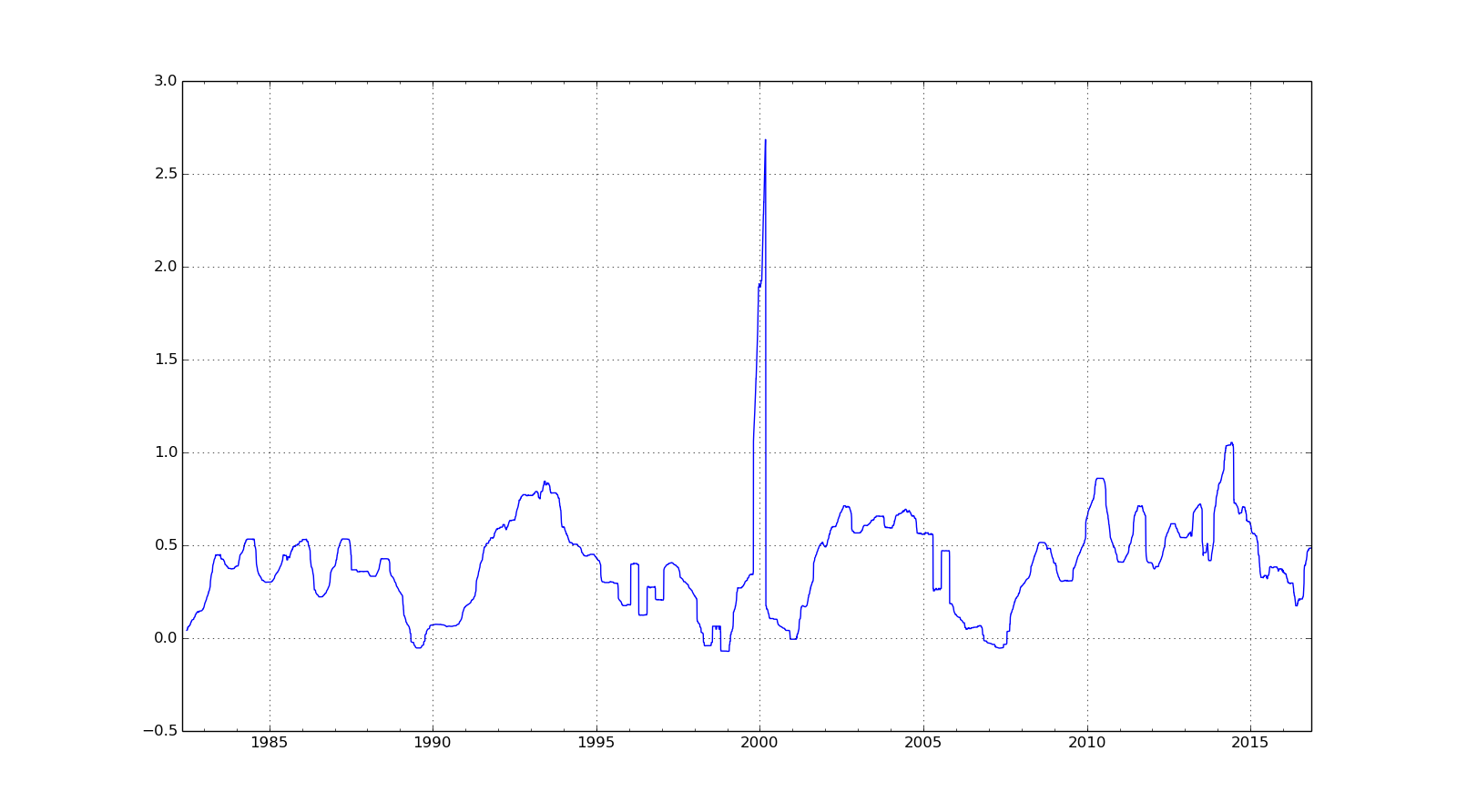
A cursory look at the data

figure_1.png

That's the US 10 year. There is a 125 day moving average on there to smooth it.

It doesn't look the market ever goes into contago for any decent length of time.

GAT
 
Back
Top