
Fully automated futures trading

Hi GAT,

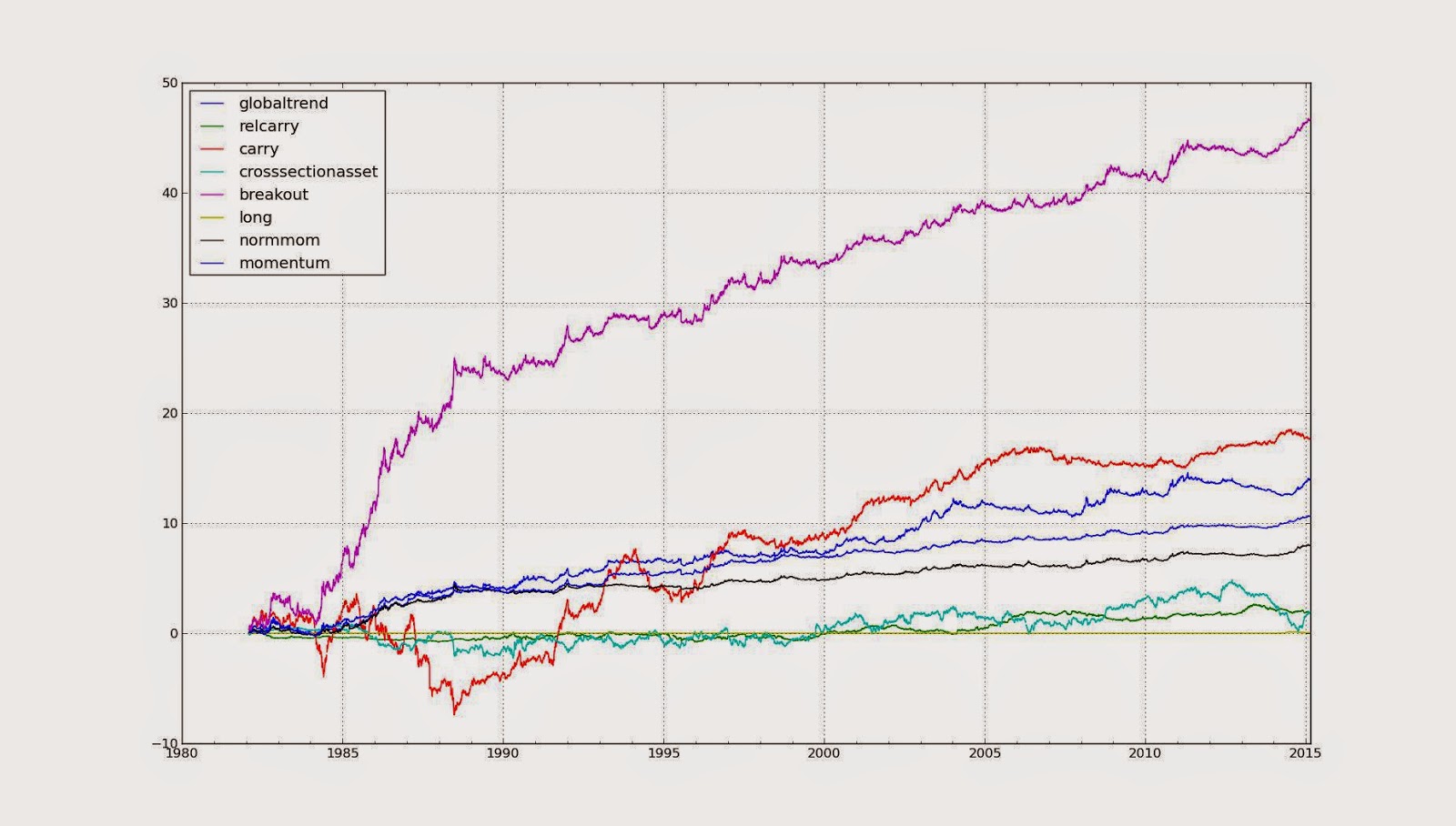
I am currently reading your book I must say it has really filled in all the gaps in my 5 years of experience with the markets. I have several questions about an old chart you posted in page 6 of this thread.
plot.jpg


If you don't mind sharing,

1) Why does breakout outperform momentum by such a huge margin? I ask because you provided some correlations in your blog for ewmac vs breakout and it seems that breakout and momentum should be pretty similar in terms of performance.
Is the breakout rule in this picture similar to http://qoppac.blogspot.sg/2016/05/a-simple-breakout-trading-rule.html or a vastly different animal?

2) What is the difference between relative carry and carry?

3) What is the difference between momentum and normmom?

4) What is the difference between globaltrend vs momentum?

5) Can you elaborate a bit more about crosssectionasset?

Thank you so much!

1) the graph is not vol adjusted, but shows the contribution of each trading rule to total profits. Breakout has a higher weight, so contributes more. Having said that breakout does seem to be more profitable than ewmac [remember something can be correlated, but still have a higher average return].

2) carry is done on each instrument, relative carry within asset class

3) the former is ewmac on the price, the latter ewmac on the cumulative vol normalised returns

4) the former looks at the entire asset class, the latter just each instrument

5) it's mean reversion within asset class ;if CAC has outpaced AEX then I'd buy the latter

I'll be releasing python code for all these at some point

GAT
 
1) the graph is not vol adjusted, but shows the contribution of each trading rule to total profits. Breakout has a higher weight, so contributes more. Having said that breakout does seem to be more profitable than ewmac [remember something can be correlated, but still have a higher average return].

2) carry is done on each instrument, relative carry within asset class

3) the former is ewmac on the price, the latter ewmac on the cumulative vol normalised returns

4) the former looks at the entire asset class, the latter just each instrument

5) it's mean reversion within asset class ;if CAC has outpaced AEX then I'd buy the latter

I'll be releasing python code for all these at some point

GAT

In case I missed it, could you please give one more time exact definitions of 'breakout' & 'momentum'?
 
Slippage £146 vs £320 expectations. I'm seriously considering running my execution algo as a standalone scalping system (on a small number of markets with very limited risk). It will be interesting to see if this cruddy slow thing can really still make money in the world of HFT when it isn't attached to a much slower trading system. That little project will have to wait until I've refactored my code; something I am putting off for as long as possible.

GAT

Did you ever get around to testing this? I have to admit to being really impressed by the performance of such a simple algo. All of the fancy crap my broker uses can't hold a candle to it (not an apples to apples comparison, but still).
 
Did you ever get around to testing this? I have to admit to being really impressed by the performance of such a simple algo. All of the fancy crap my broker uses can't hold a candle to it (not an apples to apples comparison, but still).

No not yet. Refactoring takes second place to finishing my book for an end of year deadline.

Are these algos for equities? My impression is that it's harder to get decent execution in equities (market rules, more HFT predators, more fragmented markets).

GAT
 
Are these algos for equities? My impression is that it's harder to get decent execution in equities (market rules, more HFT predators, more fragmented markets).

GAT

Yes. That comment wasn't fair and said out of frustration. I wouldn't expect futures vs. stock execution quality to be anything close to the same animal. However, I've seen major degradation in my fill quality over the last few years. Just to give a few stats that will make you glad you've chosen to focus on futures, here are slippage numbers (normalized by %ADV) by year for one model (~5k trades per year):

2013: 45 bps
2014: 60 bps
2015: 69 bps
2016: 74 bps

I've analyzed the data a million different ways and the only conclusion I can come up with is that HFT algos are evolving faster than my broker's smart router. Anyway, appreciate your contributions here and elsewhere. Trading is my primary income source, so I don't think the slower pace would be a match for me...but you've certainly got me thinking about implementing similar concepts on much smaller time frames.
 
Here's my trading journal. I've been running this system since April last year. It's fully automated, futures trading, with a bias towards trend following.

Here is the p&l to date. I will do a more thorough analysis after a full year

plot.jpg


Current positions (hope the codes make sense):

AEX 201502 1
ASX 201503 1
AUD 201503 -1
AUS10 201503 1
AUS3 201503 2
AUSSTIR 201603 1
BOBL 201503 5
BTP 201503 2
BUND 201503 1
CAC 201502 2
CORN 201512 -1
CRUDE_W 201512 -1
EDOLLAR 201806 3
EUR 201503 -1
EUROSTX 201503 -9
FEEDCOW 201503 1
FTSE 201503 -2
GAS_US 201504 -1
GBP 201503 -1
JPY 201503 -1
KR10 201503 1
KR3 201503 5
LIVECOW 201510 -1
MXP 201503 -1
NASDAQ 201503 1
SHATZ 201503 23
SMI 201503 1
SP500 201503 1
US10 201503 1
US2 201503 3
US5 201503 1
V2X 201503 -1
VIX 201503 -1
WHEAT 201512 -1


More information to follow. I'll try and answer any questions.

The impressive thing is the lack of draw-downs out of the gate. Every system I've ever run begins with losses, as most smart algos narrow down to some variation on the dump-losers-first-let-winners-run theme. You do not seem to have this problem. I have never seen this not to be the case. PS You're using a Unix platform. I like you.
 
No not yet. Refactoring takes second place to finishing my book for an end of year deadline.

Are these algos for equities? My impression is that it's harder to get decent execution in equities (market rules, more HFT predators, more fragmented markets).

GAT
I'm really looking forward to reading another book by you. Your first book honestly revolutionized how I view trading and dramatically helped me refine my own strategies.

What is the topic of your new book? Is there any more information you're able to share? I'd be happy to help with proof-reading ;-)
 
Does anyone have any advice on where to receive realtime data feeds? I have a lot of historical data and am now in the process of monitoring things realtime. I am aware of CSIdata, but they are end of day only. Are there any other data sources available (with a high degree of accuracy) for e.g., at least hourly futures data for a reasonable price?
 
Does anyone have any advice on where to receive realtime data feeds? I have a lot of historical data and am now in the process of monitoring things realtime. I am aware of CSIdata, but they are end of day only. Are there any other data sources available (with a high degree of accuracy) for e.g., at least hourly futures data for a reasonable price?

I have used both Interactive Brokers API for receiving real time data and IQFeed. IB is cheaper if you are already using them as a broker. IQFeed is more expensive, but can get cheaper if you use their fee waiver program for GLOBEX futures. For IQFeed you may need to pay like 300$ for their developer license if you want to get their API documentation or you can use some open source library to connect to them.
 
Back
Top