The Persistent Foozler
“t is essential that you establish rules to guide your behavior. You will need to create definition and give yourself direction. Otherwise, you will feel overwhelmed with too many possibilities. Without these rules one of the most likely possibilities is that you will create devastating losses for yourself. The big psychological problem here is, if you make up and have to play by your own rules, you also have to take total and complete responsibility for your actions as well as the outcome of your actions.” Mark Douglas, The Disciplined Trader, pp. 49-50
For the last six months, I have been working on establishing the rules which will guide my behavior in the markets. Prior to this time, I have been trading for nearly nine years without any plan whatsoever. The biggest risk to my potential for success is that I know from my experience that I too easily allow myself to become “overwhelmed with too many possibilities.” I have tended to track too many different kinds of instruments – stocks, options, futures, forex - across too many time frames, flipping through too many bar intervals, simply looking for something, anything, to trade.
But that was then, and this is now.
I have gone through the steps that dbphoenix has outlined in his Trading Plan/The Trading Journal threads. I “hired myself to do a job.” That job was to observe price in order to develop a consistently profitable trading plan based upon those observations.
Based upon these observations, I developed a trading plan. I have paper traded that plan for six weeks, and I have just completed my third week of sim trading. On Monday, I will trade live. My plan is to trade live for this one week, and then based upon my end-of-week assessment, I will decide whether to continue live trading, or revert back to an earlier stage – Sim Trading, Paper Trading, or, if need be, all the way back to Observation. I will take this one week at a time.
The Plan
I have decided that this would be a day trading plan, as I do not particularly like being in the market overnight. I like being in cash at the end of the day. Also, I am at a point in my life where I would like to trade for consistent, additional income, rather than long-term capital appreciation.
I have decided to trade stocks and ETF’s. I decided this because while I am a net loser on my trading activities overall, I am net profitable on my stock and ETF trades. As part of my observation period, I worked on building a profile of the characteristics a stock or ETF would have to have, in order to provide me, in the words of dbphoenix, “the range and volatility I require but also the safety that enables me to relax and trade in an objective and rational manner.” I have a current list of thirty-five stocks and ETF’s that meet my requirements.
“What you want to do is become an expert at just one particular type of behavior pattern that repeats itself with some degree of frequency.” Mark Douglas, The Disciplined Trader, pp. 208-209
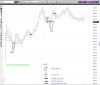
I really took this recommendation to heart as I undertook the observation of price action stage of plan development. The pattern that I came to build my trading plan around is a retracement strategy. For lack of a better term, I call it a “double-bottom pullback,” or DBP for short. This pattern, and my plan itself is best illustrated with a visual example. I will use a sim trade I took from today’s session to illustrate.


A Summary:
1) NUGT is trading above today’s open – this is required. It does not matter whether the security gapped open lower, higher, or flat with the prior session’s close. But price must be above the open.
2) NUGT makes a high price for the session, and pulls back from that high.
3) Price then rallies, but fails to make a new high.
4) Price again pulls back and tests the low of the initial retracement from the session high. In this case, price under cut the initial low. This is not a requirement. Price may under cut the low, equall the low, or form a higher low, and still fulfill the requirement of the DBP. In this case, price finds support just below that level. I enter on a buy stop above the market, and I am, in the words of nodoji, “swept into the trade.” Initial stop loss is below the low of the DBP.
5) NUGT continues to rally. I trail my stop, and I exit near the end of the day as NUGT “double tops.”
That is my plan in a nutshell, so to speak. This particular example happened to be a “textbook” example. Not all trades proceed as favorably as this one did. My true challenge is sticking to the plan, not allowing myself to be distracted by looking for trades elsewhere other than the securities on my list, and only to take trades that meet my plan’s criteria.
I will post a review each evening starting on Monday.
“t is essential that you establish rules to guide your behavior. You will need to create definition and give yourself direction. Otherwise, you will feel overwhelmed with too many possibilities. Without these rules one of the most likely possibilities is that you will create devastating losses for yourself. The big psychological problem here is, if you make up and have to play by your own rules, you also have to take total and complete responsibility for your actions as well as the outcome of your actions.” Mark Douglas, The Disciplined Trader, pp. 49-50
For the last six months, I have been working on establishing the rules which will guide my behavior in the markets. Prior to this time, I have been trading for nearly nine years without any plan whatsoever. The biggest risk to my potential for success is that I know from my experience that I too easily allow myself to become “overwhelmed with too many possibilities.” I have tended to track too many different kinds of instruments – stocks, options, futures, forex - across too many time frames, flipping through too many bar intervals, simply looking for something, anything, to trade.
But that was then, and this is now.
I have gone through the steps that dbphoenix has outlined in his Trading Plan/The Trading Journal threads. I “hired myself to do a job.” That job was to observe price in order to develop a consistently profitable trading plan based upon those observations.
Based upon these observations, I developed a trading plan. I have paper traded that plan for six weeks, and I have just completed my third week of sim trading. On Monday, I will trade live. My plan is to trade live for this one week, and then based upon my end-of-week assessment, I will decide whether to continue live trading, or revert back to an earlier stage – Sim Trading, Paper Trading, or, if need be, all the way back to Observation. I will take this one week at a time.
The Plan
I have decided that this would be a day trading plan, as I do not particularly like being in the market overnight. I like being in cash at the end of the day. Also, I am at a point in my life where I would like to trade for consistent, additional income, rather than long-term capital appreciation.
I have decided to trade stocks and ETF’s. I decided this because while I am a net loser on my trading activities overall, I am net profitable on my stock and ETF trades. As part of my observation period, I worked on building a profile of the characteristics a stock or ETF would have to have, in order to provide me, in the words of dbphoenix, “the range and volatility I require but also the safety that enables me to relax and trade in an objective and rational manner.” I have a current list of thirty-five stocks and ETF’s that meet my requirements.
“What you want to do is become an expert at just one particular type of behavior pattern that repeats itself with some degree of frequency.” Mark Douglas, The Disciplined Trader, pp. 208-209
I really took this recommendation to heart as I undertook the observation of price action stage of plan development. The pattern that I came to build my trading plan around is a retracement strategy. For lack of a better term, I call it a “double-bottom pullback,” or DBP for short. This pattern, and my plan itself is best illustrated with a visual example. I will use a sim trade I took from today’s session to illustrate.
A Summary:
1) NUGT is trading above today’s open – this is required. It does not matter whether the security gapped open lower, higher, or flat with the prior session’s close. But price must be above the open.
2) NUGT makes a high price for the session, and pulls back from that high.
3) Price then rallies, but fails to make a new high.
4) Price again pulls back and tests the low of the initial retracement from the session high. In this case, price under cut the initial low. This is not a requirement. Price may under cut the low, equall the low, or form a higher low, and still fulfill the requirement of the DBP. In this case, price finds support just below that level. I enter on a buy stop above the market, and I am, in the words of nodoji, “swept into the trade.” Initial stop loss is below the low of the DBP.
5) NUGT continues to rally. I trail my stop, and I exit near the end of the day as NUGT “double tops.”
That is my plan in a nutshell, so to speak. This particular example happened to be a “textbook” example. Not all trades proceed as favorably as this one did. My true challenge is sticking to the plan, not allowing myself to be distracted by looking for trades elsewhere other than the securities on my list, and only to take trades that meet my plan’s criteria.
I will post a review each evening starting on Monday.

 ) lol
) lol