You are using an out of date browser. It may not display this or other websites correctly.
You should upgrade or use an alternative browser.
You should upgrade or use an alternative browser.
Fraudcurrents - NOAA just proved you were a fool
- Thread starter jem
- Start date

Yeah right, whatever.
Government Data Show U.S. in Decade-Long Cooling
http://www.forbes.com/sites/jamestaylor/2014/06/25/government-data-show-u-s-in-decade-long-cooling/
Let's take a look at what happens to scientific charts after the politicians get involved...
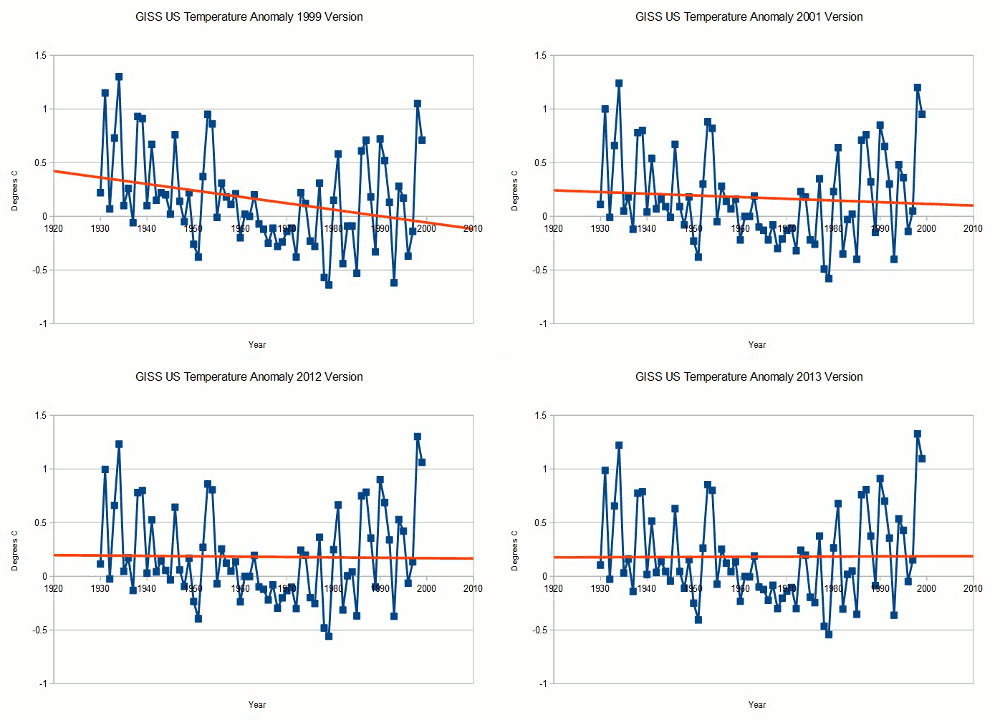
You don't learn well do you? The temp adjustment was proper and done by scientists, and who cares about a short time period of only US temps except for ignorant delude righties?
Can you post some of these models to prove they are not wrong?
Here you go lucrum/666, one slip up and this incarnation will also go on ignore.
http://www.theguardian.com/environm...t/01/ipcc-global-warming-projections-accurate
You don't learn well do you? The temp adjustment was proper and done by scientists, and who cares about a short time period of only US temps except for ignorant delude righties?
How about the British Met HadCRUT data showing the worldwide temperatures have not increased for over 17 years. Or the IPCC calls it - "the pause" - which they are unable to explain in their failed models.
Live your global warming fantasy - but I would urge you to buy some winter gear.
How about the British Met HadCRUT data showing the worldwide temperatures have not increased for over 17 years. Or the IPCC calls it - "the pause" - which they are unable to explain in their failed models.
Live your global warming fantasy - but I would urge you to buy some winter gear.
Read and learn idiot
http://www.theguardian.com/environm...t/01/ipcc-global-warming-projections-accurate
Here you go lucrum/666, one slip up and this incarnation will also go on ignore.
Is everyone on this site Lucrum in your eyes? The guy has had the same handle for more than a decade, and 20k posts, and you think he is in the business of making multiple handles? LOL.
models have failed fallen outside the 2.5% level.... they have failed.
http://www.spiegel.de/international...lems-with-climate-change-models-a-906721.html
SPIEGEL: Do the computer models with which physicists simulate the future climate ever show the sort of long standstill in temperature change that we're observing right now?
Storch: Yes, but only extremely rarely. At my institute, we analyzed how often such a 15-year stagnation in global warming occurred in the simulations. The answer was: in under 2 percent of all the times we ran the simulation. In other words, over 98 percent of forecasts show CO2 emissions as high as we have had in recent years leading to more of a temperature increase.
SPIEGEL: How long will it still be possible to reconcile such a pause in global warming with established climate forecasts?
Storch: If things continue as they have been, in five years, at the latest, we will need to acknowledge that something is fundamentally wrong with our climate models. A 20-year pause in global warming does not occur in a single modeled scenario. But even today, we are finding it very difficult to reconcile actual temperature trends with our expectations.
SPIEGEL: What could be wrong with the models?
Storch: There are two conceivable explanations -- and neither is very pleasant for us. The first possibility is that less global warming is occurring than expected because greenhouse gases, especially CO2, have less of an effect than we have assumed. This wouldn't mean that there is no man-made greenhouse effect, but simply that our effect on climate events is not as great as we have believed. The other possibility is that, in our simulations, we have underestimated how much the climate fluctuates owing to natural causes.
SPIEGEL: That sounds quite embarrassing for your profession, if you have to go back and adjust your models to fit with realityâ¦
Storch: Why? That's how the process of scientific discovery works. There is no last word in research, and that includes climate research. It's never the truth that we offer, but only our best possible approximation of reality. But that often gets forgotten in the way the public perceives and describes our work.
SPIEGEL: But it has been climate researchers themselves who have feigned a degree of certainty even though it doesn't actually exist. For example, the IPCC announced with 95 percent certainty that humans contribute to climate change.
http://www.spiegel.de/international...lems-with-climate-change-models-a-906721.html
SPIEGEL: Do the computer models with which physicists simulate the future climate ever show the sort of long standstill in temperature change that we're observing right now?
Storch: Yes, but only extremely rarely. At my institute, we analyzed how often such a 15-year stagnation in global warming occurred in the simulations. The answer was: in under 2 percent of all the times we ran the simulation. In other words, over 98 percent of forecasts show CO2 emissions as high as we have had in recent years leading to more of a temperature increase.
SPIEGEL: How long will it still be possible to reconcile such a pause in global warming with established climate forecasts?
Storch: If things continue as they have been, in five years, at the latest, we will need to acknowledge that something is fundamentally wrong with our climate models. A 20-year pause in global warming does not occur in a single modeled scenario. But even today, we are finding it very difficult to reconcile actual temperature trends with our expectations.
SPIEGEL: What could be wrong with the models?
Storch: There are two conceivable explanations -- and neither is very pleasant for us. The first possibility is that less global warming is occurring than expected because greenhouse gases, especially CO2, have less of an effect than we have assumed. This wouldn't mean that there is no man-made greenhouse effect, but simply that our effect on climate events is not as great as we have believed. The other possibility is that, in our simulations, we have underestimated how much the climate fluctuates owing to natural causes.
SPIEGEL: That sounds quite embarrassing for your profession, if you have to go back and adjust your models to fit with realityâ¦
Storch: Why? That's how the process of scientific discovery works. There is no last word in research, and that includes climate research. It's never the truth that we offer, but only our best possible approximation of reality. But that often gets forgotten in the way the public perceives and describes our work.
SPIEGEL: But it has been climate researchers themselves who have feigned a degree of certainty even though it doesn't actually exist. For example, the IPCC announced with 95 percent certainty that humans contribute to climate change.
Is everyone on this site Lucrum in your eyes? The guy has had the same handle for more than a decade, and 20k posts, and you think he is in the business of making multiple handles? LOL.
Yes.
All in all, the IPCC models do an impressive job accurately representing and projecting changes in the global climate, contrary to contrarian claims. In fact, the IPCC global surface warming projections have performed much better than predictions made by climate contrarians .
http://www.theguardian.com/environm...t/01/ipcc-global-warming-projections-accurate
http://www.theguardian.com/environm...t/01/ipcc-global-warming-projections-accurate
All in all, the IPCC models do an impressive job accurately representing and projecting changes in the global climate, contrary to contrarian claims. In fact, the IPCC global surface warming projections have performed much better than predictions made by climate contrarians .
http://www.theguardian.com/environm...t/01/ipcc-global-warming-projections-accurate