
More on the recent fraud/fool of piehole's..... Richard Lindzen.
Quotes by Richard Lindzen
Climate MythWhat the Science Says
""We’ve already seen almost the equivalent of a doubling of CO2 (in radiative forcing) and that has produced very little warming""
25 July 2012 (Source)
This argument ignores the cooling effect of aerosols and the planet's thermal inertia.
"If I’m wrong, we’ll know it in 50 years and can do something."
30 April 2012 (Source)
A large amount of warming is delayed, and if we don’t act now we could pass tipping points.
"Only with positive feedbacks from water vapor and clouds does one get the large warmings that are associated with alarm. What the satellite data seems to show is that these positive feedbacks are model artifacts."
22 February 2012 (Source)
Evidence is building that net cloud feedback is likely positive and unlikely to be strongly negative.
"...one can see no warming since 1997."
22 February 2012 (Source)
Global temperature is still rising and 2010 was the hottest recorded.
"As Phil Jones acknowledged, there has been no statistically significant warming in 15 years."
22 February 2012 (Source)
Phil Jones was misquoted.
"You have to remember, this is an issue where what most scientists agree on has nothing to do with the alarm. I think the real problem is so many scientists have gone along with it without pointing out that what has been established reasonably well has nothing to do with the urgency that’s being promoted, which is largely a political matter."
6 April 2011 (Source)
A large amount of warming is delayed, and if we don’t act now we could pass tipping points.
"In the North Pole, you don’t have a [ice] cap, you have sea ice; it’s very variable. And as far as Greenland and Antarctica go, there’s no evidence of any significant change. I mean, you know, again your measurements aren’t that great, but any reports you hear are again focusing on tiny changes that would have no implication."
6 April 2011 (Source)
Arctic sea ice has shrunk by an area equal to Western Australia, and summer or multi-year sea ice might be all gone within a decade.
"The crucial thing is sensitivity: you know, what do you expect a doubling of CO2 to do? If it's only a degree, then you could go through at least two doublings and probably exhaust much of your fossil fuel before you would do anything that would bother anyone."
6 April 2011 (Source)
Net positive feedback is confirmed by many different lines of evidence.
"[Emissions cuts] would be a moral disaster, because it would mean that much of the world would preclude development and so they'd be more vulnerable to the disasters that occur regardless of man [...] Your vulnerability increases as your wealth decreases."
6 April 2011 (Source)
Those who contribute the least greenhouse gases will be most impacted by climate change.
"The evidence is pretty good that even if everyone [cut emissions] in the whole world it wouldn't make a lot of difference."
6 April 2011 (Source)
If every nation agrees to limit CO2 emissions, we can achieve significant cuts on a global scale.
"It's a heavy cost for no benefit, and it's no benefit for you, no benefit for your children, no benefit for your grandchildren, no benefit for your great-great-great-great-grandchildren. I mean, what's the point of that?"
6 April 2011 (Source)
The benefits of a price on carbon outweigh the costs several times over.
"For Australia to act now is, you know, a bit bizarre, and certainly cannot be justified by any impact it would have on Australia or anyone."
6 April 2011 (Source)
A large amount of warming is delayed, and if we don’t act now we could pass tipping points.
"I think even Flannery acknowledged that Australia doing this [a carbon tax] would have no discernible impact for virtually a millennium, even if Australia's output during that millennium was increasing exponentially."
6 April 2011 (Source)
CO2 limits won't cool the planet, but they can make the difference between continued accelerating global warming to catastrophic levels vs. slowing and eventually stopping the warming at hopefully safe levels
"If we doubled CO2, it's well accepted that you should get about 1 degree warming if nothing else happened. [...] But 1 degree is reckoned as not very significant. The question then is: is what we've seen so far suggesting that you have more than that, and the answer is no."
6 April 2011 (Source)
Net positive feedback is confirmed by many different lines of evidence.
"If we doubled CO2, it's well accepted that you should get about 1 degree warming if nothing else happened."
6 April 2011 (Source)
Net positive feedback is confirmed by many different lines of evidence.
"The models do say you should have seen 2-5 times more than you've already seen, you know, you have to then accept, if you believe the models, that you actually should have gotten far more warming than you've seen, but some mysterious process has cancelled part of it."
6 April 2011 (Source)
This argument ignores the cooling effect of aerosols and the planet's thermal inertia.
"If nothing else changed, adding the amount of CO2 that we've added thus far should account for maybe a quarter of what we've seen."
6 April 2011 (Source)
Theory, models and direct measurement confirm CO2 is currently the main driver of climate change.
"There's not too much disagreement that there has been a very small increase in temperature [...] This is pretty tiny; it's a fraction of a degree."
6 April 2011 (Source)
A few degrees of global warming has a huge impact on ice sheets, sea levels and other aspects of climate.
Quotes by Richard Lindzen
Climate MythWhat the Science Says
""We’ve already seen almost the equivalent of a doubling of CO2 (in radiative forcing) and that has produced very little warming""
25 July 2012 (Source)
This argument ignores the cooling effect of aerosols and the planet's thermal inertia.
"If I’m wrong, we’ll know it in 50 years and can do something."
30 April 2012 (Source)
A large amount of warming is delayed, and if we don’t act now we could pass tipping points.
"Only with positive feedbacks from water vapor and clouds does one get the large warmings that are associated with alarm. What the satellite data seems to show is that these positive feedbacks are model artifacts."
22 February 2012 (Source)
Evidence is building that net cloud feedback is likely positive and unlikely to be strongly negative.
"...one can see no warming since 1997."
22 February 2012 (Source)
Global temperature is still rising and 2010 was the hottest recorded.
"As Phil Jones acknowledged, there has been no statistically significant warming in 15 years."
22 February 2012 (Source)
Phil Jones was misquoted.
"You have to remember, this is an issue where what most scientists agree on has nothing to do with the alarm. I think the real problem is so many scientists have gone along with it without pointing out that what has been established reasonably well has nothing to do with the urgency that’s being promoted, which is largely a political matter."
6 April 2011 (Source)
A large amount of warming is delayed, and if we don’t act now we could pass tipping points.
"In the North Pole, you don’t have a [ice] cap, you have sea ice; it’s very variable. And as far as Greenland and Antarctica go, there’s no evidence of any significant change. I mean, you know, again your measurements aren’t that great, but any reports you hear are again focusing on tiny changes that would have no implication."
6 April 2011 (Source)
Arctic sea ice has shrunk by an area equal to Western Australia, and summer or multi-year sea ice might be all gone within a decade.
"The crucial thing is sensitivity: you know, what do you expect a doubling of CO2 to do? If it's only a degree, then you could go through at least two doublings and probably exhaust much of your fossil fuel before you would do anything that would bother anyone."
6 April 2011 (Source)
Net positive feedback is confirmed by many different lines of evidence.
"[Emissions cuts] would be a moral disaster, because it would mean that much of the world would preclude development and so they'd be more vulnerable to the disasters that occur regardless of man [...] Your vulnerability increases as your wealth decreases."
6 April 2011 (Source)
Those who contribute the least greenhouse gases will be most impacted by climate change.
"The evidence is pretty good that even if everyone [cut emissions] in the whole world it wouldn't make a lot of difference."
6 April 2011 (Source)
If every nation agrees to limit CO2 emissions, we can achieve significant cuts on a global scale.
"It's a heavy cost for no benefit, and it's no benefit for you, no benefit for your children, no benefit for your grandchildren, no benefit for your great-great-great-great-grandchildren. I mean, what's the point of that?"
6 April 2011 (Source)
The benefits of a price on carbon outweigh the costs several times over.
"For Australia to act now is, you know, a bit bizarre, and certainly cannot be justified by any impact it would have on Australia or anyone."
6 April 2011 (Source)
A large amount of warming is delayed, and if we don’t act now we could pass tipping points.
"I think even Flannery acknowledged that Australia doing this [a carbon tax] would have no discernible impact for virtually a millennium, even if Australia's output during that millennium was increasing exponentially."
6 April 2011 (Source)
CO2 limits won't cool the planet, but they can make the difference between continued accelerating global warming to catastrophic levels vs. slowing and eventually stopping the warming at hopefully safe levels
"If we doubled CO2, it's well accepted that you should get about 1 degree warming if nothing else happened. [...] But 1 degree is reckoned as not very significant. The question then is: is what we've seen so far suggesting that you have more than that, and the answer is no."
6 April 2011 (Source)
Net positive feedback is confirmed by many different lines of evidence.
"If we doubled CO2, it's well accepted that you should get about 1 degree warming if nothing else happened."
6 April 2011 (Source)
Net positive feedback is confirmed by many different lines of evidence.
"The models do say you should have seen 2-5 times more than you've already seen, you know, you have to then accept, if you believe the models, that you actually should have gotten far more warming than you've seen, but some mysterious process has cancelled part of it."
6 April 2011 (Source)
This argument ignores the cooling effect of aerosols and the planet's thermal inertia.
"If nothing else changed, adding the amount of CO2 that we've added thus far should account for maybe a quarter of what we've seen."
6 April 2011 (Source)
Theory, models and direct measurement confirm CO2 is currently the main driver of climate change.
"There's not too much disagreement that there has been a very small increase in temperature [...] This is pretty tiny; it's a fraction of a degree."
6 April 2011 (Source)
A few degrees of global warming has a huge impact on ice sheets, sea levels and other aspects of climate.
Last edited:

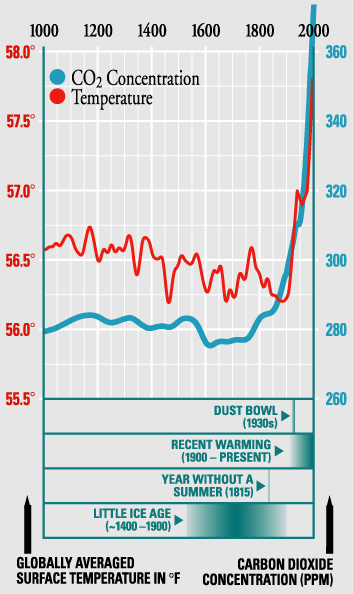




 One of FC's charts shows this, but there is nothing unusual about it. Heat from the deep ocean is recognized by meteorologists as one of the sources contributing to natural climate change.