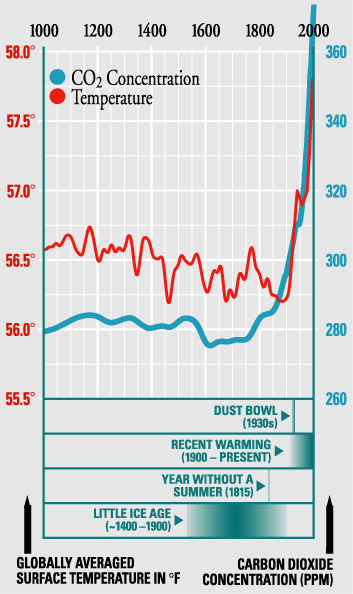
We can pay a little now, or pay much more later.
***************************************************************
A global commission will announce its finding on Tuesday that an ambitious series of measures to limit emissions would cost $4 trillion or so over the next 15 years, an increase of roughly 5 percent over the amount that would likely be spent anyway on new power plants, transit systems and other infrastructure.
When the secondary benefits of greener policies — like lower fuel costs, fewer premature deaths from air pollution and reduced medical bills — are taken into account, the changes might wind up saving money, according to the findings of the group, the Global Commission on the Economy and Climate.
The report seeks to upend some longstanding assumptions. It points out, for instance, that the cost of renewable energy has been plunging so fast that most previous analyses of its potential role are out of date. “Renewable energy sources have emerged with stunning and unexpected speed as large-scale, and increasingly economically viable, alternatives to fossil fuels,” the report said.
Perhaps the most important overall point of the report is that economic policies around the world are still aligned to favor fossil fuels, even though unchecked emissions from coal, oil and natural gas represent a potentially grave risk to future generations. “We have to get the prices right,” said Helen Mountford, who worked on the report and is the director of economics at the World Resources Institute, a Washington think tank.
Nowhere is this issue clearer, the commission said, than in the $600 billion a year spent to subsidize fossil fuels, more than six times the level of subsidies going to renewable energy.
http://www.nytimes.com/2014/09...av=top-news&_r=0
***************************************************************
A global commission will announce its finding on Tuesday that an ambitious series of measures to limit emissions would cost $4 trillion or so over the next 15 years, an increase of roughly 5 percent over the amount that would likely be spent anyway on new power plants, transit systems and other infrastructure.
When the secondary benefits of greener policies — like lower fuel costs, fewer premature deaths from air pollution and reduced medical bills — are taken into account, the changes might wind up saving money, according to the findings of the group, the Global Commission on the Economy and Climate.
The report seeks to upend some longstanding assumptions. It points out, for instance, that the cost of renewable energy has been plunging so fast that most previous analyses of its potential role are out of date. “Renewable energy sources have emerged with stunning and unexpected speed as large-scale, and increasingly economically viable, alternatives to fossil fuels,” the report said.
Perhaps the most important overall point of the report is that economic policies around the world are still aligned to favor fossil fuels, even though unchecked emissions from coal, oil and natural gas represent a potentially grave risk to future generations. “We have to get the prices right,” said Helen Mountford, who worked on the report and is the director of economics at the World Resources Institute, a Washington think tank.
Nowhere is this issue clearer, the commission said, than in the $600 billion a year spent to subsidize fossil fuels, more than six times the level of subsidies going to renewable energy.
http://www.nytimes.com/2014/09...av=top-news&_r=0