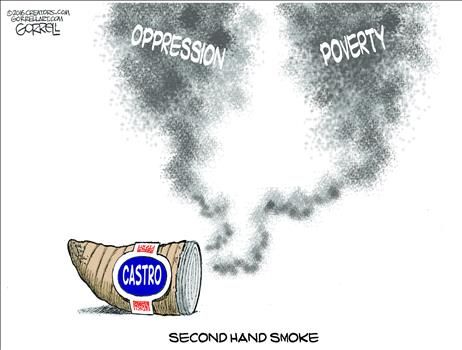
Fidel Castro is dead

It's good to be familiar with Cuban history, domination by the U.S., the Fulgencio Batista era, and the revolution in which hardly a shot was fired. It was a revolution between capital and labor, as with many other revolutions (notably not the American Revolution, however). In the aftermath of any revolution, not everyone is happy, especially those whose heads roll in the streets, or those whose capital is seized. In the case of the Cuban Revolution, as in all other capital versus labor revolutions, much of the surviving capital leaves. Labor celebrates, and then reality sets in. It is an old, old story to be repeated ad infinitum, probably in the U.S. sometime in the late 21st century. But not before I am gone, thankfully.

Behaving like adults is the right thing. I am happy with the Obama initiatives. It would be a bad mistake for the Trump administration to roll detente back. I hope they don't.
 
Last edited:
Some people will give up all their freedom just to get a little free healthcare.

better to die on your feet than live on your knees

Maybe in the early days, Cuba and the world would be better off if both Castros and all their kind died a few decades ago. Nobody should have that much power. The pathetic thing is, they need nothing anybody can give them, but can't prosper, for no good reason.
 
My reading of history is that people rebel against govt corruption and the decadence of their leaders. They don't want the govt sucking up all the money and taking away their freedoms while those connected to the power live lavish and corrupt lifestyles. Yes frequently money and the bankers are on the side of those in control... but the cause for the rebellion is oppostion to oppressive and corrupt govt.

The US is a model. No taxation without representation. The colonies did not want a remote leader making decrees and creating taxes that were not benefiting the people.

It's good to be familiar with Cuban history, domination by the U.S., the Fulgencio Batista era, and the revolution in which hardly a shot was fired. It was a revolution between capital and labor, as with many other revolutions (notably not the American Revolution, however). In the aftermath of any revolution, not everyone is happy, especially those whose heads roll in the streets, or those whose capital is seized. In the case of the Cuban Revolution, as in all other capital versus labor revolutions, much of the surviving capital leaves. Labor celebrates, and then reality sets in. It is an old, old story to be repeated ad infinitum, probably in the U.S. sometime in the late 21st century. But not before I am gone, thankfully.

Behaving like adults is the right thing. I am happy with the Obama initiatives. It would be a bad mistake for the Trump administration to roll detente back. I hope they don't.
 
Behaving like adults is the right thing. I am happy with the Obama initiatives. It would be a bad mistake for the Trump administration to roll detente back. I hope they don't.
Agreed. It's ludicrous Drumpf would even entertain it. Probably just telling his zealots the lies they want to hear.
 
Fidel Castro, Rest In Hell
JOHN PODHORETZ / NOV. 26, 2016


Cuba was a nation of 7 million people when Fidel Castro took it over on New Year’s Eve 1960, and with a tiny economy—although its economy was one of the strongest in Latin America. So why did this tin-pot totalitarian become one of the most important, most destructive, and most evil leaders in the world for more than half a century?

Cuba mattered or two reasons.

First, it emerged in the first year of Castro’s reign that Cuba was a client state of the Soviet Union and, since it sat 90 miles from Miami, an island of casinos and sugar suddenly posed both a tactical and strategic military risk to the continental United States. This wasn’t a matter of paranoid fantasy. It had only been 18 years since the near-destruction of the Pacific fleet in Pearl Harbor, which was American territory but not (obviously) attached to the continent—a wound as fresh, if not fresher given the sheer size of what was to follow, than 9/11 is to us today. More important, the various protocols and theories governing the Atomic/Nuclear Age designed to prevent the outbreak of a hyper-destructive war had yet to harden into place. (To give you one example, the most important early effort to imagine and plan against such a thing, Herman Kahn’s On Thermonuclear War, was published after Castro’s takeover in 1960.)

The idea of an active enemy whose patron possessed nukes was terrifying, so much so that the inconsequential island became one of the two central foreign-policy concerns of the Kennedy administration and the epicenter of the most confrontational moment between the U.S. and the Soviet Union in the 45-year history of the Cold War. After Kennedy’s assassination, which was directly related to his Cuba policy, Cuba would never again play so key a role in American life or foreign policy—but Castro himself would serve both as an example for and a tool of the export of communism to the Third World, and a disruptive force throughout the Americas specifically.

Second, Castro mattered because he was an enemy of the United States—and as such quickly became the darling of intellectual and ideological forces in the West who actively wished harm on the United States. In their hunger to celebrate any counterexample to the American experiment, these haters of liberal freedoms turned a blind eye then (and, in the case of British Labour Party leader Jeremy Corbyn, continue to turn a blind eye now) to the Gulag nation Castro was systematically constructing. As long as he was a foe of the United States, he was a hero to them.

Their despicable apologetics for totalitarianism will be studied in the future the way bacteria and viruses are studied, to break down their workings and come up with treatments and vaccines to prevent them from ever infecting the world’s body politic again.

As for Castro himself, today is a day to wish devoutly that there is a Hell.

https://www.commentarymagazine.com/foreign-policy/south-and-central-america/fidel-castro-rip/
 
Last edited:
Farewell to Cuba’s brutal Big Brother

By Carlos Eire November 26
Carlos Eire is an author and the T.L. Riggs Professor of History and Religious Studies at Yale University.

One of the most brutal dictators in modern history has just died. Oddly enough, some will mourn his passing, and many an obituary will praise him. Millions of Cubans who have been waiting impatiently for this moment for more than half a century will simply ponder his crimes and recall the pain and suffering he caused.

Why this discrepancy? Because deceit was one of Fidel Castro’s greatest talents, and gullibility is one of the world’s greatest frailties. A genius at myth-making, Castro relied on the human thirst for myths and heroes. His lies were beautiful, and so appealing. According to Castro and to his propagandists, the so-called revolution was not about creating a repressive totalitarian state and securing his rule as an absolute monarch, but rather about eliminating illiteracy, poverty, racism, class differences and every other ill known to humankind. This bold lie became believable, thanks largely to Castro’s incessant boasting about free schools and medical care, which made his myth of the benevolent utopian revolution irresistible to many of the world’s poor.

Many intellectuals, journalists and educated people in the First World fell for this myth, too — though they would have been among the first to be jailed or killed by Castro in his own realm — and their assumptions acquired an intensity similar to that of religious convictions. Pointing out to such believers that Castro imprisoned, tortured and murdered thousands more of his own people than any other Latin American dictator was usually futile. His well-documented cruelty made little difference, even when acknowledged, for he was judged according to some aberrant ethical code that defied logic.

This Kafkaesque moral disequilibrium had a touch of magical realism, for sure, as outrageously implausible as anything that Castro’s close friend Gabriel García Márquez could dream up. For instance, in 1998, around the same time that Chile’s ruler Augusto Pinochet was arrested in London for his crimes against humanity, Cuba’s self-anointed “maximum leader” visited Spain with ample fanfare, unmolested, even though his human rights abuses dwarfed those of Pinochet.

Even worse, whenever Castro traveled abroad, many swooned in his presence. In 1995, when he came to New York to speak at the United Nations, many of the leading lights of that city jostled so intently for a chance to meet with him at media mogul Mort Zuckerman’s triplex penthouse on Fifth Avenue that Time magazine declared “Fidel Takes Manhattan!” Not to be outdone, Newsweek called Castro “The Hottest Ticket in Manhattan.” None of the American elites who hobnobbed with Castro that day seemed to care that he had put nuclear weapons to their heads in 1962.

If this were a just world, 13 facts would be etched on Castro’s tombstone and highlighted in every obituary, as bullet points — a fitting metaphor for someone who used firing squads to murder thousands of his own people.

●He turned Cuba into a colony of the Soviet Union and nearly caused a nuclear holocaust.

●He sponsored terrorism wherever he could and allied himself with many of the worst dictators on earth.

●He was responsible for so many thousands of executions and disappearances in Cuba that a precise number is hard to reckon.

●He brooked no dissent and built concentration camps and prisons at an unprecedented rate, filling them to capacity, incarcerating a higher percentage of his own people than most other modern dictators, including Stalin.

●He condoned and encouraged torture and extrajudicial killings.

●He forced nearly 20 percent of his people into exile, and prompted thousands to meet their deaths at sea, unseen and uncounted, while fleeing from him in crude vessels.

●He claimed all property for himself and his henchmen, strangled food production and impoverished the vast majority of his people.

●He outlawed private enterprise and labor unions, wiped out Cuba’s large middle class and turned Cubans into slaves of the state.

●He persecuted gay people and tried to eradicate religion.

●He censored all means of expression and communication.

●He established a fraudulent school system that provided indoctrination rather than education, and created a two-tier health-care system, with inferior medical care for the majority of Cubans and superior care for himself and his oligarchy, and then claimed that all his repressive measures were absolutely necessary to ensure the survival of these two ostensibly “free” social welfare projects.

●He turned Cuba into a labyrinth of ruins and established an apartheid society in which millions of foreign visitors enjoyed rights and privileges forbidden to his people.

●He never apologized for any of his crimes and never stood trial for them.

In sum, Fidel Castro was the spitting image of Big Brother in George Orwell’s novel “1984.” So, adiós, Big Brother, king of all Cuban nightmares. And may your successor, Little Brother, soon slide off the bloody throne bequeathed to him.

https://www.washingtonpost.com/opin...efa856caf2a_story.html?utm_term=.da017a5c8170

 
bg112816dAPR20161127024510.jpg
 
Jem . . . you need to read more piezoe.


The US is a model. No taxation without representation.


How Much Tax Do America's Undocumented Immigrants Actually Pay?


Since the New York Times reported that Donald Trump may have avoided paying federal income taxes for 18 years, the Republican presidential candidate has defended himself, saying he “brilliantly used” U.S. tax rules to his advantage to pay as little as legally possible. Over the years, Trump has consistently blasted others for not paying their fair share of taxes. Barack Obama, Amazon boss Jeff Bezos and America’s undocumented immigrants all found themselves in Trump’s cross-hairs at one time or another regarding tax payments.

Trump has claimed that the latter group, undocumented immigrants, were getting $4.2 billion in tax credits, a statement that was later found to be misleading. In fact, America’s undocumented immigrants likely pay more in taxes than Donald Trump. According to a report from The Institute on Taxation & Economic Policy (ITEP), they pay a hefty amount of state and local tax, just like other people living in the United States. Collectively, America’s undocumented immigrants pay an estimated $11.64 billion in state and local taxes every year with at least 50 percent of undocumented immigrant households filing tax returns using Individual Tax Identification Numbers.

Many who do not file tax returns still have taxes deducted from their pay checks. Out of that $11.64 billion total, undocumented immigrants pay $6.9 billion in sales and excise taxes, $3.6 billion in property taxes and about $1.1 billion in personal income taxes. ITEP estimated that if America’s 11 million undocumented immigrants were granted citizenship allowing them to work legally, current state and tax contributions would be boosted by over $2.1 billion a year.


Jem . . . you need to read more piezoe.


How Much Tax Do America's Undocumented Immigrants Actually Pay?


Since the New York Times reported that Donald Trump may have avoided paying federal income taxes for 18 years, the Republican presidential candidate has defended himself, saying he “brilliantly used” U.S. tax rules to his advantage to pay as little as legally possible. Over the years, Trump has consistently blasted others for not paying their fair share of taxes. Barack Obama, Amazon boss Jeff Bezos and America’s undocumented immigrants all found themselves in Trump’s cross-hairs at one time or another regarding tax payments.

Trump has claimed that the latter group, undocumented immigrants, were getting $4.2 billion in tax credits, a statement that was later found to be misleading. In fact, America’s undocumented immigrants likely pay more in taxes than Donald Trump. According to a report from The Institute on Taxation & Economic Policy (ITEP), they pay a hefty amount of state and local tax, just like other people living in the United States. Collectively, America’s undocumented immigrants pay an estimated $11.64 billion in state and local taxes every year with at least 50 percent of undocumented immigrant households filing tax returns using Individual Tax Identification Numbers.

Many who do not file tax returns still have taxes deducted from their pay checks. Out of that $11.64 billion total, undocumented immigrants pay $6.9 billion in sales and excise taxes, $3.6 billion in property taxes and about $1.1 billion in personal income taxes. ITEP estimated that if America’s 11 million undocumented immigrants were granted citizenship allowing them to work legally, current state and tax contributions would be boosted by over $2.1 billion a year.


So explain to us again how much illigel immigrants pay in federal taxes compared to the tax credits they receive.

Explain to us again how many billlions illegal immigrants draw in public benefits.

The number is much greater than the 11 Billion or so that illegal immigrants pay in sales taxes, etc.
 
People who praise Castro have to be the most ignorant people in the world. Just see what Venezuela is today, thanks to Castro's influence. Simply abhorrent.

https://www.washingtonpost.com/opin...2b15787add0_story.html?utm_term=.4f6f6789efec

Farewell to Cuba’s brutal Big Brother

By Carlos Eire November 26
Carlos Eire is an author and the T.L. Riggs Professor of History and Religious Studies at Yale University.

One of the most brutal dictators in modern history has just died. Oddly enough, some will mourn his passing, and many an obituary will praise him. Millions of Cubans who have been waiting impatiently for this moment for more than half a century will simply ponder his crimes and recall the pain and suffering he caused.

Why this discrepancy? Because deceit was one of Fidel Castro’s greatest talents, and gullibility is one of the world’s greatest frailties. A genius at myth-making, Castro relied on the human thirst for myths and heroes. His lies were beautiful, and so appealing. According to Castro and to his propagandists, the so-called revolution was not about creating a repressive totalitarian state and securing his rule as an absolute monarch, but rather about eliminating illiteracy, poverty, racism, class differences and every other ill known to humankind. This bold lie became believable, thanks largely to Castro’s incessant boasting about free schools and medical care, which made his myth of the benevolent utopian revolution irresistible to many of the world’s poor.

Many intellectuals, journalists and educated people in the First World fell for this myth, too — though they would have been among the first to be jailed or killed by Castro in his own realm — and their assumptions acquired an intensity similar to that of religious convictions. Pointing out to such believers that Castro imprisoned, tortured and murdered thousands more of his own people than any other Latin American dictator was usually futile. His well-documented cruelty made little difference, even when acknowledged, for he was judged according to some aberrant ethical code that defied logic.

This Kafkaesque moral disequilibrium had a touch of magical realism, for sure, as outrageously implausible as anything that Castro’s close friend Gabriel García Márquez could dream up. For instance, in 1998, around the same time that Chile’s ruler Augusto Pinochet was arrested in London for his crimes against humanity, Cuba’s self-anointed “maximum leader” visited Spain with ample fanfare, unmolested, even though his human rights abuses dwarfed those of Pinochet.

Even worse, whenever Castro traveled abroad, many swooned in his presence. In 1995, when he came to New York to speak at the United Nations, many of the leading lights of that city jostled so intently for a chance to meet with him at media mogul Mort Zuckerman’s triplex penthouse on Fifth Avenue that Time magazine declared “Fidel Takes Manhattan!” Not to be outdone, Newsweek called Castro “The Hottest Ticket in Manhattan.” None of the American elites who hobnobbed with Castro that day seemed to care that he had put nuclear weapons to their heads in 1962.

If this were a just world, 13 facts would be etched on Castro’s tombstone and highlighted in every obituary, as bullet points — a fitting metaphor for someone who used firing squads to murder thousands of his own people.

●He turned Cuba into a colony of the Soviet Union and nearly caused a nuclear holocaust.

●He sponsored terrorism wherever he could and allied himself with many of the worst dictators on earth.

●He was responsible for so many thousands of executions and disappearances in Cuba that a precise number is hard to reckon.

●He brooked no dissent and built concentration camps and prisons at an unprecedented rate, filling them to capacity, incarcerating a higher percentage of his own people than most other modern dictators, including Stalin.

●He condoned and encouraged torture and extrajudicial killings.

●He forced nearly 20 percent of his people into exile, and prompted thousands to meet their deaths at sea, unseen and uncounted, while fleeing from him in crude vessels.

●He claimed all property for himself and his henchmen, strangled food production and impoverished the vast majority of his people.

●He outlawed private enterprise and labor unions, wiped out Cuba’s large middle class and turned Cubans into slaves of the state.

●He persecuted gay people and tried to eradicate religion.

●He censored all means of expression and communication.

●He established a fraudulent school system that provided indoctrination rather than education, and created a two-tier health-care system, with inferior medical care for the majority of Cubans and superior care for himself and his oligarchy, and then claimed that all his repressive measures were absolutely necessary to ensure the survival of these two ostensibly “free” social welfare projects.

●He turned Cuba into a labyrinth of ruins and established an apartheid society in which millions of foreign visitors enjoyed rights and privileges forbidden to his people.

●He never apologized for any of his crimes and never stood trial for them.

In sum, Fidel Castro was the spitting image of Big Brother in George Orwell’s novel “1984.” So, adiós, Big Brother, king of all Cuban nightmares. And may your successor, Little Brother, soon slide off the bloody throne bequeathed to him.

https://www.washingtonpost.com/opin...efa856caf2a_story.html?utm_term=.da017a5c8170
 
Back
Top