Malibu Grand Prix was the brainchild of Ron Cameron, who’d earned his first million in the stock market while he was still in college. Like a lot of rich young men, Cameron amassed a collection of high-performance toys—boats, bikes, and sundry off-road vehicles—that constantly needed attention, so he hired a moonlighting Pasadena firefighter, Jack Long, to maintain them. A
Wall Street Journal article about Grand Prix of America encouraged Cameron to consider opening a track of his own, and he asked Long if he could build a viable car.
“I can build anything,” Long said. “But what are you going to do about getting gas?”
This was during the fuel crisis, when cars idled for hours at gas stations. But Cameron wasn’t worried.
“Hell,” he said, “they’ll be having so much fun, they’ll bring their own gas!”
Cameron put together a prospectus and had no trouble finding investors. “Ron had one of those dynamic personalities,” says David Bursteen, who joined the company a year after it opened and eventually rose to vice president of marketing. “He could get anybody excited about anything.” To seal the deal, Cameron arranged test drives along the circular driveway in front of his mansion in Malibu.
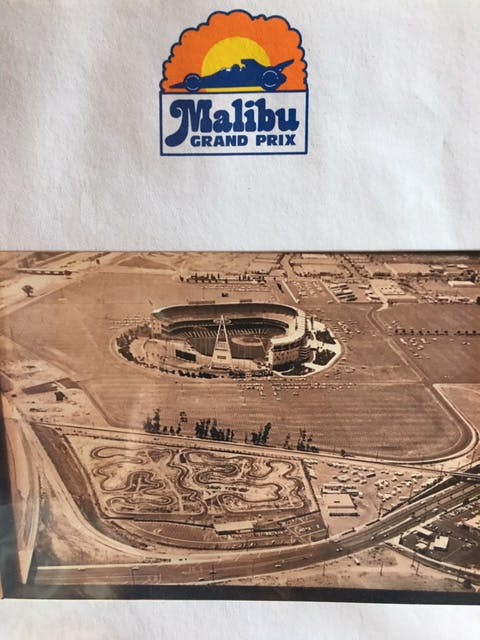
Cameron raised $250,000 in seed money from local businessmen and leased space in the parking lot of Anaheim Stadium, home of the Los Angeles Angels baseball team. He then commissioned Long to design a car to be built in the nearby shop of Bill Stroppe, who ran Ford’s West Coast racing operation. After the initial production run of 24 cars, Long set up a dedicated Malibu Grand Prix operation in Anaheim and, later, a much larger one in Woodland Hills, where a crew of 20 cranked out hundreds of cars.
the Jack Long Collection
Over the next four decades, Malibu Grand Prix would be repeatedly resold, reshaped, and rebranded. Along the way, the company developed new cars and collected a ragtag menagerie of models from failed racetrack franchises. Cars were later modified as components broke, suppliers changed, and tastes shifted. Today, all of these mismatched cars are often grouped generically—and misleadingly—under the Malibu Grand Prix umbrella.
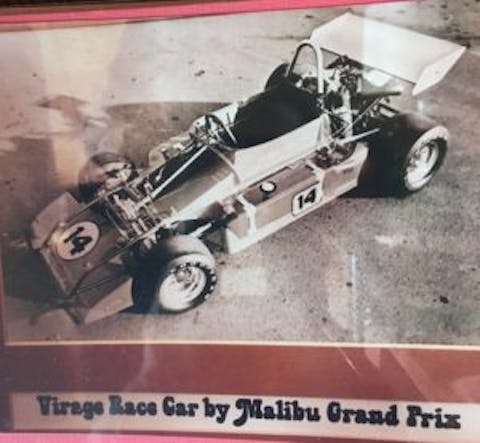
The original Malibu Grand Prix car was dubbed the Virage—a sophisticated name (meaning “curve” in French) for a workmanlike but robust piece of shade-tree engineering. Although the general idea was to create a car that looked like a two-thirds-scale version of an F1 or Indy car, Long’s primary concern was making sure it could withstand what promised to be brutal wear and tear, so the Virage was based largely on proven technology and built like a tank.
A conventional ladder-type frame fabricated out of round 4130 chromoly tubing served as a stout foundation. The front suspension was inspired by the twin I-beam layout found on Ford F-Series pickups, while the rear end featured a live axle located by trailing arms. Long went with discs brakes at the front and drums at the rear. Although the tractor-style worm-and-gear steering was vague, Goodyear slicks mounted on 10-inch wheels generated unexpectedly impressive cornering loads.
The drivetrain was built around a single-rotor Fichtel & Sachs rotary engine that, like the drive belts, were often used in snowmobiles. (Later, it was superseded by slightly more powerful and much more reliable two-stroke and then four-stroke motors.) The Dana rear end incorporated a centrifugal clutch typically found in golf carts. With a hammerhead nose and a large, freestanding rear wing, the fiberglass bodywork resembled the Formula 1 March 751 car and A.J. Foyt Coyote Indy car of the day.
The Virage weighed roughly 650 pounds and made 28 horsepower, which translated into a decent power-to-weight ratio. To minimize risk, Long limited speed in two ways—first, by creating serpentine circuits with no extended straightaways, and second, by designing the Ackerman steering geometry to promote understeer. Lot and lots of understeer.
“Every car was different, but all of them pushed like pigs,” says my friend Tommy Browne, who used Malibu Grand Prix to transition from motocross to race cars. “So what you’d do was stick seat cushions behind you to push you forward in the cockpit and get more weight on the front wheels. That worked so well that I tried stuffing pillows on each side of my legs so I wasn’t flopping around the cockpit. When I got out of the car, my leg was numb—for two weeks! Turned out I’d pinched my sciatic nerve.”
Thanks to its tight performance window, the Virage was surprisingly tricky to drive quickly. “You had to know how to pick the right car,” Kendall says. “Some of them had bad clutches. Some had better brakes. Because of the suspension travel and the open diff, you couldn’t pitch the car like a go-kart, and if you overdrove it like a race car driver, you’d be slow. It was tough for the open-wheel guys. I think my showroom stock experience really helped.”
Setting a quick lap time required talent, technique, determination, and seat time. Lots and lots of seat time. For hard-core would-be racers with no other outlet, Malibu Grand Prix became an obsession. (Ask me how I know this.)
There are plenty of stories of guys—and they were always guys—spending $1000 a month, looking for elusive tenths of seconds. <<<< VZ
Barry Goldstein was a thirtysomething CPA when he got hooked. “I would leave work early—I was the boss, so that was easy—and I’d drive 30, 40, 50 laps before I went home to eat dinner,” he recalls. “There was a special car they’d pull out for me, and I had a custom fiberglass seat that they would fit in the cockpit. I probably did, on average, 300 laps a week.” Today, Goldstein tracks a Porsche Cayman with a built 3.8-liter 911 motor. But his claim to motorsports fame is that he used to hold the lap record at the Malibu Grand Prix in Northridge.