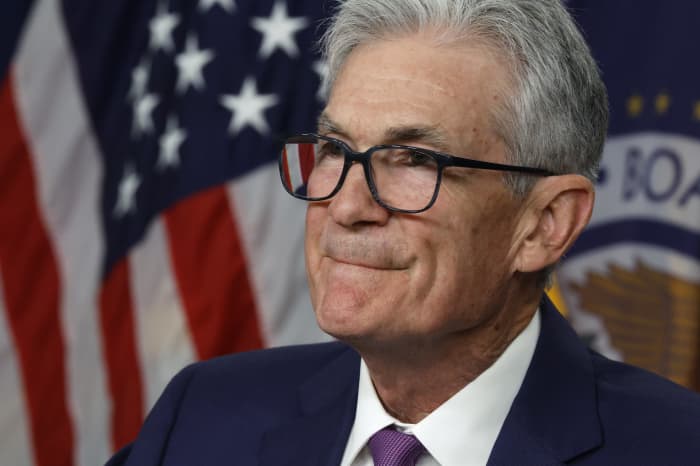
"Fed Speak"

LOL so then moooooooove already.
To where? My friend was contemplating on moving out of Silicon Valley to Texas. He found out Texas offered cheaper rent, cheaper food price, as well as cheaper salary. So in the end, he decided to stay put because California at least offered better weather. :)
 
To where? My friend was contemplating on moving out of Silicon Valley to Texas. He found out Texas offered cheaper rent, cheaper food price, as well as cheaper salary. So in the end, he decided to stay put because California at least offered better weather. :)
Cheaper salary, how could he pass that up?
 
favicons
reuters.com
Fed officials mull whether rates high enough as inflation expectations jump
May. 10th, 2024

NEW ORLEANS, May 10 (Reuters) - Debate over whether U.S. interest rates are high enough deepened among Federal Reserve officials this week, and may be stoked further after a key survey showed a jump in consumers' inflation expectations.

"There are ... important upside risks to inflation that are on my mind, and I think there's also uncertainties about how restrictive policy is and whether it's sufficiently restrictive" to return inflation to the U.S. central bank's 2% target, Dallas Fed President Lorie Logan said at a Louisiana Bankers Association conference in New Orleans.

"I think it's just too early to think about cutting rates ... I think I need to see some of these uncertainties resolved about the path that we're on, and we need to remain very flexible," Logan said, though she did not directly address whether she feels the Fed may need to again raise its benchmark policy rate from the 5.25%-5.50% range that has been maintained since July.

In on appearance on CNBC, Minneapolis Fed President Neel Kashkari said he's in a "wait-and-see mode" in regards to what's next for central bank policy and the Fed can stay at current rates "as long as needed" to bring inflation down. But he added there is a "high" bar to concluding that higher rates are needed to cool inflation.

Many U.S. central bank officials, including Fed Chair Jerome Powell, have said they still think further rate hikes will prove unnecessary.

In an interview with Reuters, Atlanta Fed President Raphael Bostic said he still thought inflation was likely to slow under the current monetary policy and allow the central bank to begin reducing its policy rate in 2024 - though perhaps by only a quarter of a percentage point and not until the final months of the year.
"I still have that belief," Bostic said in the interview on Thursday, though "it is going to take some time" to be sure inflation is set to fall.

But the outlook is in flux after three months in which inflation stopped improving.

Data on Friday provided a further jolt in the wrong direction. Year-ahead inflation expectations in the University of Michigan's survey of consumer sentiment rose from 3.2% to 3.5% in May, the highest level since November, and longer-term expectations ticked higher as well.
While a month's reversal may not be significant, if it continues it would challenge the Fed's current assessment that expectations are "anchored" - and add to arguments made by Logan and some others that rates may not be high enough to finish the inflation fight.

Anchored expectations are considered by Fed officials as an important sign of the central bank's credibility, and an aid in bringing inflation back to 2%.

'WALKING A TIGHTROPE'
Chicago Fed President Austan Goolsbee, in an appearance at the Economic Club of Minnesota, said a drift higher in inflation expectations "bodes awful" for further inflation progress, but the immediate results were not a concern.

"There is not much evidence that inflation is stalling out," Goolsbee said, adding that he regarded current policy as "relatively restrictive."

The University of Michigan data was released after Logan began her remarks, and she did not address it.

The survey also showed overall consumer sentiment nose-diving, a confusing signal that could point to lower consumer spending in the months ahead even as households expect higher inflation.

"The Fed is walking a tightrope as they balance both mandates of price stability and growth," Jeffrey Roach, chief economist for LPL Financial, wrote. "Although it's not our base case, we do see rising risks of stagflation," in which growth slows and price increases remain strong.

The Fed's preferred measure of inflation, the personal consumption expenditures price index, rose at a 2.7% annual rate in March, with little progress shown in the first three months of the year.

In an essay published earlier this week, Kashkari, opens new tab also raised the possibility that rates may not be restrictive enough, given the continued strength of the U.S. economy, particularly the housing market.
"It is hard for me to explain the robust economic activity that has persisted," Kashkari said. "It raises questions about how restrictive policy really is."

In contrast, San Francisco Fed President Mary Daly, in a taped interview on Thursday, said it is possible the "neutral" interest rate for the U.S. had risen a bit, implying that any given level of the benchmark policy rate would lean less on economic activity than it would otherwise.

But she said the solution for the Fed in that case would be to keep its policy rate at the current level for longer.

Even if the neutral rate is higher "we still have restrictive policy, which is what we want," Daly said. "But it might take more time to ... bring inflation down."

The Fed is fighting inflationary fiscal policy with monetary policy. It's like bringing a pea shooter to a knife fight. Of course a 5.25-5.50 policy rate is too low to force down inflation by much. The current policy rate is the same as Larry Summers suggested, at the outset, would be necessary. (Likely Phillips curve* inspired.) At the time, I was quite certain that Summers was underestimating what it would take to cause a recession in the face of large fiscal stimulus.

You can either do this slowly or with more urgency. Quickly, by the monetary policy route, would take close to a double digit policy rate, double what Summers suggested, and double pain plus a year or more... There are more effective options, and probably better. The most powerful are all fiscal (tax rates!). These effective measures are politically unpopular or would step on the wrong toes, as seen from the perspective of those to whom the toes belong, i.e., campaign contributors.
_________________
*https://www.stlouisfed.org/open-vault/2020/january/what-is-phillips-curve-why-flattened
 
favicons
marketwatch.com
‘Various’ Fed officials said they were willing to hike interest rates if needed, minutes show
May 22, 2024
im-93793959


Federal Reserve officials indicated a willingness to raise interest rates again if inflation doesn’t cool off further, according to minutes of the April-May meeting released Wednesday.

“Various participants mentioned a willingness to tighten policy further should risks to inflation materialize in a way that such an action became appropriate,” the minutes said.

The Fed released a summary of their April 30-May 1 closed-door discussion three weeks after the meeting.

At the meeting, the Fed voted to keep its benchmark interest rate in a range of 5.25%-5.5%, where it has been since last July.

In their discussion, Fed officials expressed dismay about “disappointing” inflation readings, saying the most recent data “pointed to more persistence in inflation in coming months.”

Kathy Bostjancic, chief economist at Nationwide, said the Fed has gotten “more tentative” about starting to cut interest rates.

“The minutes not surprisingly showed that after the faster-than-expected inflation readings in the first quarter, Fed officials’ confidence levels had been shaken,” Bostjancic said.

She said the Fed could still cut rates this year, if inflation does not reaccelerate and the economy softens. The earliest the Fed could move would be at the September meeting, which is her forecast, Bostjancic added.

Minutes show Fed officials fretted that the cost of housing hadn’t slowed as much as they expected. Nor had the cost of labor eased as much as they were hoping. Those are two of the biggest sources of current U.S. inflation.

What’s more, a steadily growing U.S., economy could keep consumer demand for goods and services sufficiently high to keep prices somewhat elevated, some Fed officials suggested.

As a result, Fed officials “assessed that it would take longer than previously anticipated for them to gain greater confidence that inflation would move” toward their 2% goal. Still, Fed officials said they expected the economy to grow at a slower pace and help bring supply and demand back into better balance.

Since that decision was announced, Fed officials have stressed in their public comments the need to be patient and keep rates steady for a longer period of time to ensure that trend inflation remains on the path back to the 2% target. This sentiment was reflected in the minutes. The need for patience in cutting rates stemmed from hot inflation readings between January and March.

What wasn’t clear from Fed speeches, and was revealed in the minutes, is that these hot inflation prints caused “many” officials to worry that the level of the Fed’s benchmark rate might not be high enough to cool inflation.

“Although monetary policy was seen as restrictive, many participants commented on their uncertainty about the degree of restrictiveness,” the minutes said.

This uncertainty stemmed from the possibility that high interest rates may be having smaller effects than in the past, or that the so-called “neutral” rate of interest might be higher than previously thought, the minutes said.

Officials also wondered whether the economy’s trend growth rate was lower than estimated. That means that there is some worry that the economy could be overheating, said Bostjancic.

In their discussion of upcoming policy moves, officials talked about holding rates for longer should inflation remain sticky or cutting them in the event of unexpected weakening in the labor market.

This was a more hawkish stance than at the prior Fed meeting in March, when officials ”judged that the policy rate was likely at its peak for this tightening cycle, and almost all participants judged that it would be appropriate to move policy to a less restrictive stance at some point this year if the economy evolved broadly as they expected. ”

Since the May meeting, the April CPI data was released and was seen by many Fed officials as a relief after the strong inflation readings in the first quarter.

Stocks DJIA SPX dropped after the minutes were released. The yield on the 10-year Treasury note BX:TMUBMUSD10Y didn’t move very much. It has been trading below 5% since shortly after Fed Chairman Jerome Powell’s May 1 press conference, which was seen as dovish.
 
“The minutes not surprisingly showed that after the faster-than-expected inflation readings in the first quarter, Fed officials’ confidence levels had been shaken,” Bostjancic said.

She said the Fed could still cut rates this year, if inflation does not reaccelerate and the economy softens. The earliest the Fed could move would be at the September meeting, which is her forecast, Bostjancic added.


But all 3 major indexes are registering new ATH on a daily basis, so what the hell does it matter whether Fed cuts the rate or not? :rolleyes: I mean, do I really care? No. What about you? Do you care?
 
Looks like the Fed is just ignoring all the fiscal stimulus from the IRA. They don't seem interested anymore in raising rates. Even with that 275K NFP print I doubt they'll do anything. The labor shortage will not abate anytime soon so if you are looking for a drop in NFP numbers you'll be waiting for awhile.

The most surprising thing to me listening to the prognosticators is they all believe housing costs will just magically go back to the previous trend. That is delusional thinking due to the ever rising tide of NIMBYs. Lets face it the local politicians will never go against the NIMBYs since the politicians themselves own real estate. Its the same problem in the rest of the Anglosphere. Toronto is an absolute joke where real estate prices are 10X median salary.
 
Never like to pay attention to these news policies, adhere to their own trading philosophy, with "0.01 hands "can basically achieve stable profits, the policy impact is difficult to estimate.
 
Back
Top