Fear And Dread Of Deflation—-The Keynesian Big Lie At Work

I'm sure your food price data is valid. You still seem to me to be flirting with the idea that "a little" deflation would not be so bad. As long as we can agree that deflation is negative inflation in the overall economy and not just some price reductions in a segment of the economy, oil for example, we can discuss this on the same wavelength.

It does seem to me that the official inflation figures underestimate the inflation that most of us experience in our everyday lives. It is a fact that the government has revised its methods of computing various measures of inflation in recent decades. These revisions have invariably resulted in a lower, official inflation rate used to adjust inflation indexed treasuries and entitlements. Cutting adjustments of entitlements and interest on treasuries isn't as evil as it first sounds, because there is feedback into the economy that helps hold inflation in check.

One of the changes has been the introduction of hedonics. That's perhaps the most controversial change. Also, when baskets of good and services are used to compute an inflation measure the components are weighted; changes in the prices of some components counting much more than others. You can access these weighting factors at the Bureau of Labor Statistics website. An estimate of the CPI as it would have been computed in 1986 is available at shadowstatstics.com. The 1986 methods produce an inflation rate that is about 3 to 4% higher than the CPI estimated by current methods.

A good argument can be made, I won't make it here, for the 1986 method producing inflation rates that correspond better to the inflation actually experienced by consumers. I have never known an economist, however, who seems interested in my experience with sticker shock at the grocery store. The newer methods produce numbers just as useful to economists as the older methods, but have the advantage of helping to control inflation via feedback from inflation indexed entitlements.

Clearly, the estimation of inflation in the prices of goods and services in the overall economy is an inexact undertaking. Using current methods, the Fed economists decide what they think is the best estimate for their purposes. They are aware of flaws in the inflation estimates and the difficulty of estimating the effects of changes in monetary policy, so they have built in a safety factor. And that is why you see the inflation target set at 2% and not zero %. It isn't that a two percent inflation rate is better than a one percent inflation rate; it is that 2% is less dangerous than a lower target! The Fed believes that deflation could have an extremely deleterious affect on the U.S. economy. Consequently, of the two evils, mild inflation vs. deflation, they consider the former to be a much lesser evil. They use very low core inflation, and other measures too, as a warning that deflation may be on the horizon. They want to lessen the odds of deflation by choosing a target inflation rate well away from zero. They chose 2%, and my guess is that that is not an arbitrary number, but one based on economic research and error estimates for the inflation measures.

Just having prices in some parts of the economy rising or falling is not necessarily what concerns the Fed economists. Their concern is what is happening in the economy overall, in other words, the macro view. If the core inflation rate, everything but food and energy, falls below 1%, they will start to get concerned about the possibility of deflation, i.e., a negative inflation rate, in the overall economy. The Fed's view, which I share, is backed up by past experience and a vast body of economic research and studies.

If you are one that believes "a little deflation" would not be so bad, then I would say the correctness of you position depends on how much is "a little", for how long, and what measures you would take to prevent slipping further into deflation. Would you, Fed like, try to control the deflation rate at say 2%. You could try monetary policy. Even were that possible, you'd then have real interest rates on public and private debt not merely rising, but rising compounded over time! Talk about debt trauma! Yikes!

The U.S. is a nation of borrowers and spenders -- through a constant barrage of advertising, and capitalist hucksterism in general, we have unconsciously become psychologically well-suited to borrowing and spending. Notwithstanding the impossibility of infinite growth -- this is a pattern that fuels growth and innovation in an economy. Among fully developed nations, the U.S. economy consistently leads in growth and innovation. It takes credit to grease the American economy's wheels. Significant deflation in the U.S. economy would be an unmitigated disaster!

The U.S. flirted briefly with deflation in late 2008 to early 2009, but the Fed stepped in with extraordinary measures to rescue our economy. And thank goodness for that!

It isn't until you get to the last third of your post do you begin to fall off the tracks, in my opinion. First, I had a nice chuckle when you said that the Fed's view is backed up by past experience and a vast body of economic research and studies. That's quite amusing. This forum allows 10,000 characters per post, and I wouldn't be able to post all of the prediction FAILs and missed bubbles, housing crises, etc. All the things the Fed is paid to foresee with their vast experience and data. Yet, run-of-the-mill traders and economists see things clearer than they do.

When I say "a little deflation", I'm referring to the natural business cycle. The cycle that has been interrupted by massive central bank and government meddling. If the cycle were allowed to auto correct, and interest rates were not artificially altered, and bubbles weren't allowed to be created - or were deflated when spotted - we'd have short periods of deflation before growth took off again. But they don't. They try to go against the laws of nature until the walls come crashing down and real deflation is a risk. They only exacerbate this, they don't prevent it or mitigate it.

The US is a nation of borrowers and spenders because we have essentially punished those fiscally responsible (savers) and rewarded all those who took risky bets with high leverage. We've enabled the behavior and the economy we are stuck with in no different manner than a parent enables poor child behavior. So why should we be shocked when people go all-in on leverage, borrow to the hilt and just walk away when everything comes crashing down? Why should we be surprised when pension funds - who have relied on good, stable rates to provide returns have no choice but to throw their money into the casino to get some yield? Who enables all this? Your precious Fed and your beloved Big, Bloated Government.

The Us flirted briefly with deflation in late 2008 as a result of a decade or so of bad Fed/Government practice and bubble creation. Then, they compounded their error by not letting the market clear itself. The result is that deflation is coming no matter what they do.

And they know it.
 
10-year yield falls to 20-month low on deflation worries, GDP

By Joseph Adinolfi
Published: Jan 30, 2015 10:47 a.m. ET

"30-year yield hits all-time low

"U.S. GDP was a weaker than expected in the fourth quarter, driving flows into Treasurys.

"NEW YORK (MarketWatch) — The 10-year yield fell to its lowest level since May 2013 Friday as month-end buying, worries about deflation in Europe and a weaker-than-expected reading on fourth-quarter gross domestic product growth drove investors into the safety of the bond market.

"The yield on the 10-year Treasury TMUBMUSD10Y, -4.38% was down 7.3 basis points to 1.680%, according to Tradeweb, while the yield on the 30-year Treasury hit an all-time low, down 7.5 basis points to 2.243%.

"A provisional reading on the eurozone’s rate of inflation in January slipped further into negative territory early Friday, driving investors into European and U.S. debt. The market’s worries about deflation and lagging growth were further stoked by a weak reading on U.S. gross domestic product growth.

"U.S. GDP grew by 2.6% in the fourth quarter, down from 5% in the third quarter, according to a preliminary government estimate released by the Commerce Department. Economists surveyed by MarketWatch had predicted 3.2% growth.

"The yield on the German 10-year bund TMBMKDE-10Y, -15.45% was 1.5 basis points lower to 0.341%.

"Treasury yields have been pushing lower since the new year began, as negative yields in Europe and worries about the global economy sinking into deflation increase the appeal of U.S. debt as a haven for investors."

http://www.marketwatch.com/story/10...month-low-on-deflation-worries-gdp-2015-01-30
 
10-year yield falls to 20-month low on deflation worries, GDP

By Joseph Adinolfi
Published: Jan 30, 2015 10:47 a.m. ET

"30-year yield hits all-time low

"U.S. GDP was a weaker than expected in the fourth quarter, driving flows into Treasurys.

"NEW YORK (MarketWatch) — The 10-year yield fell to its lowest level since May 2013 Friday as month-end buying, worries about deflation in Europe and a weaker-than-expected reading on fourth-quarter gross domestic product growth drove investors into the safety of the bond market.

"The yield on the 10-year Treasury TMUBMUSD10Y, -4.38% was down 7.3 basis points to 1.680%, according to Tradeweb, while the yield on the 30-year Treasury hit an all-time low, down 7.5 basis points to 2.243%.

"A provisional reading on the eurozone’s rate of inflation in January slipped further into negative territory early Friday, driving investors into European and U.S. debt. The market’s worries about deflation and lagging growth were further stoked by a weak reading on U.S. gross domestic product growth.

"U.S. GDP grew by 2.6% in the fourth quarter, down from 5% in the third quarter, according to a preliminary government estimate released by the Commerce Department. Economists surveyed by MarketWatch had predicted 3.2% growth.

"The yield on the German 10-year bund TMBMKDE-10Y, -15.45% was 1.5 basis points lower to 0.341%.

"Treasury yields have been pushing lower since the new year began, as negative yields in Europe and worries about the global economy sinking into deflation increase the appeal of U.S. debt as a haven for investors."

http://www.marketwatch.com/story/10...month-low-on-deflation-worries-gdp-2015-01-30

10 year through the roof today.
 
10 year through the roof today.
Yikes!

file.gif
 
Except that periods of low inflation (below the 2% target rate) occur as a natural course of the business cycle. We have to let them occur. But we don't. The moment prices fall below the magical, mystically created 2%, Central Bankers are on the airwaves about pushing loose monetary policy, printing more money and keeping emergency measures in place (for over 6 years now in the US, many more in Japan for all the good it's done either country).

I pulled the data yesterday for 172 categories in the grocery store (all that are tracked by IRI) and out of 172, 121 are rising, 80 of them well over 2%. Of the 50 or so that are falling, this is the first year for many of them falling in a long time. Is that deflation? I don't think so.

Yet central bankers are all over the wire worried about deflation here in the United States, which, for anything other than gas prices, is a joke. One year of falling prices does not constitute deflation, much less any need to put "emergency measures in place".

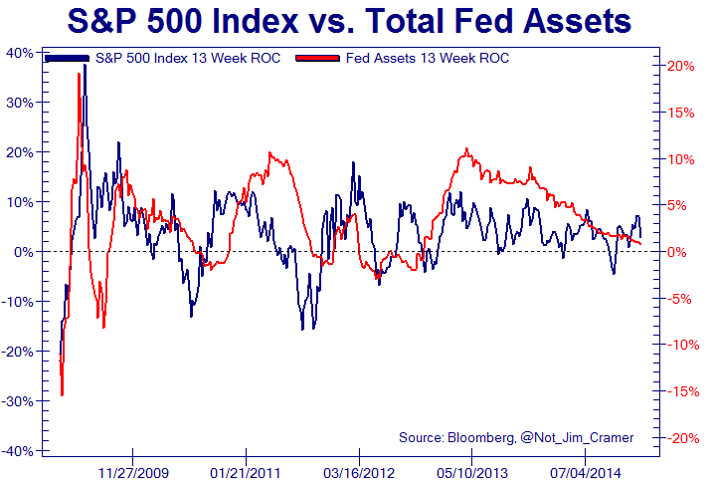
QE is about pushing asset prices, creating wealth inequality by making the rich, richer, and distorting markets so that if (ever) the accomodative policy is removed, chaos reigns.

Let me know if you want the excel file on food stuffs. You can pm me your email.

Oh, and:

B8XnGUGCYAEHM_d.png:large

This statement:

The moment prices fall below the magical, mystically created 2%, Central Bankers are on the airwaves about pushing loose monetary policy, printing more money and keeping emergency measures in place...

in particular, is completely out of touch with reality, and what is going on at the moment. It is what one expects from someone whose mind has become fixated on a false reality, and consequently their perceptions become filtered and distorted so as to convince themselves that the reality is what it is not.

What is actually happening is that the U.S. economy is recovering, and in no small part due to the extraordinary actions of the Fed and Treasury. Now that there are signs that the economy is on the mend, albeit slowly, there has been anticipation that the Fed will, before too long, begin, ever so gradually, to tighten.

We were subjected to endless predictions of QE leading to out of control hyperinflation. When it was clear that there would be no hyperinflation, we were subjected to claims that QE had actually accomplished nothing. The absurdity of this assertion is clear. Anyone, other than a lunatic, would presume it is not with the goal of accomplishing nothing that other Central Banks are now following in the Fed's footsteps. Finally, with the U.S. economy on the mend, we are being subjected to ridiculous claims that the Fed has no way to exit without ruining the economy and bankrupting the nation. I suspect we will never hear the end from the Jekyll Island conspiracy nuts, or amateur economists who haven't a clue how the Fed operates and are absolutely convinced that the Fed is nothing but a branch of Chase J.P Morgan.

In anticipation of rising interest rates, the Forex markets have bid up the dollar, because markets, in the normal course of events, react in anticipation rather than after the fact. The dollar has been strengthening, even though the Fed has not yet begun to tighten. Other central banks have decided to take steps toward QE and monetary easing. The reaction in the Forex markets has further fueled strengthening of the dollar vis a vis other currencies.

A stronger dollar along with weak wages will quite naturally lead to low inflation. That is what we see in the U.S. economy. The Fed has not, however reacted as the poster I have quoted said they do, but on the contrary has adopted a conservative wait and watch approach. They have delayed for the time being any significant tightening, and in the meantime the inflation rate has rebounded some. This is consistent with higher employment and further economic recovery. The Fed, as always, maintains a watchful stance with regard to any danger of the economy slipping into deflation and would of course take action, if needed, to prevent deflation. In the meantime we can expect both very slowly rising inflation, further recovery and some additional strengthening of the dollar, which as a fiat currency is always relative to what other currencies are doing. At some point, devaluation in the currencies of trading partners will slow and stabilize. The U.S., equity markets having already been through 6 years of strong recovery, will quite naturally slow their advance, and in fact they appear, at present, to be putting in a top, which may take many months.

In the early phases of QE we saw a weakening of the currency and a consequent rise in equity prices. We should see, for a while, the effect of a recovering economy tempered with a strong dollar lead to a more or less level market, to slightly up or down depending on whether the economy or dollar strength is the more important factor. The longer range market bias, other than at times of crisis, is always up, driven by both psychology and inflation. U.S. monetary policy is presently in limbo waiting on further macro economic development, but eventual Fed tightening is widely-anticipated.

The reality is that there is simply no justification in the actions of the present U.S. Fed under Janet Yellen for a remark such as "the moment prices fall below the magical, mystically created 2%, Central Bankers are on the airwaves about pushing loose monetary policy, printing more money and keeping emergency measures in place."

Yes, occasionally an incautious Fed branch bank President sends reporters scurrying by suggesting what actions the Fed might take in this or that hypothetical scenario. But there is no truth to any remark that suggests the Fed will do anything in the "moment", except, of course, under the most extraordinary circumstances. If the Fed can be criticized for their speed of decision making, it is for moving too slowly rather than too rapidly.

There is nothing magical nor mystical about the Fed's 2% target. Secondly the Fed and Treasury are not keeping emergency measures in place. Even though recent inflation, as measured by the Fed, has been a little below their 2% target, they are waiting and watching, meanwhile the macro economy is moving in the intended direction, as are inflation estimates. The U.S. economy's inertia may be likened to that of a giant oil tanker, and the Fed to a fleet of tugs pushing and pulling to reposition the tanker. Patience is always needed when waiting on a giant economy to reposition itself.
 
Last edited:
What is actually happening is that the U.S. economy is recovering, and in no small part due to the extraordinary actions of the Fed and Treasury.

It is? Talk about lack of hold on reality. Please tell me - what is recovering in the US Economy? What metrics do you look at when you do your voodoo dance?

20130422_ECO.jpg


Now that there are signs that the economy is on the mend, albeit slowly, there has been anticipation that the Fed will, before too long, begin, ever so gradually, to tighten.

No, not really. We have some nice consolation prizes for you, though.

We were subjected to endless predictions of QE leading to out of control hyperinflation. When it was clear that there would be no hyperinflation, we were subjected to claims that QE had actually accomplished nothing. The absurdity of this assertion is clear. Anyone, other than a lunatic, would presume it is not with the goal of accomplishing nothing that other Central Banks are now following in the Fed's footsteps.

QE certainly accomplished something, it's silly to say it hasn't. First, it goosed the stock market quite well. Second (although in tandem with the first result) it made the rich, richer and widened the gap between the haves and have-nots.

income_inequality.jpg


Lastly (but certainly not least), it penalized savers and those who rely on fixed income. So to say QE did nothing is quite silly, I agree! Well done, Fed!

In anticipation of rising interest rates, the Forex markets have bid up the dollar, because markets, in the normal course of events, react in anticipation rather than after the fact. The dollar has been strengthening, even though the Fed has not yet begun to tighten. Other central banks have decided to take steps toward QE and monetary easing. The reaction in the Forex markets has further fueled strengthening of the dollar vis a vis other currencies.

Yeah, because other major central banks have engaged on unprecedented QE. It's a race to the bottom, sport. The Fed has paused in it's accommodation and currencies reflect that.

A stronger dollar along with weak wages will quite naturally lead to low inflation. That is what we see in the U.S. economy.

With the notable exception that there are almost no food price declines at all (for the consumer), just energy (gas).

The U.S., equity markets having already been through 6 years of strong recovery, .

Thanks, QE!

In the early phases of QE we saw a weakening of the currency and a consequent rise in equity prices. We should see, for a while, the effect of a recovering economy tempered with a strong dollar lead to a more or less level market, to slightly up or down depending on whether the economy or dollar strength is the more important factor. The longer range market bias, other than at times of crisis, is always up, driven by both psychology and inflation. U.S. monetary policy is presently in limbo waiting on further macro economic development, but eventual Fed tightening is widely-anticipated.

It is? Is that why there was such an earthquake in financial markets with Friday's job data as the entire world repriced the idea that maybe, just maybe, the Fed might actually hike in the next year?

The reality is that there is simply no justification in the actions of the present U.S. Fed under Janet Yellen for a remark such as "the moment prices fall below the magical, mystically created 2%, Central Bankers are on the airwaves about pushing loose monetary policy, printing more money and keeping emergency measures in place."

There is no justification, on this we agree. That hasn't stopped Fed officials like Bullard or Kocherlakota, Dudley, etc. for calling for more easing whenever the stock market dips slightly. Oh wait, that's right, they care about inflation. My bad. Prices that aren't falling (and aren't rising) need more QE. Do you even listen to the Fed speeches?

Yes, occasionally an incautious Fed branch bank President sends reporters scurrying by suggesting what actions the Fed might take in this or that hypothetical scenario. But there is no truth to any remark that suggests the Fed will do anything in the "moment", except, of course, under the most extraordinary circumstances. If the Fed can be criticized for their speed of decision making, it is for moving too slowly rather than too rapidly.

Ah, you do listen. Never mind that the market takes each speaker at their word to help determine future Fed direction. Must be more of that Yellen "transparency".

There is nothing magical nor mystical about the Fed's 2% target. Secondly the Fed and Treasury are not keeping emergency measures in place.

So near zero rates 6 years after a crisis is normal operations, then? LOL!

Even though recent inflation, as measured by the Fed, has been a little below their 2% target, they are waiting and watching, meanwhile the macro economy is moving in the intended direction, as are inflation estimates. The U.S. economy's inertia may be likened to that of a giant oil tanker, and the Fed to a fleet of tugs pushing and pulling to reposition the tanker. Patience is always needed when waiting on a giant economy to reposition itself.

Princeton academics and Fed Cheerleaders everywhere applaud this shameless plug of yours, Piezoe. Bravo!
 
Here's a link to a Bloomberg article on the Fed: bloomberg.com/news/articles/2015-02-09/powell-says-audit-bill-is-misguided-threat-to-fed-independence

and the front page of Bloomberg today featured a video interview with Fed Governor Powell. Very informative.
 
Here's a link to a Bloomberg article on the Fed: bloomberg.com/news/articles/2015-02-09/powell-says-audit-bill-is-misguided-threat-to-fed-independence

and the front page of Bloomberg today featured a video interview with Fed Governor Powell. Very informative.


Gee, a Fed Governor who is against auditing the Fed? In other news, dog bites man.
 
Back
Top