ES Journal - 2019/2020

Status
Not open for further replies.
Last trade had a 22 point stop and a 99 point target - got to within 93 points and closed with 81. Crazy.

Wish I had the stones to trade regular size so I could buy a bunch of congressional seats like Bloomberg.

Can u post a chart of one of your trades, so I can see an easy trade? I just been scalping. If u wait 2 min the price will move up or down 2 points no matter where u get in. So if it goes against u, u can wait till it then turns around and goes in your favor.
 
Exactimundo!

5.3.2 Using Free Vibrations to Measure Properties of a System

We will describe one very important application of the results developed in the preceding section.


It often happens that we need to measure the dynamical properties of an engineering system. For example, we might want to measure the natural frequency and damping coefficient for a structure after it has been built, to make sure that design predictions were correct, and to use in future models of the system.


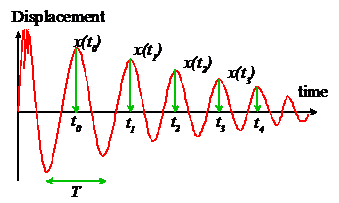
You can use the free vibration response to do this, as follows. First, you instrument your design by attaching accelerometers to appropriate points. You then use an impulse hammer to excite a particular mode of vibration, as discussed in Section 5.1.3. You use your accelerometer readings to determine the displacement at the point where the structure was excited: the results will be a graph similar to the one shown below.


image010.gif


We then identify a nice looking peak, and call the time there
eq0037MP.gif
empty.gif
eq0037M.gif
empty.gif
, as shown.


The following quantities are then measured from the graph:


1. The period of oscillation. The period of oscillation was defined in Section 5.1.2: it is the time between two peaks, as shown. Since the signal is (supposedly) periodic, it is often best to estimate T as follows

eq0038MP.gif
empty.gif
eq0038M.gif
empty.gif


where
eq0039MP.gif
empty.gif
eq0039M.gif
empty.gif
is the time at which the nth peak occurs, as shown in the picture.
 
Can u post a chart of one of your trades, so I can see an easy trade?

Here are four easy to see set-ups: Easy to see after the fact to be sure. But if you define your set ups and start looking for those set ups that happen over and over and over and over and over and over and over and over and over and over and over and over and over and over and over and over and over and over and over and over and over and over and over and over and over and over and over and over and over and over and over and over and over and over and over and over and over and over and over and over and over you will also see these in real time, and not only see them, but anticipate them and be able to trade them in an unhurried and calm manner.

First marker: 50% retrace of the last swing from premkt low to the session open high with higher low is a buy.

Second marker: S/R test with higher low continuation

Third Marker: S/R Test of AM breakout level and also 50% retrace of the swing from the last 50% to session high (this is the one I spoke of as the last trade yesterday. Bought 3001 and was looking for a run at the figure 3100. Got as close as 3093xx and stalled. Closed it at 3082-3's.

Fourth Marker: 50% retrace with higher low is a buy

All after the fact and I don't want to hear no $hit from the crybaby section - I was answering a question from a friend.

ES.JPG


And here are the two main swings and their respective halfway backs ... Someone once wrote a book or an article called "The Trading Rule that Can Make You Rich." The rule was to buy/sell 50% retracements of strong trends and swings.

HWB's.JPG
 
Status
Not open for further replies.
Back
Top