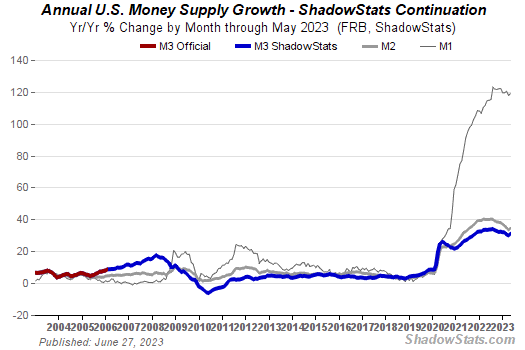
But they don't really print. They buy or sell longer term interest bearing debt (U.S. Treasuries) which has the effect of increasing or decreasing aggregate bank reserves. The actualy 'dollars' in circulation have not changed much for over a decade...printed dollars are created and destroyed according to the demand for circulation...which has been declining becuase of the expanding use of credit and debit cards. What really happens when the dollar supply changes, is that credits are added or subtracted from the aggregate bank reserves.
It goes like this: the Fed decides for whatever policy reason to buy U.S. treasuries, so it either bids for them at auction or it buys them in the secondary market through its primary dealers. The Fed creates a liabilty on its books for the amount of the Treasuries purchased ('Cash' debt account is credited) and the Fed adds a corresponding asset on its books for the amount and kind of the Treasuries acquired. If the Treaury securitiy is purchased at auction from the Treasury, the 'cash' so created is added to the account of the Treasury as an asset and the Treasury lists a corresponding liability in Treasury debt. The Treasury then pays its obligations, redeems maturing securities, whatever, and the 'cash' is then credited to the aggregate private bank accounts at the Fed. If the Treasury security is purchased in the secondary market the so created 'cash' is transferred to the aggregate private banking market directly and the Treasury asset is debited from the aggregate private banking assets and credited to the Fed as an asset.
In this way, assets that would otherwise be in the aggegage private banking balance sheet decline and aggregate reserves increase (unless the banks lend the money out). Income producing assets decline in the aggregate private bank balance sheet and income producing assets increase on the Fed balance sheet...remember the Fed creates non interest bearing liabilities to acquire interest bearing assets. What really happens is the private bank operating profits from investment decline and the income shifts to the Fed which they return to the Treasury.
Note that all this is simply credits and correspondinig debits that all take place within the aggregate banking system. In terms of supply of money to the economy nothing really happens unless private credit epands or contracts....and the transfer of liabilities and assets within the government and private aggregate bank balance sheets does not of itself change private credit.
This is why, in previous threads, I have always described money as credit and why I have indicated that the supply of currency is irrelevent and cannot of itself create a condition of inflation. This is why the Quantity Theory of Money created in the 17th century, before modern fiat currency and credit markets, no longer explains the issues of money supply that translates into price index inflation that can be measured.
For inflation to manifest there has to be an expansion of aggregate private credit to the extent that excess reserves decline and aggregate private debt expands,....cash reserves are exchanged for private interest bearing assets...and bank income increases apart from the intergovernment banking ledgers. In this way you see that the dollar is only 'credit', all money is credit and is integrated with all sovereign credit of differring coupon and duration. All notions of money supply need to be adjusted to thinking about 'private credit supply and demand.'
You can have M1 increase as credit contracts becuase the loans paid off return longer term assets to demand deposit assets. This is not inflationary, it is the opposite, it is deflationary.