From a piece entitled "Back to the Future" by
Doomberg, which I have a subscription to. This is really scary, freaky and stupid shit.
------------
With this sensible and self-evident set of concepts now described, it might surprise our readers to learn that the European Union and Britain are not only incentivizing a
return to the primitive concept of burning wood for energy on a massive scale, but they also claim doing so is
carbon neutral (spoiler alert: it isn’t, not even close).
Nearly 40% of Europe’s so-called renewable energy is currently obtained by combusting wood, and a sizable portion of what’s being burned is derived from clearcutting forests in the US. In a farce so perverted and obscene that it can only be the work of bloated and arrogant bureaucracies, a carbon accounting loophole is causing
huge amounts of CO2 to be pumped into the atmosphere
today that will take
decades to abate using natural means. The details are staggering. Let’s dig in.
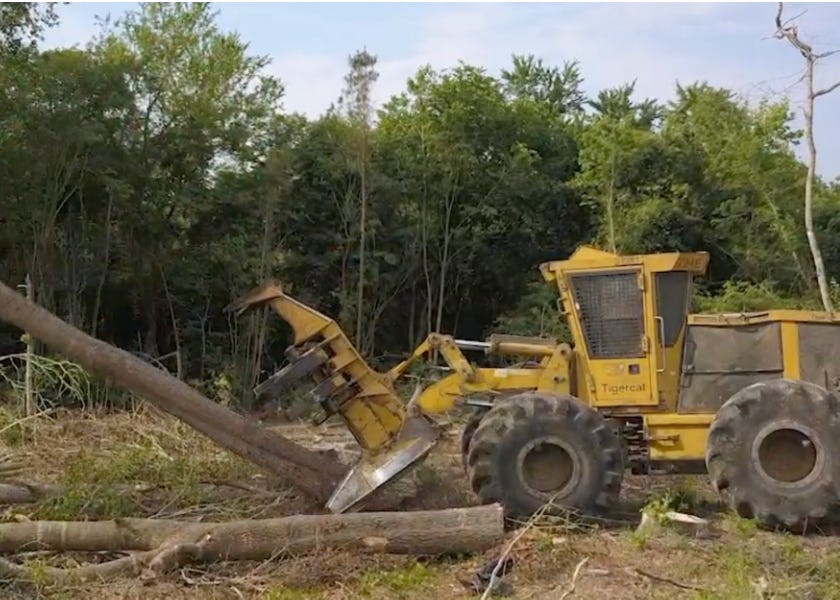
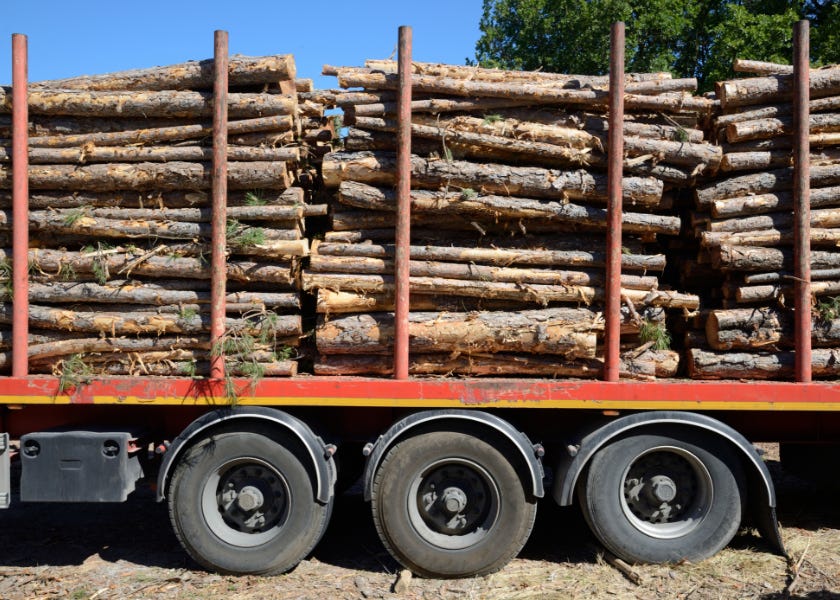
All across the US Southeast, massive industrial feller bunchers are cutting down and stacking mature trees with ruthless efficiency. The resulting logs are loaded onto trailers and hauled by diesel-powered trucks to wood pellet factories. Once there, the logs are milled, dried, and pressed through specialty extruders at high pressure, all of which require significant primary energy and
raise local pollution issues. The resulting pellets are transported to coastal ports – again, using diesel – where they are loaded onto cargo ships. The diesel-powered cargo ships make their way across the ocean, emitting CO2 along each of their several thousands of miles traveled. Once in Europe, the pellets are burned,
emitting more CO2 per unit of heat generated than any other fuel source currently used at scale (including coal, and by a wide margin). We are meant to believe
this process is somehow carbon neutral.
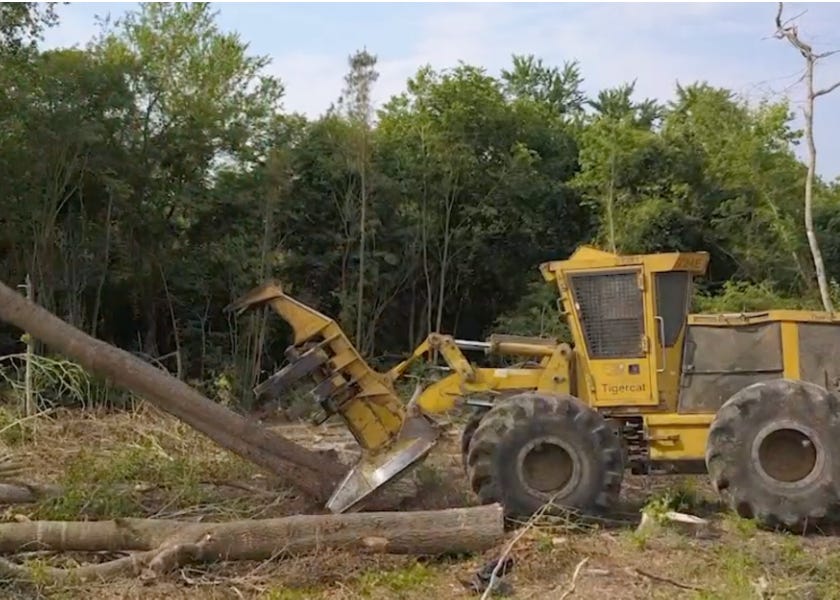
Feller buncher | CNN
The loophole that enables this orgy of deforestation boils down to how and where emissions are counted. We
quote from a scathing report by
Chatham House for the answer:
“
Existing national and intergovernmental policy frameworks treat forest biomass as zero-carbon at the point of combustion and grant it access to financial and regulatory support. Consumption of wood pellets is growing rapidly as a result. Yet these frameworks do not take full account of the contribution of biomass burning to increased carbon emissions.”
From the perspective of Britain and the EU, the wood pellets they burn were immaculately conceived – the manner in which the pellets arrived at
their power plants is not relevant to
their carbon emission calculations. By burning “carbon neutral” wood pellets and decreasing
their use of coal, European environmentalists get to brag to the rest of us about what wonderful stewards of this shared planet they are, all while being among its worst offenders.
Further, the fact that mature trees sequester huge amounts of CO2 compared to newly planted saplings is ignored, making the premature death of that generation irrelevant to the
political calculations of environmental impact. While a claim that mature trees are good for the planet syncs intuitively, it has also been
studied and quantified:
“
A sweeping study of forests around the world finds that the older the tree, the greater its potential to store carbon and slow climate change.
The 38 researchers from 15 countries found that 97 percent of trees from more than 400 species studied grew more quickly as they aged, thus absorbing more carbon. Although trees become less efficient at processing carbon as they get older, there are a greater number of leaves to absorb CO2, explained Nate Stephenson, lead author of the study. Leaves are crucial in photosynthesis, the process by which plants make energy and absorb carbon dioxide.”
What is clear is that the
time value of carbon emissions does not fit neatly into the spreadsheets of the European environmental elite, despite their repeated hand wringing about how
urgent the carbon crisis is, what
little time we have to bend the shape of the curve, and the devastating consequences of not acting
immediately.
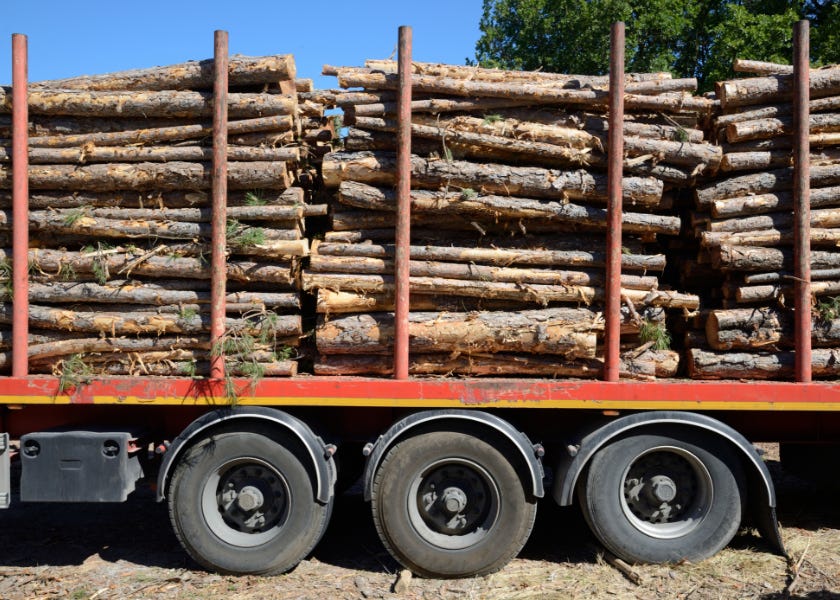
Logs on a trailer | Getty
Lest you think the burning of US trees to power Europe is a minor sideshow in the grand carbon game, we return to the
Chatham House report for more context:
“
In 2019, according to our analysis, US-sourced pellets burnt for energy in the UK were responsible for 13 million–16 million tonnes of CO₂ emissions, when taking into account emissions from their combustion and their supply chain, forgone removals of CO₂ from the atmosphere due to the harvest of live trees and emissions from the decay of roots and unused logging residues left in the forest after harvest. Almost none of these emissions are included in the UK’s national greenhouse gas inventory; if they were, this would have added between 22 and 27 per cent to the emissions from total UK electricity generation, or 2.8–3.6 per cent of total UK greenhouse gas emissions in 2019. This volume is equivalent to the annual greenhouse gas emissions from 6 million to 7 million passenger vehicles.”
As a benchmark,
Statistaestimates that 2.7 million passenger vehicles were sold in the UK in 2019, the year quoted in the
Chatham Study. Only a
fraction of those were electric vehicles. The burning of mature US trees
absolutely overwhelms the carbon impact of
all electric vehiclesever sold in the UK. All the economic sacrifices made in the name of minimizing our impact on the climate are turned into a mockery by this one insanity.
To the credit of some 800 scientists from virtually all disciplines, serious efforts to reverse course have been made. In 2018, a letter was
penned that accurately pointed out the environmental bankruptcy of the current biomass accounting policy. They argued the EU should “
restrict the forest biomass eligible under the directive to residues and wastes.” The letter was largely ignored. Here’s a key section from it:
“
The adverse implications not just for carbon but for global forests and biodiversity are also large. More than 100% of Europe’s annual harvest of wood would be needed to supply just one-third of the expanded renewable energy directive. Because demand for wood and paper will remain, the result will be increased degradation of forests around the world. The example Europe would set for other countries would be even more dangerous. Europe has been properly encouraging countries such as Indonesia and Brazil to protect their forests, but the message of this directive is ‘cut your forests so long as someone burns them for energy.’ Once countries invest in such efforts, fixing the error may become impossible. If the world moves to supply just an additional 3% of global energy with wood, it must double its commercial cuttings of the world’s forests.”
Back in the US, publicly traded companies like Enviva are rushing to meet Europe’s virtually insatiable demand for “carbon neutral” wood. Despite lots of happy talk about responsible forest management, good corporate citizenship, low-impact supply chains, and other public relations spin, the company was recently thrilled to announce it will soon be cutting down more trees. Here is Enviva’s chief executive officer on the company’s last earnings call bragging about a massive expansion into the German market (transcript sourced via
Bloomberg):
“
We are very pleased to have announced yesterday that we have signed our first series of German agreements, including a memorandum of understanding with the German utility. This new customer is focused on providing baseload dispatchable renewable energy and our pellets will be used to displace coal in one of its large power plants. We expect this MOU to become a firm contract within the next 12 months. This contract as I mentioned is large with delivered volumes over the 10 to 15-year term expected to be at least one million metric tons per year, which means this one contract alone could underwrite the construction of the new plan.
We also announced yesterday that we signed a letter of intent with another new German customer to serve a completely new industrial vertical for us. This new customer intends to use and give us wood pellets to phase out fossil fuels and generate green process heat and their manufacturing facilities in Germany. Delivered volumes under this 10-year agreement are expected to be around the 100,000 metric tons per year with deliveries to start as early as 2023. We expect to convert this LOI to a firm contract within the next few months.”
Germany – a country proactively shutting down nuclear power plants despite suffering a massive energy crisis – is turning back to
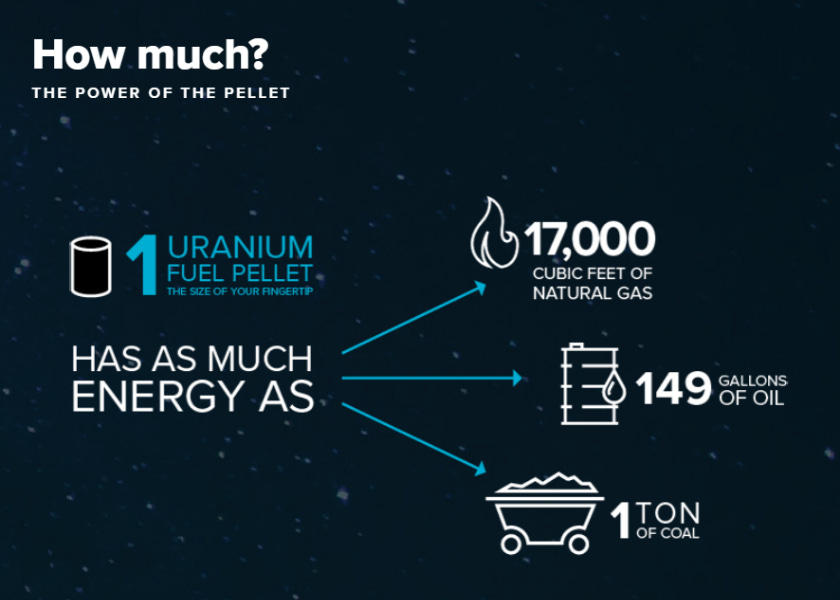
wood for power. What do nuclear plants use as fuel? Uranium. The staggering advantages of uranium-enabled power are made evident by this graphic
from the
Nuclear Energy Institute:
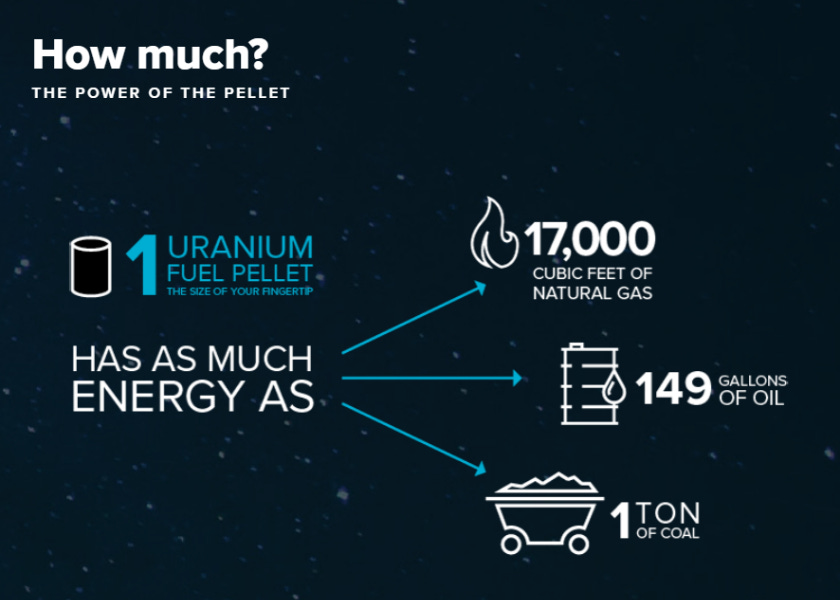
A single pellet of uranium fuel
no bigger than your fingertip provides as much energy as a ton of coal (and certainly even more wood). Think about that!
Doomberg readers might well think about that, but alas, those leading the climate parade are more likely to meet our incredulity with a look off into the distance, shades drawn over their eyes, and claim with knowing vehemence, “Trees? Where we’re going, we don’t need trees.”