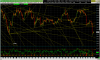
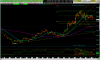
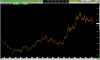
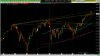
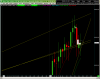
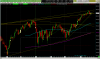
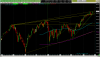
this does not make sense, firstly, in order to relate everything that you said, you first need to visualize the price movement using the wave or pater theory of the market. If you analyze only a fragment, then it can be, for example, Wulf, etc.
I can only show a fragment within the confines of this message board. However, if you watch the market every day, that information is stored in your mind.
Then you can begin price analysis based on your recollection of the 3 stages of price action.
Price in any given time frame can be doing the following.
1) Trending.
2) Ranging.
3) Consolidating.
When I say higher time frame, I would for example mean say the daily or even more important weekly time frame.
So in the above example, Price after traveling down a bit was in a consolidation phase, getting ready to trend or break out higher since overall trend in higher frames is still biased positive. Trades can be made in the trending or ranging phases of the market but not in consolidation since that is sideways movement that will eventually break out to the upside or break down to the downside.
We would look at the possibility of bullish price action since the higher time frames are influencing the lower time frames.
Obviously, if a new report was about to come out, we would normally not want to be in a trade since we could get a spike either higher or lower.
Remember this is not an exact science so we can not be 100% right. However, with patience and waiting for the right opportunity while not trading if price has already either broken out or broken down, we can achieve a higher probability of success.
When this is done over hundreds of trades and years, we can achieve a level of confidence in the system.
Last edited: