
Do you see patterns in Random Walks?

Quote from MAESTRO:

I don’t think the question here is whether one could mimic the actual price behavior using any sort of a random generator or not. I think the more fundamental question here is whether the price behavior it self is a reflection of an objective random character of the market’s underlying forces or the price is a reflection of some sort of a deterministic non-linear algorithm that produces chaotic moves in the market.

My personal opinion has always been that RANDOMNESS is an objective and necessary characteristic of nature. It is more persistent than we might think and governs many of the behavioral patterns ...
Cheers,
MAESTRO
Algorithmic traders are NOT interested in explaining the "reality".

We do NOT care if mkt is random or not. These questions belongs to philosophy. We dont care about the sex of angels, as well.

The only (pragmatic) purpose of using random generations is to assess the robustness of the trading methodology. It's an experimental setting.

We are merely interested in algorithmic creations which extract as much reward to risk as possible from the mkt.
The mathematical models need not to represent the "reality" (provided that a "reality" "exists" at all).

Remember that the famous probabilist B. De Finetti, started his famous lifetime work on probability theory with the sentence:
<b>"Probability does not exist"</b>.

In math, we don't care explaining what something "is".
We define math properties (axioms) and proceed from there.

Tom
 
Quote from intradaybill:

In epistemology nobody cares about what we believe but how we justify our own beliefs. As such, I have not seen any convincing justification of such belief about randomness and it sounds to me more like religion or dogma than anything else.

If as you say dear MAESTRO "RANDOMNESS is an objective and necessary characteristic of nature", why do things you lay on a table stay there unless disturbed by external forces? Why the arrow of time persists in only one direction and we do not see time reversals? Why things fall to the ground with an acceleration function that has been measured to be invariant of mass in one part in 15 trillion?

Maybe at some level there is randomness but it is a mystery how this order we measure in the macroworld emerges from randomness. The obvious suspicion is then that this randomness is epiphenomenal and not a primary phenomenon, IMO. But again, I can't justify this belief.


Here is an easy explanation. Imagine a completely sealed jar filled with gas under certain pressure. Although the paths of the gas molecules are governed by the random (Brownian motion) process the pressure inside the jar remains remarkably constant if the temperature is maintained accurately. One could measure this pressure with any desirable degree of accuracy and rely on the fact that it would stay the same for a prolonged period of time. What causes the pressure to stay stable is the velocity “averaging” of billions of the gas molecules over any given period of time. It creates equilibrium that causes this very stable observation being one of the characteristic of a pure RANDOM phenomenon – infinitely long AVERAGE! The same thing occurs with gravity and any other fields and energy sources – they are simple averages of much more complex RANDOM processes that exhibit very stable patterns that we mistake for being “deterministic”. That is why “things lay on a table with no motion” until this equilibrium is changed. That is why the things fall with a very predictable speed to the ground. It is because of a very stable average of billions of micro forces that indeed have the RANDOM nature. Randomness does not mean “patternless”. In contrary, randomness offers way more stability in patterns simply because of the phenomenon of constant averaging. BTW, what does the average of infinite length look like if plotted on, let’s say price chart? It is a straight line! And regardless of what the price does in any instant the average of the infinite length will remain the same. Here is your stability and an illusion of the “detrerminism”.

P.S. I appreciate your wiliness to debate. Without you this thread would be pointless! I do enjoy a good debate and I hope that I stay within very polite boundaries because the absolutely last thing I would want is to offend you in any way. I do respect very much your point of view and your knowledge base.

Cheers,
MAESTRO
 
Algorithmic traders are NOT interested in explaining the "reality".

In contrary, any algorithmic trading developer starts by designing a model of the reality that he/she believes has enough accuracy to rely on.

We do NOT care if mkt is random or not. These questions belongs to philosophy. We dont care about the sex of angels, as well.

Your are making this choice every time you create an algorithm;
you just do not know about it or you do not register it in your conciseness.

The only (pragmatic) purpose of using random generations is to assess the robustness of the trading methodology. It's an experimental setting.

Not at all. The "testing" is only a small part of decision making model creation process.

We are merely interested in algorithmic creations which extract as much reward to risk as possible from the mkt.
The mathematical models need not to represent the "reality" (provided that a "reality" "exists" at all).


Detached from the reality models eventually fail

Remember that the famous probabilist B. De Finetti, started his famous lifetime work on probability theory with the sentence:
"Probability does not exist"
.

Finetti, as the matter of fact, has been the biggest opponent of determinism; he was a probabilistic pragmatism believer.

In math, we don't care explaining what something "is".
We define math properties (axioms) and proceed from there


Well, being an applied mathematician for more than 35 years I disagree with this statement completely.

Cheers,
MAESTRO
 
Quote from MAESTRO:

Algorithmic traders are NOT interested in explaining the "reality".

In contrary, any algorithmic trading developer starts by designing a model of the reality that he/she believes has enough accuracy to rely on.

We do NOT care if mkt is random or not. These questions belongs to philosophy. We dont care about the sex of angels, as well.

Your are making this choice every time you create an algorithm;
you just do not know about it or you do not register it in your conciseness.

The only (pragmatic) purpose of using random generations is to assess the robustness of the trading methodology. It's an experimental setting.

Not at all. The "testing" is only a small part of decision making model creation process.

We are merely interested in algorithmic creations which extract as much reward to risk as possible from the mkt.
The mathematical models need not to represent the "reality" (provided that a "reality" "exists" at all).


Detached from the reality models eventually fail

Remember that the famous probabilist B. De Finetti, started his famous lifetime work on probability theory with the sentence:
"Probability does not exist"
.

Finetti, as the matter of fact, has been the biggest opponent of determinism; he was a probabilistic pragmatism believer.

In math, we don't care explaining what something "is".
We define math properties (axioms) and proceed from there


Well, being an applied mathematician for more than 35 years I disagree with this statement completely.

Cheers,
MAESTRO


Well i am an algorithmic trading developer...
(http://www.elitetrader.com/vb/showthread.php?s=&threadid=222126&perpage=6&pagenumber=9)

I also happen to be a mathematician.

And you can see how my "reality detached models" models do make some buck. ;-)

This confirms that these questions really belong to phylosophy.

Tom
 
Quote from fullautotrading:

Algorithmic traders are NOT interested in explaining the "reality".

We do NOT care if mkt is random or not. These questions belongs to philosophy. We dont care about the sex of angels, as well.

The only (pragmatic) purpose of using random generations is to assess the robustness of the trading methodology. It's an experimental setting.

We are merely interested in algorithmic creations which extract as much reward to risk as possible from the mkt.
The mathematical models need not to represent the "reality" (provided that a "reality" "exists" at all).

Remember that the famous probabilist B. De Finetti, started his famous lifetime work on probability theory with the sentence:
<b>"Probability does not exist"</b>.

In math, we don't care explaining what something "is".
We define math properties (axioms) and proceed from there.

Tom
Tom, this was a masterpiece, one of the best - if not the best - post I have seen in ET. Thanks.

10^100 ***
 
Quote from ronblack:


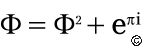
10^100 ***

Did you mean

golden_rule.gif


??? :D
 
Quote from MAESTRO:

Imagine a completely sealed jar filled with gas under certain pressure. Although the paths of the gas molecules are governed by the random (Brownian motion) process the pressure inside the jar remains remarkably constant if the temperature is maintained accurately.

MAESTRO, the motion of each particle in the jar is deterministic and completely governed by Newton's second law. There is nothing random about the phenomenon you described. However, due to the particle collisions, the process appears chaotic. You are using the term random to describe chaotic processes. All of your examples are deterministic chaotic processes. Up to now, you have never offered a truly random process.

Deterministic chaos is not randomness. Nowadays there are supercomputers that can simulate and track the motion of each particle of the gas in the jar with amazing accuracy. These supercomputers are simulating how galaxies are formed from cosmic gases.

Brownian motion is a model of a deterministic chaotic reality. There is nothing fundamentally random about this. To say something is random you must refute the principle of the need of an antecedent, proximate cause and of no creation ex nihilo. Some people claim that this happens in QM but it is only metaphysics with no justification. Also, some other interpretations of QM I have mentioned before, like the many words, do not accept randomness.

I still wait for a truly random process example and I will be willing to discuss it. BUT I suggest we stop labeling deterministic chaos as randomness.
 
Quote from intradaybill:


I still wait for a truly random process example and I will be willing to discuss it. BUT I suggest we stop labeling deterministic chaos as randomness.

May be we should agree on something first. Do you accept that any deterministic system has to have less complexity than the tools we use to measure it in order to be certain that it is in fact a deterministic system? If a system is more complex than the tools we have to understand it then there is always a part of this system that cannot be explained within the set of available to us tools. (Gödel's incompleteness theorem and Ashby's principle of requisite variety). if that is the case then there is always a process that is too complex for any available set of tools to describe it with any predetermined degree of accuracy. Thus this process is random within this set of observation tools.
 
Back
Top