Do option holders have any recourse for expirations during a Presidential Order to close exchanges?

Well, anyone can be sued...it's whether the case is summarily dismissed. But I digress.

Also, had a thought in the interim that Fannie and Freddie are publicly traded but quasi governmental...all really a moot point because the above hypothetical is without precedent.

If I was a betting man, I'd ask how large the bag they're left holding is. If it's a few contracts a few dollars ITM, your broker might pay and file it under customer consideration rather than risk litigation and regulatory action. If we're talking about millions and enough to mount a substantive defense, the question is a bit cloudy.
 
Your exercise notice might simply be rejected when your broker attempts to transmit it to the OCC and then they might simply send you a rejection notice. Again I would call Jim Binder at OCC. No option exchanges are involved in your assignment - it's pretty much between the sending/receiving brokerage house(s) and the OCC. No exchanges involved until the stock print and you can sue all of them,but you might want to review all the agreements in place. I suspect closing doesn't mean everyone goes home. Now if the closing is related to some damage to the infrastructure that could alter things. You send notice to your broker - they confirm it's valid and then transmit it to the OCC. Timing doesn't matter much as it all occurs after the close.

The circuit courts have never looked kindly at overriding decisions made by the federally chartered SROs, but they have all been sued. In the case of the CBOE a really disgruntled member - unhappy with a regulatory decision - set fire to them.
 
That's the post I was trying to tease out of you! And SRO--that's the entity I was trying to remember.

And here we go:
http://lawreview.uchicago.edu/sites/lawreview.uchicago.edu/files/77-2-SRO Immunity-Nafday.pdf
https://www.cato.org/blog/financial-regulators-are-not-above-constitution

The circuit courts have never looked kindly at overriding decisions made by the federally chartered SROs, but they have all been sued. In the case of the CBOE a really disgruntled member - unhappy with a regulatory decision - set fire to them.
Yeah, but they also look really dimly on executive branch interference with contracts. And I'm not aware of any situation where it's come up before. And I suspect presenting the opportunity to test it in court is anathema to SROs and the SEC. But it's still a fun thought exercise to ask the hypothetical.
 
Good points ! Why would you close the markets for 90 days ? It's always been in everyone's best interest to reopen markets as quickly as possible. IMHO even circuit-breakers disenfranchise one side of the trade. Fair and Orderly is the gold standard - if you can't maintain a FAO resolve your issues and get open as soon as is feasible.
When they halt futures - they almost always leave the front options open for price discovery. Does removing discovery - as bad as it may be - instill confidence.
You also have overseas surrogates for many products. I ran an options overlay in 87 and had my best quarter ever in the period following. In 89 when you had a similar market break it was shooting fish in a barrel.
The SEC commissioners have a ton of emergency powers as well, but closing for an extended period serves what interest?
 
12771957_10201625877085209_3580497636745441319_o (1).jpg
 
You may want to check the archive of OCC operational memos. I'll venture there is a memo that covers your situation.
There isn't. My scenario (I didn't say this, but meant it) was for a restriction until and past expiration. The Characteristics and Risks disclosure is explicit the OCC nor SEC have ever done this.

It's really a moot point for me, because I've been operating under the assumption I'm the one holding the bag in the event the exchanges are closed and I'm holding the options. I now know that's no entirely true and I've been pricing in a bit more risk than I needed (though that's negligible).

The SEC commissioners have a ton of emergency powers as well, but closing for an extended period serves what interest?
Well, some powers only exist on paper until they're used and challenged in court.

Also, here's the background from a fees hearing surrounding Spicer v CBOE (https://law.justia.com/cases/federal/district-courts/FSupp/844/1226/1523175/):
This action was brought in the aftermath of the October 19, 1987 "Black Monday" stock market upheaval a day in which the stock and other equity markets across the United States experienced gross declines without comparison since the stock market crash of 1929. The Dow Jones Industrial Average fell by 508 points a decline of 22.6 percent from the close of trading on Friday, October 16, to the close of trading on Monday, October 19, 1987. The index for Standard & Poors 500 dropped 57.68 points, or 20.74 percent of its value. The volume of trading on all exchanges soared.

This suit was based specifically on the events which occurred on the floor of the Chicago Board Options Exchange ("CBOE") on October 20, 1987, the day after the vast declines had taken place in the equity markets. The prices for these options on October 19 & 20, 1987, were unusually high at times and unstable throughout the day, at least in part, because of the declines and instability in the equity markets.

The first complaint in this case was filed in March 1988. Two other complaints were filed in the next three months. The plaintiffs' principal theory of liability was premised upon the defendants' failure to disclose certain risks. Defendants included CBOE, the Options Clearing Corporation ("OCC"), and a number of market makers. In June 1988, the first complaint was consolidated with the two other similar complaints. The remainder of 1988 was devoted to sorting out the various claims, including the filing of a consolidated complaint, followed by the first motion to certify the class, class discovery, and the first motions to dismiss. The case accelerated when the second consolidated complaint was filed in March 1989. The balance of 1989 was devoted to class discovery, briefing on certification of the class and the several motions to dismiss, and frequent hearings before the court to clarify the substance and parameters of the claims. The defendants filed surreply memoranda opposing class certification and supporting the motions to dismiss. CBOE also sought a hearing to present testimony on the issue of class certification.

In January 1990, we granted the class certification motion. The class was defined as:

All persons, other than market makers, who purchased OEX or OEZ series [Standards & Poors 100] index options through market orders during a rotation on October 20, 1987, at the Chicago Board Options Exchange, and who [allegedly] suffered damages from such purchases because of paying excessive prices for those options as a result of defendants' alleged misconduct.
Class Certification Order, entered January 30, 1990. On October 24, 1990, we granted in part and denied in part the defendants' motions to dismiss, dismissing the defendant market makers from the case. Most of 1991 was devoted to discovery. Defendants CBOE's and OCC's motion for summary judgment was filed in early 1992, and expert discovery continued for several months. On December 3, 1992, we granted in part and denied in part the defendants' motion for summary judgment. The defendants' motion for summary judgment was granted with respect to the Securities Act of 1933 § 12(2) claim and denied with respect to the Securities and Exchange Act of 1934 § 10b (and Rule 10b-5) claim generally. Partial summary judgment was also granted on one issue under 10b-5 the risk from the way the rotations were conducted. Preparation for trial continued. On December 22, 1992, the case was resolved by settlement, in the amount of $10,000,000.00.

TL;DR: Plaintiffs won $10m award against CBOE for CBOE's failure to disclose risks that were inherent to floor trading. 39% of which went to attorneys...
 
If you were an investor you got a postage stamp and a can of Pepsi. There was actually a small amount left in the class action settlement after the distribution. The CBOE and the plaintiff attorneys couldn't agree - at first - which University to gift the balance to. The dispute as to what to do with the balance carried on for weeks.
 
Yes, "Other Risks" is what I was referring to.

No, the risks are clearly described. The options may expire worthless during an Order to close the markets. The contracts won't be cancelled. They simply won't trade and at worst will be forbidden to exercise.

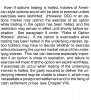
According to the jpg image @beerntrading posted earlier, it looks like even when trading is halted, exercising would still be permitted as long as the option was not expired DURING the market shutdown. It's just that everything would take place AFTER the exchange is opened. So the risk to the exerciser is that the exercising might not be profitable anymore cuz by the time when the option is exercised, the market price after the exchange is opened might be different from the price during the closure so if the market price has moved to/out of the favour of the holder depending on what the option is, the exercise might lose and it looks like the exercising is irrevocable.
 

Attachments

  • occ_OptionExerciseDuringClosingExchange.jpg
    occ_OptionExerciseDuringClosingExchange.jpg
    316.9 KB · Views: 14
Last edited:
Everyone so far has been talking about physically settled options, what about cash settled options like the SPX? I assume they settle at the last closing price, even if that is hopelessly stale?

I think the cash settlement would be easier as it's just an exchange of money and no physical delivery of any assets is involved. I think with cash settlement, the issue is the potential profitability from exercising, if I understood the .jpg image that @beerntrading posted earlier.
 
Back
Top