the information the lockdown fascists have been trying to hide.
“All I had to do was follow the data and just be willing to go forward into the teeth of the narrative and fight the media.
“As people were beating up on me, what I said was I’d rather them beat up on me than have someone lose their job. I’d rather have them beat up on me than have kids locked out of school. I’m totally willing to take whatever heat comes our way because we’re doing the right thing.”
“All I had to do was follow the data and just be willing to go forward into the teeth of the narrative and fight the media.
“As people were beating up on me, what I said was I’d rather them beat up on me than have someone lose their job. I’d rather have them beat up on me than have kids locked out of school. I’m totally willing to take whatever heat comes our way because we’re doing the right thing.”
Great article. Sure to trigger the griefers.
Exclusive: Florida Gov. DeSantis Says Lockdowns Were a ‘Huge Mistake’
Florida Gov. Ron DeSantis issued a statewide stay-at-home order on April 1 last year, locking down the Sunshine State for 30 days amid global panic about the CCP (Chinese Communist Party) virus outbreak. Sitting in his office exactly one year later, he told The Epoch Times that the lockdowns were a “huge mistake,” including in his own state.
“We wanted to mitigate the damage. Now, in hindsight, the 15 days to slow the spread and the 30—it didn’t work,” DeSantis said. “We shouldn’t have gone down that road.”
Florida’s lockdown order was notably less strict than some of the stay-at-home measures imposed in other states. Recreational activities like walking, biking, playing golf, and beachgoing were allowed, while what constituted an “essential business” was broadly defined.
“Our economy kept going,” DeSantis said. “It was much different than what you saw in some of those lockdown states.”
However, the governor now regrets issuing the order at all and is convinced that states that have carried on with lockdowns are perpetuating a destructive blunder.
After the initial 30-day lockdown in Florida lapsed, DeSantis commenced a phased reopening. He faced fierce criticism at each stage from establishment media, as well as segments of his own constituency beholden to the lockdown narrative.
The governor fully reopened Florida on Sept. 25, 2020. When cases began to rise as part of the winter surge, he didn’t reimpose any restrictions. While lockdown proponents forecasted doom and gloom, DeSantis stood his ground.
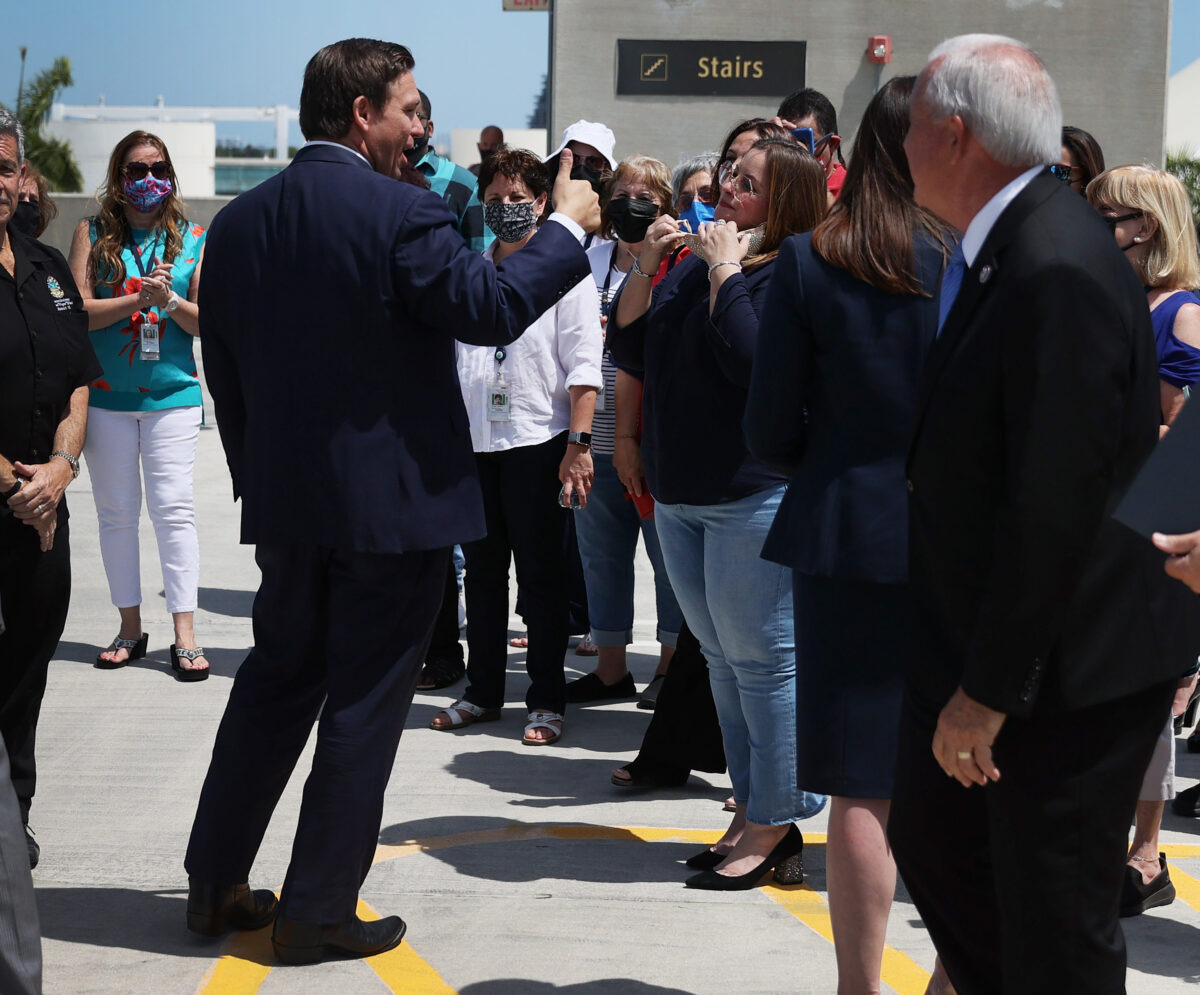
Florida Gov. Ron DeSantis gives a thumbs up as he leaves a press conference where he spoke about the cruise industry at the Port of Miami on April 8, 2021. (Joe Raedle/Getty Images)
The governor’s persistence wasn’t a leap of faith. Less than two weeks after Florida’s full reopening in late September, scientists from Stanford, Harvard, and Oxford universities went public with the Great Barrington Declaration, which disavowed lockdowns as a destructive and futile mitigation measure. The declaration, which has since been signed by 13,985 medical and public health scientists, calls on public officials to adopt the focused protection approach—the exact strategy employed by DeSantis.
Despite dire predictions about the pandemic in Florida, DeSantis has been vindicated. On April 1, Florida ranked 27th among all states in deaths per capita from the CCP virus, commonly known as COVID-19.
The ranking’s significance is amplified because the Sunshine State’s population is the sixth oldest in the United States by median age. California—the lockdown state often compared to Florida due to its lower per-capita death rate—is the sixth youngest. The risk of dying from the CCP virus is highest for people over 55, with the group accounting for 93 percent of deaths nationwide.
While Florida is either performing better or relatively the same as the strict lockdown states in terms of CCP virus mortalities, the state’s economy is booming compared to the crippled economies in California and New York.
Though less quantifiable, the human suffering from the lockdown-related rise in suicides, mental health issues, postponed medical treatments, and opioid deaths is undeniably immense.
“It’s been a huge, huge mistake in terms of policy,” DeSantis said.
“All I had to do was follow the data and just be willing to go forward into the teeth of the narrative and fight the media.
“As people were beating up on me, what I said was I’d rather them beat up on me than have someone lose their job. I’d rather have them beat up on me than have kids locked out of school. I’m totally willing to take whatever heat comes our way because we’re doing the right thing.”
‘Don’t Let Them Roll Over Us’
The Epoch Times spent a day embedded with DeSantis as he crisscrossed the state on April 1, jetting southeast from the seat of state government in Tallahassee to a press conference in Titusville and then back north to the Clay County Fair on the outskirts of Jacksonville.
Across dozens of encounters with Floridians from all walks of life, one trend persisted: People thanked DeSantis for his work and his policies. Business owners praised him for not shutting them down.
Chris Allen, the owner of Java Jitters, opened a coffee shop in Orange Park Mall during the pandemic.
“We could not have done that if it wasn’t for Ron DeSantis,” Allen told The Epoch Times after personally thanking the governor during an encounter at the Clay County Fair.
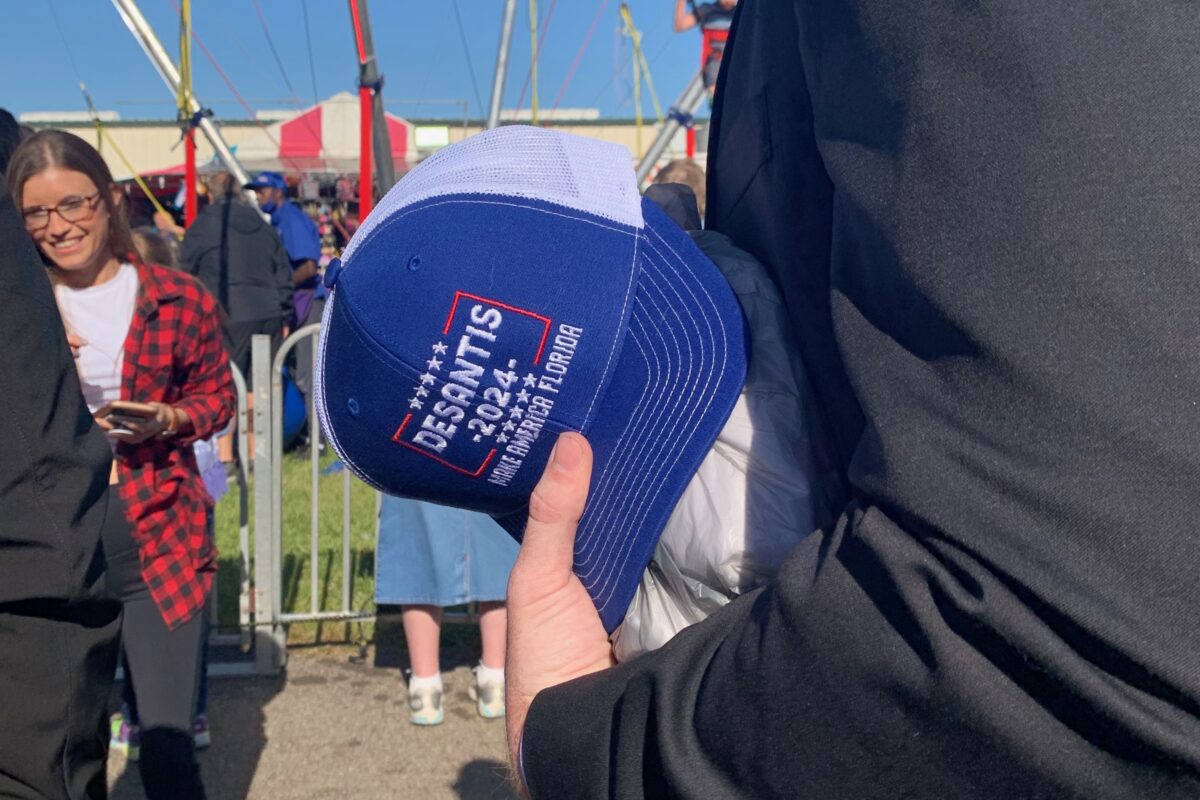
A staff member for Gov. Ron DeSantis holds a “DeSantis 2024, Make America Florida” hat at the Clay County fair on April 1, 2021. The staff member said the hat was handed to the governor by a fair attendee. (Ivan Pentchoukov/Epoch Times)
At the time of the interview, Florida’s unemployment rate was 4.7 percent compared to 6.2 percent nationally. Lockdown states like New York, New Jersey, Pennsylvania, and California had some of the highest rates in the country—8.9 percent, 7.8 percent, 7.3 percent, and 8.5 percent respectively.
“I have a tough time paying for a meal in Florida just because I saved a lot of these restaurants from oblivion,” DeSantis said. Hours after this claim, a curly fries stand at the fair declined to charge the governor.
DeSantis said some people get emotional when they meet him. Several of the interactions with the governor at the Clay County Fair resembled that description. A visibly moved elderly veteran urged the governor to not “let them roll over us.”
“If we hadn’t stood up, these people may not have jobs, the businesses may have gone under, the kids wouldn’t be in school, there’d be all these things,” DeSantis said. “This really, really impacts people in a very personal way. And I don’t think anything prior to COVID that I’ve seen in politics can quite do it on this level. And it’s really unfortunate that there were governors that had power [who did] the opposite. It really shouldn’t depend on the governor.”
Reopening the state wasn’t as easy for DeSantis as lifting his own stay-at-home measures. When he issued the final reopening order in late September 2020, he signed a companion order prohibiting local Florida governments from restricting people from working or operating a business. The order had far-reaching consequences across the state, especially in densely populated, liberal-leaning locales where the local authorities imposed their own strict measures.
DeSantis adopted a hands-off approach to local regulations at first, thinking that voters would ultimately hold local authorities responsible. It eventually became obvious that some places within the state would choose to remain locked down, despite the data showing that doing so would have no positive impact on the spread of the virus.
“They weren’t going to open this stuff up unless I pried it open,” DeSantis said.
“We had the data. We talked to some of the best scientists in the country,” he said, referring to Martin Kulldorff from Harvard, Jayanta Bhattacharya from Stanford, and Sunetra Gupta from Oxford. “Every Floridian has a right to work. Every business has a right to operate.”
In areas that were forced to reopen as a result, the economies are now booming with new hotels and restaurants opening, DeSantis said.
DeSantis received a law degree from Harvard and is a textualist when interpreting the Constitution. He believes barring the local authorities from placing restrictions on the people and businesses of Florida was squarely within his authority.
“You can’t have 67 different minimum wages, or 67 different regulations on hotels. We are one state economy, and we need to have certain rules of the road,” DeSantis said.
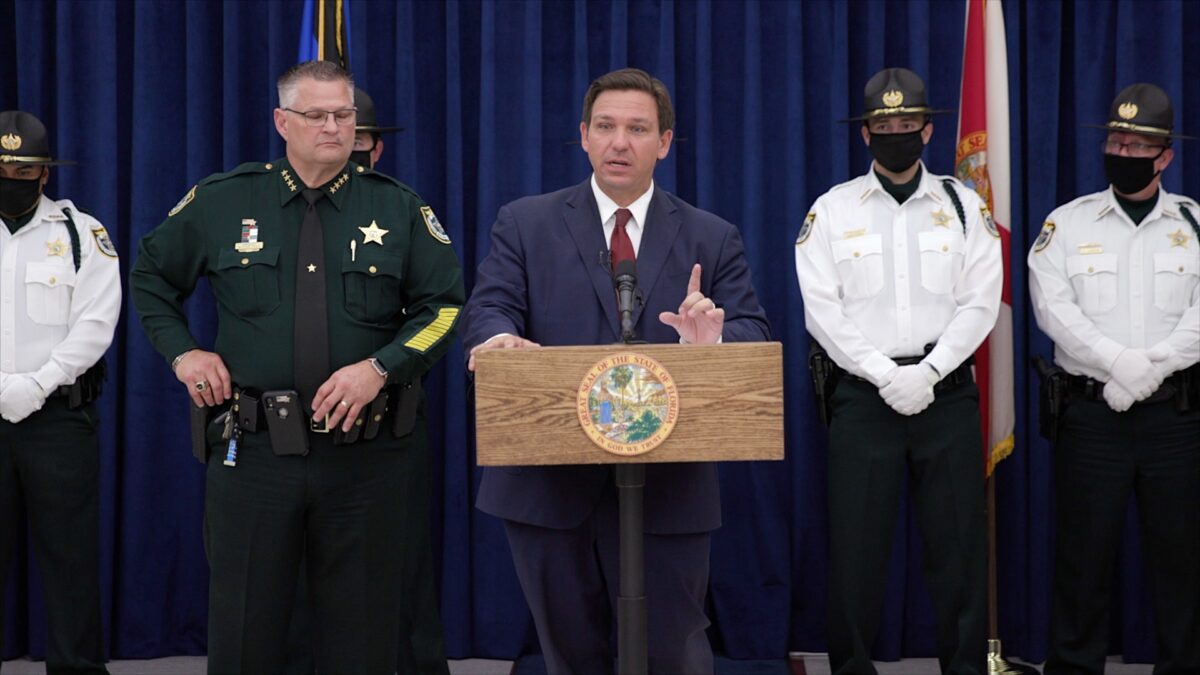
Gov. Ron DeSantis delivers remarks at a press conference in Titusville, Fla., on April 1, 2021. (Screenshot via Epoch Times)
‘They Are Never Going to Admit They Were Wrong’
Standing behind the desk in his office in Tallahassee, DeSantis leafed through a folder of praise he’s received from around the nation and across the globe. Hanging on the walls around the relatively small space were a portrait of Abraham Lincoln and copies of the Constitution and the Bill of Rights, as well as the uniform the governor wore as the captain of the Yale baseball team.
When asked why he chose Lincoln, DeSantis said the president is the best example of a leader who had to make difficult decisions in a time of crisis. When asked why some of the leaders of today have continued with lockdowns—even with ample evidence of their ineffectiveness—the governor theorized that the people involved have committed too much to the narrative and have made it impossible to change course.
“You have a situation where if you’re in this field, the pandemic, that’s something that you kind of prepare for and you’re ready for,” said DeSantis. “And a lot of these people muffed it.
“When push came to shove, they advocated policies that have not worked against the virus but have been very, very destructive. They are never going to admit they were wrong about anything, unfortunately.”
Elected leaders aren’t the only ones to blame, according to the governor. The media and big tech companies played a major role in perpetuating fears about the virus while selectively censoring one side of the mitigation debate. DeSantis said the media and tech giants stood to benefit from the lockdown as people stayed home and consumed their products.
“It was all just to generate the most clicks that they could. And so that was always trying to do the stuff that would inspire the most fear,” DeSantis said.
The fear-mongering worked, DeSantis said, pointing to CDC statistics showing that 4 out of 10 American adults delayed or avoided getting urgent or routine medical treatment in June 2020. The agency’s report said that the pattern may have contributed to the excess deaths reported during that period, due to preventable illnesses and injuries going untreated.
Emergency room doctors have reported that fewer people were coming in with cardiac-related chest pains, while more were coming in with late-stage appendicitis, something that is usually caught much earlier. The pandemic has also led to a sharp decrease in cancer screenings and detections.
“When you have people too scared to go to the emergency room when they’re literally having a heart attack, that didn’t happen in a vacuum,” DeSantis said. “Corporate media played a role in that, by really whipping up people into a frenzy.”
The profit motive wasn’t the only factor potentially driving the media’s slanted coverage, according to the governor. The pandemic hit the United States in an election year, presenting an opportunity to heap the blame on President Donald Trump.
“They viewed it as an opportunity to damage Trump. Obviously, they hated Trump more than anything,” DeSantis said.
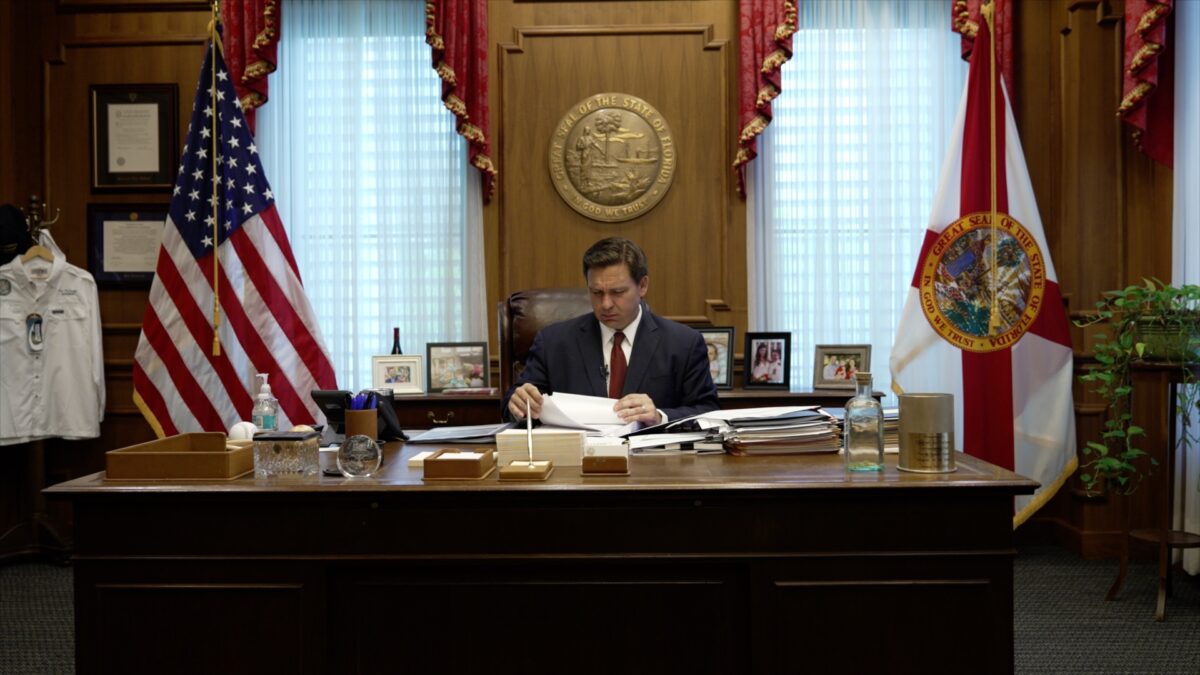
Florida Gov. Ron DeSantis in his office in Tallahassee, Fla., on April 1, 2021. (Screenshot via The Epoch Times)
‘Council of Censors’
In the April 1 interview, DeSantis criticized big tech companies for censoring critics of lockdowns. Less than a week after the interview, the governor himself became the victim of censorship. YouTube, without warning, scrubbed videos of a roundtable discussion between DeSantis and prominent scientists from Harvard, Oxford, and Stanford who assessed that lockdowns are ineffective.
The American Institute for Economic Research (AIER) was the first to flag the video’s disappearance. The original clip is now hosted on a different platform, appearing along with a full transcript on the AIER website.
“Google and YouTube have not been, throughout this pandemic, repositories of truth and scientific inquiry, but instead have acted as enforcers of a narrative, a big tech council of censors in service of the ruling elite” DeSantis said in response to YouTube’s censorship during an April 12 video conference call with three of the scientists from the banned video.
“When they took down the video … they were really continuing what they’ve been doing for the past year. [They] stifle debate, short-circuit scientific inquiry, make sure that the narrative is not questioned. And I think that we’ve seen already that that has had catastrophic consequences for our society.”
The takedown of the video suggests that Big Tech intends to keep exercising the awesome power it directed against Trump in the closing days of the previous administration. Twitter and Facebook banned the president, cutting off a direct line of communication between the commander in chief and tens of millions of Americans.
DeSantis thinks that the power monopolies have now is far more extensive than what the United States witnessed at the turn of the century.
“What we’ve seen with the Big Tech and the censorship, they are exercising more power than the monopolies at the beginning of the 20th century ever could have exercised,” the governor said. “The type of power that they’re exercising now, in some respects, is even more profound than the type of power that government typically exercises.”
No End in Sight
Desantis believes lockdown states may never fully reopen because their leaders have invested so heavily in the narrative—and the voters have grown fearful.
While restrictions are easing across the nation, only six states, including Florida, have fully reopened, according to a tracker maintained by USA Today. Eight states never issued a stay-at-home order.
“I think if your goal is no cases, then there may never be an end to it, because you’re never gonna have zero COVID,” DeSantis said, adding that a more pragmatic goal would be to aim toward a hospitalization rate indicative of a respiratory virus endemic.
“But I don’t know that they’re willing to accept that reality. I think they’re going to try to have no cases at all, which would basically mean there would never be a full end to these policies, which is scary.”