Frankly I want peace and a two-state solution. Of course given unilateral compromises and sacrifices Barak was forced to make and the fact that the Palestinians still walked away from the proposal without even a courtesy of a counter-offer, started the Intifada and elected Hamas the chances of any kind of solution any time soon are probably quite remote.Quote from fhl:
Who cares who's kissing up? Your man Clinton was more than willing to give it away, if only he could find a Palestinian that would accept the offer.

You are using an out of date browser. It may not display this or other websites correctly.
You should upgrade or use an alternative browser.
You should upgrade or use an alternative browser.
Democrats: The Peace er I Mean AIPAC Party
- Thread starter Pa(b)st Prime
- Start date
Quote from dddooo:
Frankly I want peace and a two-state solution. Of course given unilateral compromises and sacrifices Barak was forced to make and the fact that the Palestinians still walked away from the proposal without even a courtesy of a counter-offer, started the Intifada and elected Hamas the chances of any kind of solution any time soon are probably quite remote.
I see nothing that would convince me a so called two state solution would stop the terrorists and promote peace. Nothing.
Quote from dddooo:
FWIW, AIPAC is not a "political action committee" it's a "public action committee". As such the only thing it represents is extremely strong bi-partisan support of the Jewish state from the overwhelming majority of the american public. Politicians are kissing up to AIPAC because it reflects the will of the american people on the issue of Israel-Palestine.
I don't think the average American person knows much at all about the Israel-Palestine issue. If AIPAC didn't have a lot of $$$$$ ,I don't think the politicians would give them much thought.
It's not like the Saudis or Iranians don't have a lot of $$$$ but I don't see them making headways with the american public. Money is not everything. In fact there is no contradiction here, AIPAC has a lot of money but their views still represent the views of the majority of americans. You could probably say that AIPAC has a lot of money because they represent the views of the american public.Quote from TheDudeofLife:
I don't think the average American person knows much at all about the Israel-Palestine issue. If AIPAC didn't have a lot of $$$$$ ,I don't think the politicians would give them much thought.
You may be right and the average american does not know every detail, every nuance and every controversy of the I-P conflict but even the average american knows full well that Israel is the only true democracy in the region, that it was Arafat who walked away from a peace proposal and that it's the arab world who does not recognize Israel's right to exist, not the other way around.
Quote from dddooo:
No Wael, I wish it was 2% - Israel occupies less than 0.2% (two tenth of one percent) of the Middle East and that's if you include the West Bank and Gaza.
And 70:1 ratio if you take the arab population into account only, if you count all muslims it would be an order of magnitute higher.
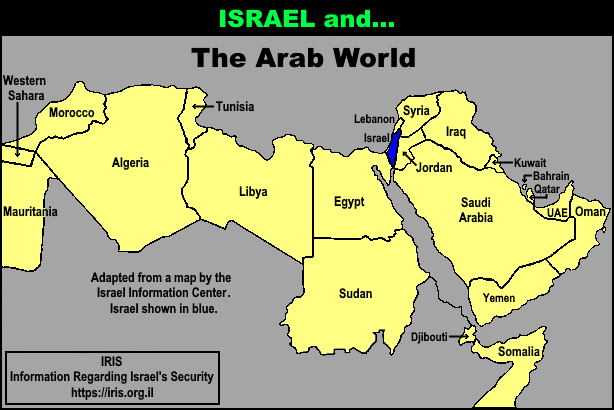
Prior to your rude arrival, the Palestinian people lived off and for that land for thousands of years.
Your map does not even bother to share me in. It is obvious that was your intention all along. Never mind the hogwash about you wanting to live in peace. Your real intention is to clear and ethnically cleanse the remaining population off the land. That objective was always clear for us. But I have to thank you for having the honesty to admit it to the rest of the people in here.
We have lived on this land for thousands of years and out of a sudden, we started watching ships swarming and arriving at our beaches filled with armed zionists who were trained in advance at the skills of killing, destruction and ethnic cleansing to clear way for other khazari colonizers like you to come and steal.
FUCK YOU YOU LITTLE ZIONIST THIEF!
Please don't exaggerate your presence in Palestine:Quote from WAEL012000:
Prior to your rude arrival, the Palestinian people lived off and for that land for thousands of years.
Mark Twain visited Palestine in 1867 and wrote in Innocents Abroad:
"Palestine sits in sackcloth and ashes. Over it broods the spell of a curse that has withered its fields and fettered its energies. Palestine is desolate and unlovely -- Palestine is no more of this workday world. It is sacred to poetry and tradition, it is dreamland." "There was hardly a tree or a shrub anywhere. Even the olive and the cactus, those fast friends of a worthless soil, had almost deserted the country". "A desolation is here that not even imagination can grace with the pomp of life and action. We reached Tabor safely. We never saw a human being on the whole route". "There is not a solitary village throughout its whole extent â not for thirty miles in either direction. ...One may ride ten miles hereabouts and not see ten human beings." ...these unpeopled deserts, these rusty mounds of barrenness..."
In 1898, German Kaiser Wilhelm II also visited Palestine. He was appalled at the condition of the country. The Ottomans had stripped the forests for lumber and firewood. The Palestinian Arabs had let an old Roman aqueduct fall into ruin. The ultimate ecological curse was the ubiquitous herds of black goats. For nearly 2,000 years after the dispersion of the Jews, Arabs had allowed their goats to graze unfenced across Palestine. They had eaten the grass down to its roots, and the topsoil had eroded and blown away. The biblical land of milk and honey had become a dust bowl.
Alphonse de Lamartine visited Palestine in 1835:
"Outside the gates of Jerusalem we saw indeed no living object, heard no living sound, we found the same void, the same silence ... as we should have expected before the entombed gates of Pompeii or Herculaneam a complete eternal silence reigns in the town, on the highways, in the country ... the tomb of a whole people."
Quote from dddooo:
Frankly I want peace and a two-state solution. Of course given unilateral compromises and sacrifices Barak was forced to make and the fact that the Palestinians still walked away from the proposal without even a courtesy of a counter-offer, started the intraday and elected Hamas the chances of any kind of solution any time soon are probably quite remote.
Khahahaha!
frankly, you wanted to steal most of the land and divide the rest into small cantons that cannot maintain an autonomous entity.
Frankly you wanted to cage the rest of the population in an attempt to make them flee or face the threat of watching their kids die from starvation.
Frankly that even your Barak admitted to that.
Frankly, your Barak didn't even think that these conditions that were imposed on us were humiliating enough; he to send Sharon to the Al Aqsa mosque to stair anger so that your barak could commit a massacre that will start the second intifada. And a massacre he did!
Quote from WAEL012000:
Khahahaha!
frankly, you wanted to steal most of the land and divide the rest into small cantons that cannot maintain an autonomous entity.
Frankly you wanted to cage the rest of the population in an attempt to make them flee or face the threat of watching their kids die from starvation.
Frankly that even your Barak admitted to that.
Frankly, your Barak didn't even think that these conditions that were imposed on us were humiliating enough; he to send Sharon to the Al Aqsa mosque to stair anger so that your barak could commit a massacre that will start the second intifada. And a massacre he did!
And to think some people want to give a so called two state solution to the likes of this.
December 27, 2000Quote from WAEL012000:
frankly, you wanted to steal most of the land and divide the rest into small cantons that cannot maintain an autonomous entity.
Frankly you wanted to cage the rest of the population in an attempt to make them flee or face the threat of watching their kids die from starvation.
Frankly that even your Barak admitted to that.
Frankly, your Barak didn't even think that these conditions that were imposed on us were humiliating enough; he to send Sharon to the Al Aqsa mosque to stair anger so that your barak could commit a massacre that will start the second intifada. And a massacre he did!
France Tuesday expressed its support for the compromise deal proposed by US President Bill Clinton to Israel and Palestinians to reach a peace agreement, describing it as the best that can be worked out now.
Spokesman of the French Foreign Ministry Francois Rivasseau said that although the Clinton proposal is not perfect, there exists no "credible alternative."
"Is there a better solution which can come out for a foreseeable term? I don't think so," he said.
http://english.people.com.cn/english/200012/27/eng20001227_58896.html
Hmm, what do you know Wael, the French thought it was a good offer, Wael thinks it was not.