
Democrats and Socialism

The great exodus out of America’s blue cities
BY KRISTIN TATE, OPINION CONTRIBUTOR — 04/24/18 09:30 AM EDT 7,546
THE VIEWS EXPRESSED BY CONTRIBUTORS ARE THEIR OWN AND NOT THE VIEW OF THE HILL
10,393

Poll: Americans now prefer GOP over Dems on taxes, but tax bill still unpopularPoll: Americans now prefer GOP over Dems on taxes, but tax bill still unpopular
TheHill.com


Autoplay: On | Off
Am I the only one in my spinning class at Equinox in Manhattan who’s fed up paying $200 every month for a gym with clean showers, $3,000 in rent every month for an apartment without cockroaches and $8 every morning for a cup of coffee? Am I the only one moving through the greater part of New York City boroughs and seeing an inexorable march of urban decay matched with the discomfort of crowding and inexplicable costs? I know I am not.

New York is the most expensive city in America. Its lower-cost neighborhoods are riddled with crime and homelessness. Its public schools, some of which are among the worst in the nation, look more like prisons than places of learning.


With between up to 50 percent of their paycheck going to a combination of federal, local and city taxes, not including other consumer taxes baked into every aspect of their consumer practices, residents don’t even have the comfort of knowing that their tax expenditures are going to the improvement of their lives in the city. New York infamously misuses the hard-earned tax revenues of its citizens in ways that scarcely benefit them.


Eventually, city and state taxes, fees, and regulations become so burdensome that people and corporations jump ship. More people are currently fleeing New York than any other metropolitan area in the nation. More than 1 million people have moved out of the New York City metro area since 2010 in search of greener pastures, which amounts to a negative net migration rate of 4.4 percent.
The recently passed tax bill, which repeals the state and local tax (SALT) deduction, will only speed up the exodus. Thanks to the bill’s passage, many New York taxpayers will save little or nothing despite a cut in the federal rate. The state’s highest earners — who have been footing an outsized share of the bill — will pay tens of thousands of dollars more in income taxes in 2018. In New York alone, loss of the SALT deduction will remove $72 billion a year in tax deductions and affect 3.4 million residents.

And make no mistake: What’s happening in the Big Apple is a microcosm of what’s happening in the nation’s blue states, cities and towns. New York, Los Angeles, Chicago — the places where power and capital have traditionally congregated — have become so over-regulated, so overpriced and mismanaged, and so morally bankrupt and soft on crime that people are leaving in droves. Of course, these high-tax cities are the same places hit hardest by the removal of the SALT deduction.

The cost of popular moving truck services, like U-Haul, is largely created through the ironclad rules of supply and demand. Turns out, there is much higher demand for trucks leaving high-tax blue states heading to low-tax red states than vice versa.

The route from California to Texas, for example, is more than twice as expensive as a route from Texas to California. Want to go from Los Angeles to Dallas? $2,558. Returning back? $1,232. Texas is the No. 1 state people move trucks to, with states like Florida, South Carolina, Tennessee, North Carolina and Colorado rounding out the top 10. The states people are fleeing? New York, New Jersey, Massachusetts, Michigan, Pennsylvania, Illinois — and at the top, California.

These facts are not coincidences. In fact, in 2016 the Golden State lost almost 143,000 net residents to other states — that figure is an 11 percent increase from 2015. Between 2005 and 2015, Los Angeles and San Francisco alone lost 250,000 residents. The largest socioeconomic segment moving from California is the upper-middle class. The state is home to some of the most burdensome taxes and regulations in the nation. Meanwhile, its social engineering — from green energy to wealth redistribution — have made many working families poorer. As California begins its long decline, the influx outward is picking up in earnest.

The only way to slow the great exodus out of America’s blue meccas is to make these areas more affordable for middle-class families; the most significant way to do that is to lower state and city income taxes. And if residents don’t want to be “double taxed” following the removal of SALT deductions, the solution is simple: remove state and city income taxes altogether.

Houston is the nation’s fourth-largest city and is able to operate, while funding massive infrastructure projects to support its population, without income tax revenue. When residents keep more of their hard-earned money, they are more incentivized to spend that money in ways that make their community a better place.

This is a lesson high-tax states and cities need to learn if they want to avoid transforming into ghost towns.

Kristin Tate is author of the new book How Do I Tax Thee?: The Field Guide to the Great American Rip-Off. Follow her on Twitter @KristinBTate.

TAGS KRISTIN TATE ECONOMY TAXATION IN THE UNITED STATES INCOME TAX TAX MONEY TAX EXPENDITURE STATE TAXATION IN THE UNITED STATES SALES TAX STATE INCOME TAX

LOAD COMMENTS (7,546)
 
JULY 12, 2013
The politics and demographics of food stamp recipients
BY RICH MORIN

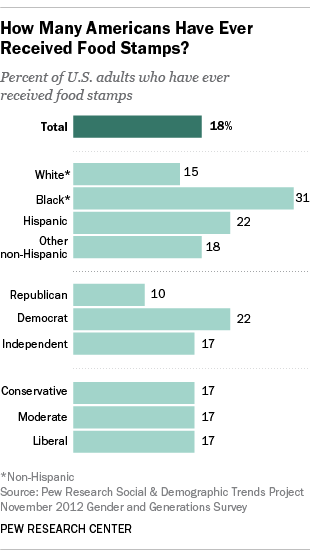
Democrats are about twice as likely as Republicans to have received food stamps at some point in their lives—a participation gap that echoes the deep partisan divide in the U.S. House of Representatives, which on Thursday produced a farm bill that did not include funding for the food stamp program.

FT_13.07.12_FoodStamps_310px.png
Overall, a Pew Research Center surveyconducted late last year found that about one-in-five Americans (18%) has participated in the food stamp program, formally known as the Supplemental Nutrition Assistance Program. About a quarter (26%) lives in a household with a current or former food stamp recipient.

Of these, about one-in-five (22%) of Democrats say they had received food stamps compared with 10% of Republicans. About 17% of political independents say they have received food stamps.

The share of food stamp beneficiaries swells even further when respondents are asked if someone else living in their household had ever received food stamps. According to the survey, about three in ten Democrats (31%) and about half as many Republicans (17%) say they or someone in their household has benefitted from the food stamp program.

But when the political lens shifts from partisanship to ideology, the participation gap vanishes. Self-described political conservatives were no more likely than liberals or moderates to have received food stamps (17% for each group), according to the survey.

Beyond politics, equally large or larger gaps emerge in the participation rates of many core social and demographic groups. For example, women were about twice as likely as men (23% vs. 12%) to have received food stamps at some point in their lives. Blacks are about twice as likely as whites to have used this benefit during their lives (31% vs. 15%). Among Hispanics, about 22% say they have collected food stamps.

Minority women in particular are far more likely than their male counterparts to have used food stamps. About four-in-ten black women (39%) have gotten help compared with 21% of black men. The gender-race participation gap is also wide among Hispanics: 31% of Hispanic women but 14% of Hispanic men received assistance.

Among whites, the gender-race gap is smaller. Still, white women are about twice as likely as white men to receive food stamp assistance (19% vs. 11%).

The survey also found that adults 65 and older are significantly less likely than other age groups to say they have received food stamps. For example, about 18% of adults aged 18 to 29 have benefitted from this entitlement program compared with 8% of those 65 and older. Those who have a high school diploma or less formal education are roughly three times more likely than college graduates to have been helped.

The farm bill passed by the House on Thursday, after a day of intense and sometimes hostile debate, was stripped of about $740 billion in funding for food stamps, setting up a confrontation with the Senate which has approved a very different version of the legislation.

The legislation represented the first time since 1973 that a House version failed to provide support for food stamps. The vote Thursday was 216-208, with all 196 Democrats present voting to oppose the measure. Twelve Republicans also voted against the bill.

While politically, congressional Republicans have focused on reducing spending on federal entitlement programs, the Pew Research survey found the U.S. to be “a “bipartisan nation of beneficiaries.”

The survey found that significant proportions of Democrats (60%) and Republicans (52%) say they have benefited from a major entitlement program at some point in their lives. So have nearly equal shares of self-identifying conservatives (57%), liberals (53%) and moderates (53%). The programs were Social Security, Medicare, Medicaid, welfare, unemployment benefits and food stamps.

CATEGORY: SOCIAL STUDIES

TOPICS: ENTITLEMENTS, POLITICAL PARTY AFFILIATION, DOMESTIC AFFAIRS AND POLICY

SHARE THIS LINK:
Rich Morin is a senior editor focusing on social and demographic trends at Pew Research Center.

GET PEW RESEARCH CENTER DATA BY EMAIL
MAKE A FINANCIAL CONTRIBUTION TO SUPPORT OUR WORK
DONATE
ABOUT FACT TANK


I don't think you understand - Democrats are in favor of feeding the poor and hungry and they do WITH THEIR OWN MONEY - Republicans don't like feeding anyone except themselves and when they can't feed themselves, they will let Democrats fund their welfare programs for them. That's socialism
 
The great exodus out of America’s blue cities
BY KRISTIN TATE, OPINION CONTRIBUTOR — 04/24/18 09:30 AM EDT 7,546
THE VIEWS EXPRESSED BY CONTRIBUTORS ARE THEIR OWN AND NOT THE VIEW OF THE HILL
10,393

Poll: Americans now prefer GOP over Dems on taxes, but tax bill still unpopularPoll: Americans now prefer GOP over Dems on taxes, but tax bill still unpopular
TheHill.com


Autoplay: On | Off
Am I the only one in my spinning class at Equinox in Manhattan who’s fed up paying $200 every month for a gym with clean showers, $3,000 in rent every month for an apartment without cockroaches and $8 every morning for a cup of coffee? Am I the only one moving through the greater part of New York City boroughs and seeing an inexorable march of urban decay matched with the discomfort of crowding and inexplicable costs? I know I am not.

New York is the most expensive city in America. Its lower-cost neighborhoods are riddled with crime and homelessness. Its public schools, some of which are among the worst in the nation, look more like prisons than places of learning.


With between up to 50 percent of their paycheck going to a combination of federal, local and city taxes, not including other consumer taxes baked into every aspect of their consumer practices, residents don’t even have the comfort of knowing that their tax expenditures are going to the improvement of their lives in the city. New York infamously misuses the hard-earned tax revenues of its citizens in ways that scarcely benefit them.


Eventually, city and state taxes, fees, and regulations become so burdensome that people and corporations jump ship. More people are currently fleeing New York than any other metropolitan area in the nation. More than 1 million people have moved out of the New York City metro area since 2010 in search of greener pastures, which amounts to a negative net migration rate of 4.4 percent.
The recently passed tax bill, which repeals the state and local tax (SALT) deduction, will only speed up the exodus. Thanks to the bill’s passage, many New York taxpayers will save little or nothing despite a cut in the federal rate. The state’s highest earners — who have been footing an outsized share of the bill — will pay tens of thousands of dollars more in income taxes in 2018. In New York alone, loss of the SALT deduction will remove $72 billion a year in tax deductions and affect 3.4 million residents.

And make no mistake: What’s happening in the Big Apple is a microcosm of what’s happening in the nation’s blue states, cities and towns. New York, Los Angeles, Chicago — the places where power and capital have traditionally congregated — have become so over-regulated, so overpriced and mismanaged, and so morally bankrupt and soft on crime that people are leaving in droves. Of course, these high-tax cities are the same places hit hardest by the removal of the SALT deduction.

The cost of popular moving truck services, like U-Haul, is largely created through the ironclad rules of supply and demand. Turns out, there is much higher demand for trucks leaving high-tax blue states heading to low-tax red states than vice versa.

The route from California to Texas, for example, is more than twice as expensive as a route from Texas to California. Want to go from Los Angeles to Dallas? $2,558. Returning back? $1,232. Texas is the No. 1 state people move trucks to, with states like Florida, South Carolina, Tennessee, North Carolina and Colorado rounding out the top 10. The states people are fleeing? New York, New Jersey, Massachusetts, Michigan, Pennsylvania, Illinois — and at the top, California.

These facts are not coincidences. In fact, in 2016 the Golden State lost almost 143,000 net residents to other states — that figure is an 11 percent increase from 2015. Between 2005 and 2015, Los Angeles and San Francisco alone lost 250,000 residents. The largest socioeconomic segment moving from California is the upper-middle class. The state is home to some of the most burdensome taxes and regulations in the nation. Meanwhile, its social engineering — from green energy to wealth redistribution — have made many working families poorer. As California begins its long decline, the influx outward is picking up in earnest.

The only way to slow the great exodus out of America’s blue meccas is to make these areas more affordable for middle-class families; the most significant way to do that is to lower state and city income taxes. And if residents don’t want to be “double taxed” following the removal of SALT deductions, the solution is simple: remove state and city income taxes altogether.

Houston is the nation’s fourth-largest city and is able to operate, while funding massive infrastructure projects to support its population, without income tax revenue. When residents keep more of their hard-earned money, they are more incentivized to spend that money in ways that make their community a better place.

This is a lesson high-tax states and cities need to learn if they want to avoid transforming into ghost towns.

Kristin Tate is author of the new book How Do I Tax Thee?: The Field Guide to the Great American Rip-Off. Follow her on Twitter @KristinBTate.

TAGS KRISTIN TATE ECONOMY TAXATION IN THE UNITED STATES INCOME TAX TAX MONEY TAX EXPENDITURE STATE TAXATION IN THE UNITED STATES SALES TAX STATE INCOME TAX

LOAD COMMENTS (7,546)

Exactly, some blue states are becoming too rich causing some people to move, which means all states should become red state shit holes on the dole.
 
The great exodus out of America’s blue cities
BY KRISTIN TATE, OPINION CONTRIBUTOR — 04/24/18 09:30 AM EDT 7,546
THE VIEWS EXPRESSED BY CONTRIBUTORS ARE THEIR OWN AND NOT THE VIEW OF THE HILL
10,393

Poll: Americans now prefer GOP over Dems on taxes, but tax bill still unpopularPoll: Americans now prefer GOP over Dems on taxes, but tax bill still unpopular
TheHill.com


Autoplay: On | Off
Am I the only one in my spinning class at Equinox in Manhattan who’s fed up paying $200 every month for a gym with clean showers, $3,000 in rent every month for an apartment without cockroaches and $8 every morning for a cup of coffee? Am I the only one moving through the greater part of New York City boroughs and seeing an inexorable march of urban decay matched with the discomfort of crowding and inexplicable costs? I know I am not.

New York is the most expensive city in America. Its lower-cost neighborhoods are riddled with crime and homelessness. Its public schools, some of which are among the worst in the nation, look more like prisons than places of learning.


With between up to 50 percent of their paycheck going to a combination of federal, local and city taxes, not including other consumer taxes baked into every aspect of their consumer practices, residents don’t even have the comfort of knowing that their tax expenditures are going to the improvement of their lives in the city. New York infamously misuses the hard-earned tax revenues of its citizens in ways that scarcely benefit them.


Eventually, city and state taxes, fees, and regulations become so burdensome that people and corporations jump ship. More people are currently fleeing New York than any other metropolitan area in the nation. More than 1 million people have moved out of the New York City metro area since 2010 in search of greener pastures, which amounts to a negative net migration rate of 4.4 percent.
The recently passed tax bill, which repeals the state and local tax (SALT) deduction, will only speed up the exodus. Thanks to the bill’s passage, many New York taxpayers will save little or nothing despite a cut in the federal rate. The state’s highest earners — who have been footing an outsized share of the bill — will pay tens of thousands of dollars more in income taxes in 2018. In New York alone, loss of the SALT deduction will remove $72 billion a year in tax deductions and affect 3.4 million residents.

And make no mistake: What’s happening in the Big Apple is a microcosm of what’s happening in the nation’s blue states, cities and towns. New York, Los Angeles, Chicago — the places where power and capital have traditionally congregated — have become so over-regulated, so overpriced and mismanaged, and so morally bankrupt and soft on crime that people are leaving in droves. Of course, these high-tax cities are the same places hit hardest by the removal of the SALT deduction.

The cost of popular moving truck services, like U-Haul, is largely created through the ironclad rules of supply and demand. Turns out, there is much higher demand for trucks leaving high-tax blue states heading to low-tax red states than vice versa.

The route from California to Texas, for example, is more than twice as expensive as a route from Texas to California. Want to go from Los Angeles to Dallas? $2,558. Returning back? $1,232. Texas is the No. 1 state people move trucks to, with states like Florida, South Carolina, Tennessee, North Carolina and Colorado rounding out the top 10. The states people are fleeing? New York, New Jersey, Massachusetts, Michigan, Pennsylvania, Illinois — and at the top, California.

These facts are not coincidences. In fact, in 2016 the Golden State lost almost 143,000 net residents to other states — that figure is an 11 percent increase from 2015. Between 2005 and 2015, Los Angeles and San Francisco alone lost 250,000 residents. The largest socioeconomic segment moving from California is the upper-middle class. The state is home to some of the most burdensome taxes and regulations in the nation. Meanwhile, its social engineering — from green energy to wealth redistribution — have made many working families poorer. As California begins its long decline, the influx outward is picking up in earnest.

The only way to slow the great exodus out of America’s blue meccas is to make these areas more affordable for middle-class families; the most significant way to do that is to lower state and city income taxes. And if residents don’t want to be “double taxed” following the removal of SALT deductions, the solution is simple: remove state and city income taxes altogether.

Houston is the nation’s fourth-largest city and is able to operate, while funding massive infrastructure projects to support its population, without income tax revenue. When residents keep more of their hard-earned money, they are more incentivized to spend that money in ways that make their community a better place.

This is a lesson high-tax states and cities need to learn if they want to avoid transforming into ghost towns.

Kristin Tate is author of the new book How Do I Tax Thee?: The Field Guide to the Great American Rip-Off. Follow her on Twitter @KristinBTate.

TAGS KRISTIN TATE ECONOMY TAXATION IN THE UNITED STATES INCOME TAX TAX MONEY TAX EXPENDITURE STATE TAXATION IN THE UNITED STATES SALES TAX STATE INCOME TAX

LOAD COMMENTS (7,546)

If the cities are crumbling and crime ridden, how can the author afford her $8 latte and $200 spin class?
 
I don't think you understand - Democrats are in favor of feeding the poor and hungry and they do WITH THEIR OWN MONEY - Republicans don't like feeding anyone except themselves and when they can't feed themselves, they will let Democrats fund their welfare programs for them. That's socialism

Democrats favor giving the money from people who work & pay taxes to those who don't pay taxes. Now Democrats have taken it a step further and fostered that socialism is their vision of the future. Let's go take a look at Venezuela to see how this works out.
 
Democrats favor giving the money from people who work & pay taxes to those who don't pay taxes. Now Democrats have taken it a step further and fostered that socialism is their vision of the future. Let's go take a look at Venezuela to see how this works out.

America is already socialist. There is no developed country that is not.

How to explain this to men with minds like children.. oh who are we kidding, they know perfectly well it is about a small change in the emphasis on exiting socialism. What is upsetting them is the use of the word which they were programmed to fear since the red scare. Loss in productivity is a fear (unfounded) however it hardly matters because due to the demographic bomb, by 2030 there will be few jobs that are not wiping the bottoms of senile seniors. CaptainObvious is a good example of this, imagine him in a decade.

The issue with Venezuela is Maduro has been getting support from Cuba and this has kept him propped up. Venezuela is Cuba's oil supply. They supply his body guards and doctors for hospitals (for the elite). Without doctors to treat the high officials and military officer's kids etc. Maduro would have been killed already.

What kind of government does Cuba have? The Castro family have run Cuba since the 50s. That is a dictatorship which runs a pseudo-communist system to supply enough to prevent revolution. Good hospitals and music schools. Solving Venezuela means tackling Cuban interference. Obama was doing that by normalization of relations, now there is nothing.
 
Last edited:
Democrats favor giving the money from people who work & pay taxes to those who don't pay taxes. Now Democrats have taken it a step further and fostered that socialism is their vision of the future. Let's go take a look at Venezuela to see how this works out.

Again you don't seem to understand, its Democrats WHO WORK and PAY for these programs and VOTE for people promoting these policies, Republicans on the other hand being the poor uneducated wretches they are, can't find good work other than the few 'businessmen' running scams so they don't pay for these programs but are happy to mooch off others when it suits them.

Proof for my claims

AP FACT CHECK: Blue high-tax states fund red low-tax states


https://www.apnews.com/2f83c72de1bd440d92cdbc0d3b6bc08c
 
Last edited:
Again you don't seem to understand, its Democrats WHO WORK and PAY for these programs and VOTE for people promoting these policies, Republicans on the other hand being the poor uneducated wretches they are, can't find good work other than the few 'businessmen' running scams so they don't pay for these programs but are happy to mooch off others when it suits them.

Proof for my claims

AP FACT CHECK: Blue high-tax states fund red low-tax states


https://www.apnews.com/2f83c72de1bd440d92cdbc0d3b6bc08c

Once again, let's look at the truth about Blue and Red states...

The concept that 'red' states are the 'moochers' is absurd. Let's eliminate military base spending, farm subsidies, and other non-welfare federal spending from the accounting.

The red states do not really want the military bases that were forced on them. These bases take up large tracts of land that are useful for other economic purposes and require local money spent on policing & other services because they tend to be high crime / low income areas. Let's put a large military base in NYC or Boston - and bulldoze all the existing homes. The displaced residents can survive on the 80%+ of large farm subsidies that are sent to the owners of corporate farms who reside in blue states (but is seen as red state money for some reason).

Let's focus on federal welfare spending--defined here as childhood nutrition programs, food stamp programs, WIC benefits TANF benefits, and other similar benefits.

This article from USA Today "New Yorkers lead pack in government benefits" compiled data showing which states had the highest per capita expenditures for every type of government-provided benefit and blue states top the list and red states made up most of the bottom 10.

Top 10 - Most dependent on government aid
1 New York
2 West Virginia
3 Rhode Island
4 Maine
5 Pennsylvania
6 Massachusetts
7 Vermont
8 Kentucky
9 Michigan
10 Connecticut

Bottom 10 - Least dependent on government aid
41 South Dakota
42 Nebraska
43 Wyoming
44 Idaho
45 Georgia
46 Texas
47 Nevada
48 Virginia
49 Colorado
50 Utah
 
Back
Top