
You are using an out of date browser. It may not display this or other websites correctly.
You should upgrade or use an alternative browser.
You should upgrade or use an alternative browser.
Democrats and Socialism
- Thread starter gwb-trading
- Start date


As if the misery in Venezuela, Cuba, North Korea is not enough? How about Italy, France, United Kingdom? Liberals increase taxes, workers demand higher wages since, they have far less after taxes and go on strike. Since, they are paying thru their nose in taxes, government gives them higher wages then, increases the taxes on the workers since, they have to pay for all entitlements. Workers again go on strike for more monies and gets it, government goes on and raises taxes yet, again because entitlements have to paid! Businesses struggle with the high taxes and either fail and go bankrupt causing job losses or layoff people! And the vicious cycle is repeated all over again! That is the Democrat Party model. Now, why would anyone in their right mind ever vote for a Democrat?
Last edited:

Gallup: Democrats Prefer Socialism to Capitalism for the First Time
Spencer Platt / Getty
13 Aug 20189,996
Gallup reported Monday morning that “Democrats have a more positive image of socialism than they do of capitalism” for the first time since the company began polling that question over the past decade.
The major shift, Gallup says, has been that Democrats have lost faith in capitalism — even as the economy has exceeded 4.1% growth and unemployment has hit all-time lows:
Attitudes toward socialism among Democrats have not changed materially since 2010, with 57% today having a positive view. The major change among Democrats has been a less upbeat attitude toward capitalism, dropping to 47% positive this year — lower than in any of the three previous measures. Republicans remain much more positive about capitalism [71%] than about socialism [16%], with little sustained change in their views of either since 2010.
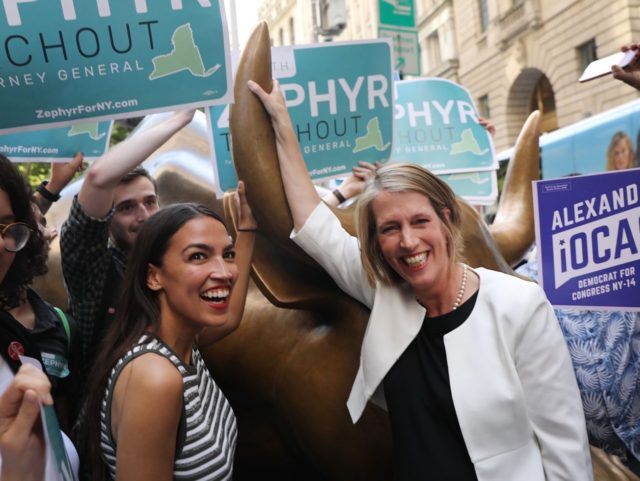
The poll mentions Democratic congressional candidate Alexandria Ocasio-Cortez, who has become a national figure since defeating incumbent Rep. Joe Crowley in a primary race in New York while running as an unabashed “democratic socialist.”
Gallup notes that there has been “12-point decline in young adults’ positive views of capitalism in just the past two years and a marked shift since 2010, when 68% viewed it positively.” That result comes in spite of growing opportunity for young people in the growing economy.
It would appear that Democrats, and young people, may have a view on capitalism that is not driven by economic reality but by politics and aesthetics.
A Reason-Rupe poll in 2014 found that two-thirds of millennials distrusted government — but that a similar proportion also wanted government to provide more necessities like health care.
Spencer Platt / Getty
13 Aug 20189,996
Gallup reported Monday morning that “Democrats have a more positive image of socialism than they do of capitalism” for the first time since the company began polling that question over the past decade.
The major shift, Gallup says, has been that Democrats have lost faith in capitalism — even as the economy has exceeded 4.1% growth and unemployment has hit all-time lows:
Attitudes toward socialism among Democrats have not changed materially since 2010, with 57% today having a positive view. The major change among Democrats has been a less upbeat attitude toward capitalism, dropping to 47% positive this year — lower than in any of the three previous measures. Republicans remain much more positive about capitalism [71%] than about socialism [16%], with little sustained change in their views of either since 2010.
The poll mentions Democratic congressional candidate Alexandria Ocasio-Cortez, who has become a national figure since defeating incumbent Rep. Joe Crowley in a primary race in New York while running as an unabashed “democratic socialist.”
Gallup notes that there has been “12-point decline in young adults’ positive views of capitalism in just the past two years and a marked shift since 2010, when 68% viewed it positively.” That result comes in spite of growing opportunity for young people in the growing economy.
It would appear that Democrats, and young people, may have a view on capitalism that is not driven by economic reality but by politics and aesthetics.
A Reason-Rupe poll in 2014 found that two-thirds of millennials distrusted government — but that a similar proportion also wanted government to provide more necessities like health care.

Gallup: Democrats Prefer Socialism to Capitalism for the First Time
Spencer Platt / Getty
13 Aug 20189,996
Gallup reported Monday morning that “Democrats have a more positive image of socialism than they do of capitalism” for the first time since the company began polling that question over the past decade.
The major shift, Gallup says, has been that Democrats have lost faith in capitalism — even as the economy has exceeded 4.1% growth and unemployment has hit all-time lows:
Attitudes toward socialism among Democrats have not changed materially since 2010, with 57% today having a positive view. The major change among Democrats has been a less upbeat attitude toward capitalism, dropping to 47% positive this year — lower than in any of the three previous measures. Republicans remain much more positive about capitalism [71%] than about socialism [16%], with little sustained change in their views of either since 2010.
The poll mentions Democratic congressional candidate Alexandria Ocasio-Cortez, who has become a national figure since defeating incumbent Rep. Joe Crowley in a primary race in New York while running as an unabashed “democratic socialist.”
Gallup notes that there has been “12-point decline in young adults’ positive views of capitalism in just the past two years and a marked shift since 2010, when 68% viewed it positively.” That result comes in spite of growing opportunity for young people in the growing economy.
It would appear that Democrats, and young people, may have a view on capitalism that is not driven by economic reality but by politics and aesthetics.
A Reason-Rupe poll in 2014 found that two-thirds of millennials distrusted government — but that a similar proportion also wanted government to provide more necessities like health care.
No surprise. In the eye of young people, "free stuff" trumps everything.

there is a good silver lining about socialists: first thing they do - they execute all fucken democrats who help them come to power
Gallup: Democrats Prefer Socialism to Capitalism for the First Time
Spencer Platt / Getty
13 Aug 20189,996
Gallup reported Monday morning that “Democrats have a more positive image of socialism than they do of capitalism” for the first time since the company began polling that question over the past decade.
The major shift, Gallup says, has been that Democrats have lost faith in capitalism — even as the economy has exceeded 4.1% growth and unemployment has hit all-time lows:
Attitudes toward socialism among Democrats have not changed materially since 2010, with 57% today having a positive view. The major change among Democrats has been a less upbeat attitude toward capitalism, dropping to 47% positive this year — lower than in any of the three previous measures. Republicans remain much more positive about capitalism [71%] than about socialism [16%], with little sustained change in their views of either since 2010.
The poll mentions Democratic congressional candidate Alexandria Ocasio-Cortez, who has become a national figure since defeating incumbent Rep. Joe Crowley in a primary race in New York while running as an unabashed “democratic socialist.”
Gallup notes that there has been “12-point decline in young adults’ positive views of capitalism in just the past two years and a marked shift since 2010, when 68% viewed it positively.” That result comes in spite of growing opportunity for young people in the growing economy.
It would appear that Democrats, and young people, may have a view on capitalism that is not driven by economic reality but by politics and aesthetics.
A Reason-Rupe poll in 2014 found that two-thirds of millennials distrusted government — but that a similar proportion also wanted government to provide more necessities like health care.
The US is socialist as are all western economies.
Democrats who 'prefer' it are nearly as ignorant as the right (nearly, hard to get that ignorant).
All trapped in a babel involving what
a. Countries call themselves.
b. What you call them.
c. What they actually are.
For example, North Korea and the USSR are/were called communist though they call themselves socialist. Both controlled by single person/small party who were dictators which made them in reality fascist dictatorships. However the Soviets were the US' allies in WWII and it is a bit tricky to call the USSR fascist as they were the allies in fighting Germany which was fascist.. so Communism was as a political term even though it did not fit.
It is impossible for a true Capitalist or Communist system to exist because they rely on human nature being perfect so the only two systems that do stay stable are fascism (in it's stable dictator form) and socialism. Both are paired up with capitalism to a varying degree and shades of communism.
Just we rarely call fascism out because after the red scare in the 50s, the public's brain in the US was made into word spaghetti.
Of course it not as neat due to an extra factor.
x. How they oscillate over time.
Last edited:

The US is socialist as are all western economies.
Democrats who 'prefer' it are nearly as ignorant as the right (nearly, hard to get that ignorant).
All trapped in a babel involving what
a. Countries call themselves.
b. What you call them.
c. What they actually are.
For example, North Korea and the USSR are/were called communist though they call themselves socialist. Both controlled by single person/small party who were dictators which made them in reality fascist dictatorships. However the Soviets were the US' allies in WWII and it is a bit tricky to call the USSR fascist as they were the allies in fighting Germany which was fascist.. so Communism was as a political term even though it did not fit.
It is impossible for a true Capitalist or Communist system to exist because they rely on human nature being perfect so the only two systems that do stay stable are fascism (in it's stable dictator form) and socialism. Both are paired up with capitalism to a varying degree and shades of communism.
Just we rarely call fascism out because after the red scare in the 50s, the public's brain in the US was made into word spaghetti.
Of course it not as neat due to an extra factor.
x. How they oscillate over time.
Biggest socialist program in the world? US defense department.
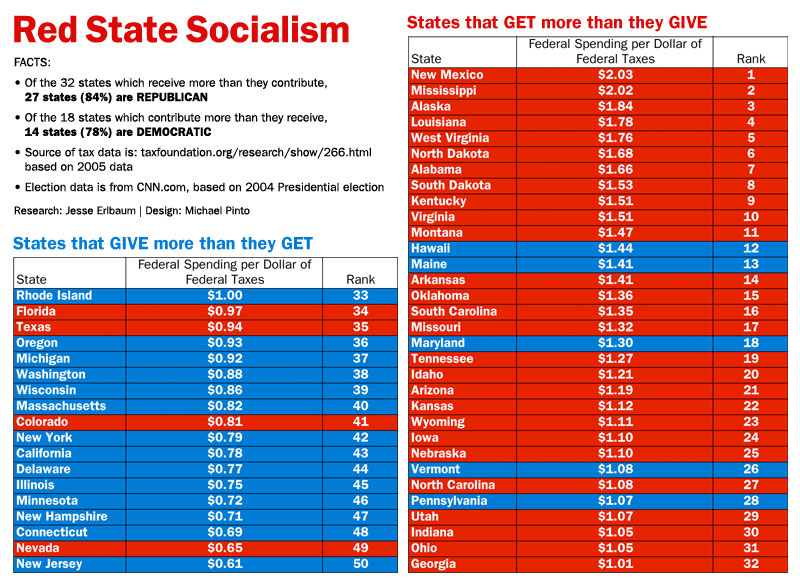
JULY 12, 2013Nice cartoon, here are some actual facts
The politics and demographics of food stamp recipients
BY RICH MORIN
Democrats are about twice as likely as Republicans to have received food stamps at some point in their lives—a participation gap that echoes the deep partisan divide in the U.S. House of Representatives, which on Thursday produced a farm bill that did not include funding for the food stamp program.
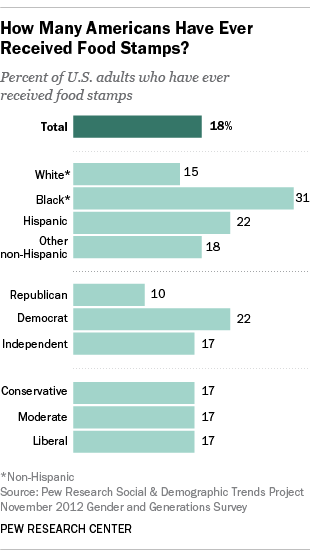
Of these, about one-in-five (22%) of Democrats say they had received food stamps compared with 10% of Republicans. About 17% of political independents say they have received food stamps.
The share of food stamp beneficiaries swells even further when respondents are asked if someone else living in their household had ever received food stamps. According to the survey, about three in ten Democrats (31%) and about half as many Republicans (17%) say they or someone in their household has benefitted from the food stamp program.
But when the political lens shifts from partisanship to ideology, the participation gap vanishes. Self-described political conservatives were no more likely than liberals or moderates to have received food stamps (17% for each group), according to the survey.
Beyond politics, equally large or larger gaps emerge in the participation rates of many core social and demographic groups. For example, women were about twice as likely as men (23% vs. 12%) to have received food stamps at some point in their lives. Blacks are about twice as likely as whites to have used this benefit during their lives (31% vs. 15%). Among Hispanics, about 22% say they have collected food stamps.
Minority women in particular are far more likely than their male counterparts to have used food stamps. About four-in-ten black women (39%) have gotten help compared with 21% of black men. The gender-race participation gap is also wide among Hispanics: 31% of Hispanic women but 14% of Hispanic men received assistance.
Among whites, the gender-race gap is smaller. Still, white women are about twice as likely as white men to receive food stamp assistance (19% vs. 11%).
The survey also found that adults 65 and older are significantly less likely than other age groups to say they have received food stamps. For example, about 18% of adults aged 18 to 29 have benefitted from this entitlement program compared with 8% of those 65 and older. Those who have a high school diploma or less formal education are roughly three times more likely than college graduates to have been helped.
The farm bill passed by the House on Thursday, after a day of intense and sometimes hostile debate, was stripped of about $740 billion in funding for food stamps, setting up a confrontation with the Senate which has approved a very different version of the legislation.
The legislation represented the first time since 1973 that a House version failed to provide support for food stamps. The vote Thursday was 216-208, with all 196 Democrats present voting to oppose the measure. Twelve Republicans also voted against the bill.
While politically, congressional Republicans have focused on reducing spending on federal entitlement programs, the Pew Research survey found the U.S. to be “a “bipartisan nation of beneficiaries.”
The survey found that significant proportions of Democrats (60%) and Republicans (52%) say they have benefited from a major entitlement program at some point in their lives. So have nearly equal shares of self-identifying conservatives (57%), liberals (53%) and moderates (53%). The programs were Social Security, Medicare, Medicaid, welfare, unemployment benefits and food stamps.
CATEGORY: SOCIAL STUDIES
TOPICS: ENTITLEMENTS, POLITICAL PARTY AFFILIATION, DOMESTIC AFFAIRS AND POLICY
SHARE THIS LINK:
Rich Morin is a senior editor focusing on social and demographic trends at Pew Research Center.
GET PEW RESEARCH CENTER DATA BY EMAIL
MAKE A FINANCIAL CONTRIBUTION TO SUPPORT OUR WORK
DONATE
ABOUT FACT TANK