Fractal .... a bit off topic...what supplements do you buy? I'm a bit of junkie myself...

You are using an out of date browser. It may not display this or other websites correctly.
You should upgrade or use an alternative browser.
You should upgrade or use an alternative browser.
Deflation...
- Thread starter Fractals 'R Us
- Start date
Quote from zdreg:
"Why is it you insist on testing peoples knowledge when you know full well they're right? That condescending attitude is an insult, and one deserves another, yea?" from achilles
i disagree with him much of the time but the fact is he can think outside of the box, which is appreciated considering the nonsense and unsubstantiated opinions which pollute ET.
use his condescending attitude, as a motivating factor to make your posts more substantial and to the point.
Oh I agree 100%. I think Martin is one of the best posters on this site. He also happens to be a condescending prick from time to time and I'm calling him on it. It's not a big deal. I wasn't put off too much and I hope he wasn't either. I am trying to make a point...
Quote from achilles28:
It's called leverage, dummy. 2008 ring a bell?
Every boom has been followed by a corrective bust since time began. Yet we made it all the way here, some 25,000 years later....in spite of this dreaded deflation, you speak of. How do you explain that, exactly? Shouldn't we all have died out in some mass deflationary extinction 5000 years ago? When humans refused to exchange clay tokens for bronze pots, in the expectation of even lower future prices, and suddenly, we all had no pots or food, then we died?!?! Isn't that how that fairy tale works?!??
Btw, prices are sticky, wages aren't. That's why living standards *decline* with high inflation. But you already knew that? You just work for a bank, or an investment bank, so you're talking your own book. Nothing new.
wages are sticky. prices are not. which is the opposite of your post.
That's why living standards *decline* with high inflation. prices move but wages are "sticky" in comparison to prices and don't keep up.
no wonder martinghoul questions you.
then there are the usual clueless ones who claim they don't care about inflation because they can keep up with inflation.
Right, pls take my word for it that I am not testing your knowledge and I am not being condescending. Like I have said many times here and elsewhere, I argue with people, because most of the time, even when I disagree, I end up learning something. I am asking questions because I want to understand the other person's logic and also subject my own line of reasoning to some stress testing.Quote from achilles28:
Why is it you insist on testing peoples knowledge when you know full well they're right? That condescending attitude is an insult, and one deserves another, yea? We both know full well capital requirements are impacted negatively by declining book values of paper assets (deflation), which is magnified by leverage. So instead of playing dumb, which is dumb in itself and counterproductive to a productive discussion, lets just get on with it?
To your point, yes, during periods of deflation, the value of paper assets declines in nominal terms. However, for a normal bank, the majority of its assets are loans. Deflation is good for the lender, since the value of the future interest payments in real terms increases in deflation. Furthermore, in deflation people don't like to lend, so a lot of the savings are simple bank deposits, which is by far the best, cheapest and the most flexible source of funding for banks. Take the Japanese megabanks, for example. They have done very well during the deflationary period in Japan. Their leverage is significantly lower than their peers in US and Europe, their loan-to-deposit ratios are a lot lower and did they have any issues in 2008? No. In fact, Mitsubishi was doing so well, they could afford to single-handedly rescue Morgan Stanely during the darkest days of 2008. Finally, if you actually look at what happened to the private banks in Zimbabwe during the periods of hyperinflation, it's pretty clear that no bank benefits from something like that. Banks in a hyperinflationary economy don't have any deposits, can't borrow, can't lend and die very quickly.
I am happy to answer your question and I thought I was answering them. In my opinion, 2008 happened because of the accumulation of leverage at all levels of the financial system. The amount of leverage was so egregious that the system became extremely fragile and unstable. No, in my opinion, deflation in itself was not a major threat to the banking system. Deflation was only a symptom and a result of bigger underlying systemic issues that surfaced during the crisis.Why don't you answer any of my questions, btw? I asked you a few, yet you want only yours addressed? Why did 2008 happen? Was deflation not a major threat to the banking system? How did humanity not only survive, but thrive in spite of the hundreds, if not thousands, of deflations that have occurred over thousands of years of civilization? Shouldn't we all be dead by now, according to you, Krugman and other deflation scare mongers?
As to humanity surviving, this is not a very sensible point. Firstly, yes, humanity survived, but many societies perished, were conquered or absorbed or just withered away. Not sure if it's deflation that killed them, but why couldn't it have done? Moreover, human species surviving some calamity doesn't imply that this calamity should be welcomed and enjoyed. Like I mentioned, humans have survived and thrived in spite of hundreds if not thousands of bubonic plague epidemics. Does that mean that I am scare-mongering when I say that bubonic plague is generally not a good thing?
Yeah, you're right, we get cheaper products, over time. But isn't it true that populations grow over time? So let me echo your statement: inflation IS NATURAL and is a consequence of population growth.I really have to question your knowledge at this point, because it seems to me you lack some basic understanding of economics. Technological and productive improvements allow the creation of cheaper products, over time. Given a static currency value, prices deflate over time. Not inflate. That's how the system is supposed to work. Deflation IS NATURAL and a consequence of technological progress. So to say it's bad, is really silly and dumb.
First of all, the fall in the prices of a specific asset class isn't how I define deflation. Secondly, I would never say that it's a bad thing. I agree with you that it's very much a necessary process of normalization.To wit, the context to which your implying (I hope), is that deflation is bad after a bubble - ie after a huge run up in some asset class. IOW, the popping of a bubble is bad. Not progressive technological improvement. Again, your wrong.
Well, given the support that the Japanese population has thrown behind Abe, I'd say that they disagree with you about deflation. There's a few other indicators that deflation for Japan was a far from a "normal thing". Moreover, let's look at the real estate prices in Japan, like you suggest.Take Japan. Their deflation is not a bad thing. It's a normal thing. Their stock market tripled. And real estate prices quadrupled. Prices have to return to original levels before growth can begin anew. That's how it works. That's how it's always worked. Artificially inflating the FIRE sector at the expense of the rest of the economy does nothing but decrease living standards for the whole, while shielding a politically protected class from insolvency of their own doing. Do you not admit that? Or is it "normal" to print Zim notes by the trillion, explode the stock market 10,000%, and then sustain that level, because.....well, a return to original values would hurt the rich? Of course, the middle and lower class get eviscerated, since they dont own any assets. But who cares, right?
What exactly is your argument?
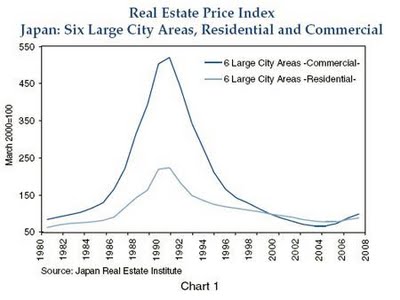
Chart above suggests that by early 2000s real estate prices in Japan returned to the original levels of the early 80s. They even started rising slightly, which isn't surprising, given how much leverage the whole world was strapping on. At the same time, did Japan get any growth? Not really, compared to pretty much any other country in the world. And yes, I agree that artificially inflating anything at the expense of the rest of the economy is a bad thing, but "artificially inflating" is a far cry from "deflating".
Finally, I always get really confused when people start showing pity and compassion for the "poor lower classes". I don't really get it. We're capitalists here, right, not socialists? If I have managed to become wealthy and powerful through my own efforts, I will use my influence to promote policies that favor me and my interests, such as lower or no taxes, less regulation, less government intervention, etc. Obviously, if, like you say, I benefit from inflation, I am gonna push for that as well. Why should I, as a self-interested capitalist, care about middle and lower classes?
Quote from achilles28:
Fractal .... a bit off topic...what supplements do you buy? I'm a bit of junkie myself...
Omega 3 from fish + 5mg lithium orotate fuels regeneration of nervous system cells, Neuro Optimizer by Jarrow == brain nutrition, probiotics, enzymes, Reish mushrooms, Hyaluronic acid == healthy soft tissues, D3 in wintertime... Not overdoing it nowadays
Quote from Martinghoul:
We're capitalists here, right, not socialists? If I have managed to become wealthy and powerful through my own efforts, I will use my influence to promote policies that favor me and my interests, such as lower or no taxes, less regulation, less government intervention, etc. Obviously, if, like you say, I benefit from inflation, I am gonna push for that as well. Why should I, as a self-interested capitalist, care about middle and lower classes?
Unfortunately, the only way to become "wealthy and powerful" today is through supporting government of more regulation. It is insertion of authority where none belongs. That's the only way to get rich today.
The technologists that make it big are either crooks, or naive and allow a 3rd party/government its intervention.
In short, we are ruled by crooks who side with the government to make their wealth. As evidenced by the power of government growing ever larger.
Wait a sec, are you giving me the whole Obama "you didn't build it" line here?Quote from FireWalker:
Unfortunately, the only way to become "wealthy and powerful" today is through supporting government of more regulation. It is insertion of authority where none belongs. That's the only way to get rich today.
The technologists that make it big are either crooks, or naive and allow a 3rd party/government its intervention.
In short, we are ruled by crooks who side with the government to make their wealth. As evidenced by the power of government growing ever larger.
Quote from Martinghoul:
Wait a sec, are you giving me the whole Obama "you didn't build it" line here?
Not exactly.
I am saying that if you are successful it is because you were granted permission to be successful. That could be because you passed the "crook" test or it could be because you are naively oblivious to how your business is used to perpetuate the central banking system and government power.