Day-Trading 2.0 for small traders

Status
Not open for further replies.
Quote from Shel M.:

Hi Everyone, hope you're enjoying the summer.

Today's morning NQ chart and trades.

25tc4tj.png


My plan goes something like this: Going (usually) with the slope of the 100 WMA; trade long at a 3 bar reversal after a higher high, trade short at a 3 bar reversal after a lower high. However, always taking precedence is support or resistance at a major level. Levels can be defined as places where price has stopped in a previous time period. What was yesterday's high? Price stopped there. Where was yesterday's low, price stopped there. Where was today's open? Price started from that point and went somewhere. Where is the high of the last week, month, year? Price stopped there and the same is true of the lows. It has been my experience that price also respects the 200 simple moving average in most time frames. What do you find of value? Comments more than welcome. Let's keep up this great thread!

Shel


Hi Shel,

Chart looks good. I trade the NQ off of a 500 volume chart
but there is a lot of noise.

I am thinking of going to a 1000 volume chart.

Keep posting
those charts. This is the best thread on the forum.

Thanks
 
Quote from josch:

Hi,

1st I want to thank you a lot -jjrvat- and others sharing excellent information in this thread.

Because examples and posts are referring to stocks, indices and Forex, I want to focus to the indices, especially the ES. There was mentioned hard to scalp ES because of pushs up and down, which often happen.

I'm feeling well with small profit by taking small risk instead of using larger waves/timeframes. Nonetheless I'm feeling unwell having a bad R/R, ie 3.5 points possible loss (set stop looking at last wave) to a 1.25 profit. So I try to be almost even with R/R, means using stoploss nearly possible profit.

The success rate of this of course is bad compared to scalp (if I remember some members talking about 60-80%). It's about 50-60%. This is -imo- ok if looking for the 'edge', but in this case part of costs -commissions- are growing because of high number of trades compared to the 'small' profit below the line.

So I want to continue part of the thread looking to this point, wondering if other traders experienced same and sharing thoughts about this.

josch

Hi josch. Very happy to read your post, and happy to see that i'm not the only one who suffers badly from the very fast pushes in the ES. I'm actually considering switing to some more slow-paced instrument.
Anyways, scalping the ES for almost 3 months. I'm to have a pretty bad R/R but not as bad as you I usually risk from 1.75-3 to get 1.25 points. Try entering a bit early, I use Haikin Ashi candels and wait for a close below/above HMA.
For the success rates, well I don't know what to tell you since I usually have between 75%-90%. usually I have 1 losing trade each day and about 5-8 winning trades. But something that might help you is searching for Double tops and double bottoms. I usually don't enter trade in the direction of the Double top/bottom beacuse this is usually a sign for reversal. Also, always search for major support and resistence lines since price might reverse there espcially in the last few ranging days.
And, don't be afraid to not take a trade, if you feel the stop is too far, step aside, like they say: "better miss a good trade then take a bad one".
 
Any advice for dealing with these situations?

stilllosing.gif


Other than situations like that, I'm doing ok.

The only thing I can think of would be that maybe those the 3 losing trades shown above began too close to the previous high or previous low... ?

edit - n/m it can't be that. There's plenty of times when the trend resumes at or past the previous high/low and goes on for many ticks.
 
Ironfist, That buy was awfully close to the previous high, you didnt give yourself much room for a minimum profit.

Even if you have the entry trigger, sometimes its already gone too far.

So if your gonna take those trades, you gotta take the potential loss that comes with them. Read Amitmans post just before yours.

But again, just my 2 cents....
 
Quote from IronFist:

Any advice for dealing with these situations?

stilllosing.gif


Other than situations like that, I'm doing ok.

The only thing I can think of would be that maybe those the 3 losing trades shown above began too close to the previous high or previous low... ?

edit - n/m it can't be that. There's plenty of times when the trend resumes at or past the previous high/low and goes on for many ticks.

Hi Ironfist,

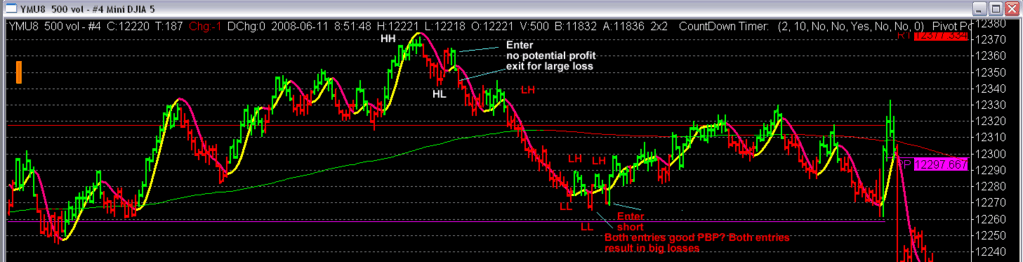
It seems that the first HL you have on the chart is
not really a HL if you look at price action instead of the
yellow MA. Although it is hard to see, it looks like there
is a swing low just before the HH.

That is probably one of the drawbacks of using a MA to look
at waves instead of price action. But then, if you are
consistently profitable, I don't think there is any reason to tweak your method since it is impossible to come up with a method
that is correct all the time.

Also, after a large down move, you have to be careful as price
might go in to consolidation. Look at how the waves got smaller
after the massive down move.

I am still studying the method, so lets keep the posts coming so we can all learn.
 
Quote from maninjapan:

Ironfist, That buy was awfully close to the previous high, you didnt give yourself much room for a minimum profit.

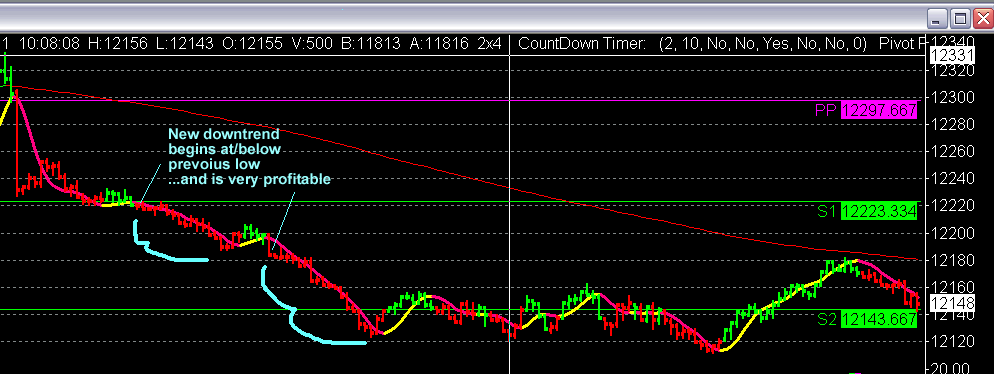
That's what I was thinking, too, but I see this happen a lot where the new entry is close to/past the previous high/low and the trade is wildly profitable:

newdowntrend.gif
 
Here's something interesting:

I thought I was holding my trades too long. I wasn't exiting for scalp profits, but was instead holding them until the FastMA reversed.

I backtested all my data exiting each trade after 10 ticks of profit, and while in some cases it caused me to have more profitable trades (like the ones that would go up 10 or 15 ticks and then reverse but the FastMA slope doesn't change until you're at a loss), but caused my overall performance to be negative.

I thought for sure this wouldn't happen. I figured it would increase my winning percentage of trades AND my equity, but it didn't. It increased my winning percentage of trades but pushed my equity curve into the red.

I'm really confused now. I thought holding out for big winning trades was a bad strategy...
 
Quote from IronFist:

Here's something interesting:

I thought I was holding my trades too long. I wasn't exiting for scalp profits, but was instead holding them until the FastMA reversed.

I backtested all my data exiting each trade after 10 ticks of profit, and while in some cases it caused me to have more profitable trades (like the ones that would go up 10 or 15 ticks and then reverse but the FastMA slope doesn't change until you're at a loss), but caused my overall performance to be negative.

I thought for sure this wouldn't happen. I figured it would increase my winning percentage of trades AND my equity, but it didn't. It increased my winning percentage of trades but pushed my equity curve into the red.

I'm really confused now. I thought holding out for big winning trades was a bad strategy...

Iron Fist I really don't know what causes the confusion. That's actually very easy ti understand. For example I once develpod a system that was based of the brakes of yesterday's low/highs and extining after the stock moved an ATR/x.
Now, when X=5 (meaning i exit the trade after it had made a move of the ATR/5). the success rates were 80% and the comulitive profit was 7000% (over 5 years) but when I've changed to X=2 the success rates dropped to 53% but the comulitve profit jumped to 18000%!. Why? because the winners were much bigger now.
That's is simple math, and is calculated with the known formula of PF (profit factor) PF = S*(W/L)/(1-S)
where
S = success rates
W = average win.
L = average loss.
for example if my system have a 10 ticks winners and 15 ticks losers and about 70% success then the formula goes:
PF = 0.7*(10/15)/(1-0.7) = 1.55. Which is, not a very good number but fair enough as numbers goes like this:
0-1 : unprofitable.
1 : B/E.
1-1.5: barely profitble.
1.5-2 : profitable enough.
2 - 3 : good.
3 - 4: very good.
4+ : amazing.
Anyways, when you come to test a system these are the numbers that should be in front of you.
 
Quote from amitman:

Iron Fist I really don't know what causes the confusion. That's actually very easy ti understand. For example I once develpod a system that was based of the brakes of yesterday's low/highs and extining after the stock moved an ATR/x.
Now, when X=5 (meaning i exit the trade after it had made a move of the ATR/5). the success rates were 80% and the comulitive profit was 7000% (over 5 years) but when I've changed to X=2 the success rates dropped to 53% but the comulitve profit jumped to 18000%!. Why? because the winners were much bigger now.

That supports what I was saying. But most stuff I've read (claiming to have been backtested) always says that smaller profit targets yielded better results overall so that's why I was surprised when my data was the opposite.
 
Quote from IronFist:

That supports what I was saying. But most stuff I've read (claiming to have been backtested) always says that smaller profit targets yielded better results overall so that's why I was surprised when my data was the opposite.

Hi IF,

Scalping and swing trading are different animals. You cannot just change your profit target and expect to turn a swing trading method into a scalping method. You also have to change entry point, stop size, and trade management.

You could try using the same swing method on a smaller market fractal to see if that works, e.g., if you are trading 500V bars try 100V bars with a smaller profit target.

A scalping strategy is different than a swing trading strategy. With swing trading, you take a larger risk to make a larger profit per contract traded. With scalping you want to reduce your risk so you can trade volume; you make less per contract but trade more contracts.
 
Status
Not open for further replies.
Back
Top