Monday / October 14, 2019 / 9:45 p.m. PST
Surprise, surprise!
I'll be if this attempt at finagling a more "hands off" approach to day trading Forex hasn't led to my painting a more well-defined picture of what I feel like I see exchange rates doing at the micromanage level, which I will also record in my personal notes without redacting the details.
One-minute Forex Chart Configuration
On a one-minute Forex chart, the white SMA (XXX) is the gravitational trend line. The
intraday trend might be bullish if candlesticks are forming above this indicator or bearish if candlesticks are forming below it, but is definitely bullish if this line is sloping upward or bearish if the line is sloping downward.
Of course the short-term actionable trend line is the
blue SMA (XXX), so the
short-term trend is bullish if candlesticks are forming above this indicator, especially if it is sloping upward, and bearish if candlesticks are forming below it, especially if it is sloping downward.
Nonetheless, the short-term trend should not be regarded as reversing direction in any significant way until it pops through the
purple and indigo SMA (XXX).
Moving back to the intraday trend however, its direction becomes clearer/more pronounce when the actionable trend lines fan out, referring to the
medium blue xxx-,
purple and indigo XXX, white and black XXX-,
orange and maroon XXX-,
black and crimson XXX-, and
dark green/lime green XXX-period SMAs.
Look for price to begin evidencing regression toward the mean by crossing back over the
medium blue SMA (XXX) once candlesticks begin making contact with the upper or lower band of the XXX-Period SMA Envelope at X.XX% deviation, and COUNT ON IT given one or more of the following conditions:
- Candlesticks begin making contact with the upper or lower band of the XXX-Period SMA Envelope at X.XX% deviation.
- The lower panel Price Anomaly Channel oscillator breaches level 3
- The lower panel Price Anomaly Channel oscillator breaches level 5.68
You are fond of saying that the only indicators you care about are moving averages and (adaptive) moving average envelopes (i.e., price ranges). So it should probably come as no surprise that the above description seems to focus heavily on trades that are initiated by regression toward the mean.
So when does a retail trader trade with the trend, if ever?
You trade with the trend when you see the actionable trend lines (moving averages) fanning out, as described above.
Otherwise, you look to the slope of the
indigo proprietary moving average on the 15-minute chart setup for the ultimate direction in which price is more than likely headed (this is roughly equivalent to the XXX-period SMA, which would be the XXX-Period SMA on a one-minute chart, or the XXX-period SMA on a five-minute chart—
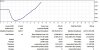
the wide burly-wood moving average in the above image).
In considering all of the above, do not lose track of (remain consciously aware of) the unique way you have come to conceptualize price movement (i.e., that it is best represented not by moving averages, but my bands, strips, or waves of a given amplitude which cover specified swaths of territory as price swings back and forth between the riverbed/shoreline of the associated “tsunami” as it betrays, conveys, or establishes a directional tendency).
(Trading successfully is a matter of correctly interpreting the relationships between all these measures.)