COVID-19

With the notable exception that one week has passed since the claim of "one week away" was made on Oct 21. Other than that, there is certainly a spike in cases.

It’s a little more than a “spike in cases”; it is a “rapid acceleration” or “exponential growth” of cases over a few mere days. The cases are now above 100,000 per day in the U.S.
 
Birx cedes White House turf to Atlas while hitting the road to spread her public health gospel
https://www.cnn.com/2020/10/29/politics/deborah-birx-task-force-scott-atlas/index.html

Dr. Deborah Birx emerged from a meeting at the White House one day in late summer with a new resolution: Never again would she sit in a meeting with Dr. Scott Atlas and listen to him pontificate on the pandemic.

That's when she went all-in on a plan to essentially abandon the White House and avoid the growing influence of Atlas, a radiologist with no expertise in epidemiology who was nevertheless rising in influence with President Donald Trump.

Birx, a physician with decades of experience in global health, told a friend that she would take her message directly to the people and simply sidestep the kind of misleading messages she'd just heard from Atlas in that meeting. The friend requested anonymity to discuss the exchange with CNN.

Now Atlas is Trump's single go-to adviser on the coronavirus. And Birx, one of the most prominent figures of the early pandemic, is in North Dakota.

She has now been to 40 states and logged more than 20,000 miles, many of them since that fateful August meeting. She tours the country by commercial air, advising small groups of state and local officials on combating transmission. She pulls a small suitcase packed with essentials and an array of the signature scarves she wears each day. Her friends call it her "self-exile."

"Her personality is to pick up and go where the fight is," said a colleague of hers for many years. "She always told us -- keep your bags packed. She'd say if you're assigned to another country, don't sit in the embassy -- go to the distant villages. You need to go where the action is, see what they are doing."

It's a handy personal credo given that Trump hasn't consulted in person with Birx in months. She still belongs to the White House coronavirus task force, but it rarely meets these days and its reports aren't widely disseminated. The President isn't deploying her to anything, so she's deploying herself.

"I've known Debbie a long time," said Dr. Jerome Kim, the director general of the International Vaccine Institute, and a former colleague at the Walter Reed Army Institute of Research. "She really is completely driven by getting things done and being effective, and I think she's frustrated."

"If she can't get it done in the White House, the way to do it is go into the field and use personal diplomacy to convince politicians there is a right way to do this and a right way to approach things, and the consequences of failure are significant," Kim said. "Without an authority coordinating things centrally, the only thing you can do is make people aware of the facts and the truth, and my guess is this is her solution," said Kim.

Finding her lane

For months, Birx put up with Trump's rhetoric about the pandemic. She told friends she could live with it, though, as long as she could occasionally get a chance to weigh in with the President.

But soon after Atlas was formally named to the task force on August 10, Birx told friends, it became clear that she wasn't going to get much time with Trump -- if any at all.

After that August meeting, she came out of the room and told a friend Atlaswas "not going to tell me what to do," the friend said, recounting the conversation.

She felt even further vindicated recently when Atlas tweeted about the folly of requiring mask-wearing and Twitter removed the tweet. She said to a friend that she wished the administration would take the same editorial approach to his statements.

Birx's own future is uncertain, like so many in the federal health bureaucracy. She's on the outs with the current administration and, if former Vice President Joe Biden is elected, it's not clear if she would be invited to stay on. Though it's a move she has successfully navigated before, working first for President George W. Bush, then President Barack Obama and now Trump. Some prominent health officials may have harmed their credibility with Biden by working to remain relevant in the Trump orbit all these months.

But even if Birx no longer has Trump's ear, she still has a public persona. And plenty of officials around the country -- struggling to deal with the pandemic in the absence of a coordinated national strategy -- are more than happy to have her help.

(More at above url)

 
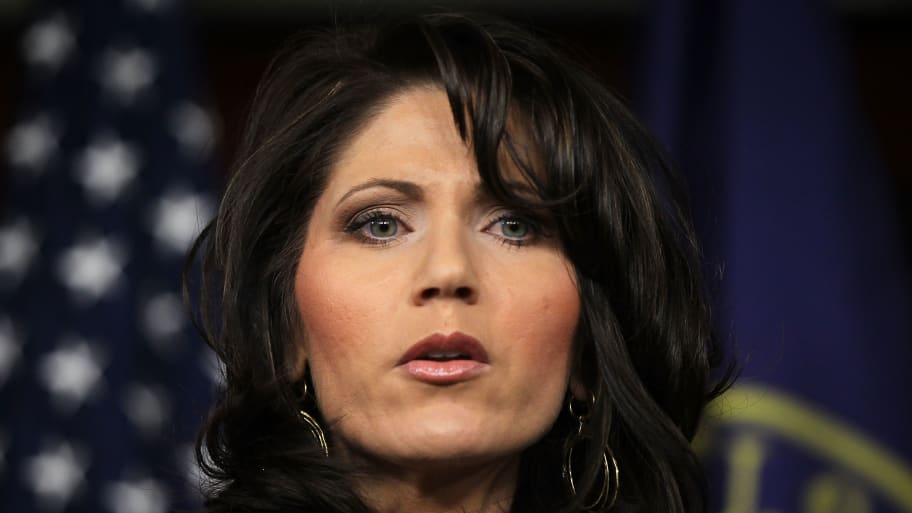
Want to see what an idiot looks like -- see the picture below.

South Dakota’s Positive Virus Rate Hits 46%—but Noem Aide Says ‘We Feel Pretty Good’
https://www.thedailybeast.com/south...but-kristi-noem-aide-says-we-feel-pretty-good

GettyImages-138145310_xhtnkl


A staggering 46 percent of coronavirus tests are coming back positive in South Dakota at the moment—but Gov. Kristi Noem has “no opinion” on masks and her team thinks everything is going just fine, The Wall Street Journal reports. The positivity rate is eight times more than the World Health Organization’s recommended 5 percent threshold at which businesses can safely reopen. But Noem’s senior advisor Maggie Seidel said, “We feel pretty good about where we’re at. The governor is not going to change any of her approach—why should she?” Noem has been ambivalent about face masks, writing in an opinion piece last week that “those who don’t want to wear a mask shouldn’t be shamed into wearing one.”

Michael Osterholm, director of the Center for Infectious Disease Research and Policy at the University of Minnesota, said that the lack of mask wearing in public could be a reason why the virus is spreading so severely in the state.

(More at above url)
 
A new CDC study suggests roughly 50% of people living with someone who has COVID-19 get it — usually in less than 5 days
https://www.businessinsider.com/cdc...smission-common-usually-within-5-days-2020-10
  • A new CDC study suggests it's very easy to get the coronavirus from someone who's living in your household.
  • The report showed that roughly half (53%) of people surveyed who were living with a COVID-19 positive person wound up sick within a week, according to their daily self-administered tests.
  • Illnesses were transmitted quickly, with 75% of infections being passed along in five days.
  • The study authors said that people "who suspect that they might have COVID-19 should isolate, stay at home, and use a separate bedroom and bathroom if feasible."
A US Centers for Disease Control and Prevention (CDC) report released Friday suggests that getting the coronavirus from someone you live with can be quick and easy, no matter their age.

The study, which is ongoing in over 100 households in Nashville, Tennessee and Marshfield, Wisconsin since April, found that roughly half (53%) of study participants living with a sick person who tested positive for COVID-19, the disease caused by the coronavirus, wound up sick themselves within a week. 75% of those secondary cases tested positive for the virus within five days or less, according to their daily, self-administered tests.

"Persons who suspect that they might have COVID-19 should isolate, stay at home, and use a separate bedroom and bathroom if feasible," the study authors wrote in their report, stressing that isolation should start as soon as the person suspects that they might be sick, even before any testing is done.

Being in the same room with a sick person is dangerous
In the study, most sick patients said they had spent many hours (four or more) together in the same room with the people they live with on the day before they started feeling unwell. That pre-symptomatic period is exactly when health experts suspect that people with the virus are at their most infectious.

"It's because the disease can spread at that moment that the disease is so contagious," the World Health Organization's Executive Director of Health Emergencies, Mike Ryan, said earlier this year. "That's why it's spread around the world in such an uncontained way."

Another factor working against people who share a home with sick patients: airflow. The coronavirus spreads well between people who are indoors, and gathered close together, in poorly-ventilated spaces, so it makes sense that people would be getting infected from those they live, breathe, sleep, and eat with every day.

"We know that the biggest risk is these closed, indoor environments," University of Maryland virologist Don Milton previously told Insider.

(However, as the study authors noted, it is always possible that some of the participants might've gotten infected in some other way.)

In the study, 40% of sick patients were sleeping in the same room as another person in their household, before they knew they were sick. The ages of the study participants ranged from younger than 12 to older than 50 years old. It was possible for household members to opt out of the study, which "did happen, but infrequently," study author Melissa Rolfes told Insider, in an email.

Put on masks if you have to share space with sick people at home

The study authors suggest that both the sick person and all the people in their household should start wearing masks as soon as they think they might have the virus, "particularly in shared spaces where appropriate distancing is not possible." You may also want to open up some windows (if it's not too cold) or get some fans moving, to improve air circulation and blow virus particles away.

If you live with someone who has the virus, you should also stay away from others who don't live in your house for two weeks, in quarantine. This is because it's possible that you could have contracted the virus, and could be capable of spreading it to others, without ever knowing you're contagious. Indeed, in the study, only 40% of sick patients' housemates who subsequently fell ill had any symptoms when their infection was initially detected by a test.

"Usually if you were to develop symptoms, it's going to be between, let's say, two and 12 days," Dr. Rishi Desai, chief medical officer at Osmosis, and a former Epidemic Intelligence Service officer at the CDC, recently told Insider.
 
Let's see how things are going in Australia -- a country which enforced lockdowns and followed the best public health principles in their COVID-19 response...

Victoria records no new coronavirus cases or deaths
https://www.abc.net.au/news/2020-11-01/victoria-records-no-new-coronavirus-cases/12836364

Victoria has recorded its fourth "double doughnut" day of zero new cases and deaths in the past week
, as the Government announces plans to get kids back into sport after lockdown.

Melbourne's 14-day rolling average of new cases per day is now 2.2, down from 2.4 on Saturday, and there is just one mystery case.

Deputy Premier James Merlino revealed restrictions would soon be eased to allow indoor and competitive sport to resume, given the continued low case numbers.

(More at above url)
 
Back
Top