
Covered Calls vs. Naked Puts

Quote from aradiel:


If I would replicade this position with a naked put, with the same breakeven, max gain, max loss points, the june 33 put would have to be trading exactly at 3.30... but will it? This is an honest question since where I trade (Brazil) there is virtually no put trading and I dont have a clue. Will the put be above 3.30, bellow it? What variables are taken into consideration?
The missing variables are dividends (if any) and the carry cost. This might be helpful:

http://www.investopedia.com/articles/optioninvestor/05/011905.asp
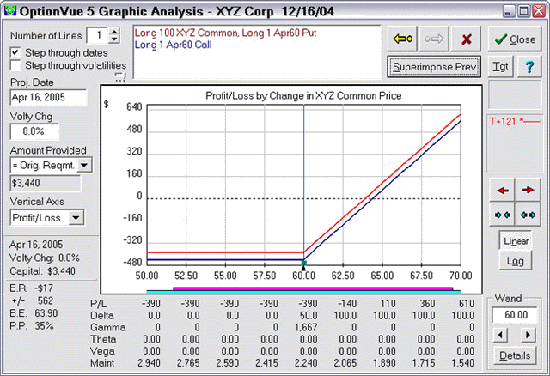
 
Quote from spindr0:

The missing variables are dividends (if any) and the carry cost. This might be helpful:

http://www.investopedia.com/articles/optioninvestor/05/011905.asp

OF-PutCall1resized.gif


The author of the article implies that if not for dividends both curves would be overlaping - instead of being parallel to - each other. Can anyone confirm that?

Also, the text states that a put call parity should exist but doesnt show any formula do calculate it or at least describe how it should behave.
 
Quote from aradiel:

The author of the article implies that if not for dividends both curves would be overlaping - instead of being parallel to - each other. Can anyone confirm that?

Also, the text states that a put call parity should exist but doesnt show any formula do calculate it or at least describe how it should behave.
Try Googling "put call parity." It's the "All You Can Eat" answer.
 
Quote from spindr0:

Try Googling "put call parity." It's the "All You Can Eat" answer.

I did and most of the articles are worst than the investopedia one.

Maybe one of the resident experts who called this thread lame, repetitive, idiot etc. could shed a light on this?:)
 
Quote from aradiel:

OF-PutCall1resized.gif


The author of the article implies that if not for dividends both curves would be overlaping - instead of being parallel to - each other. Can anyone confirm that?

Also, the text states that a put call parity should exist but doesnt show any formula do calculate it or at least describe how it should behave.

The only reason that the two lines do not overlap is because the cost of carrying the long stock is not accounted for. That is, if you buy a stock then you either pay margin interest or forgo the interest you could have earned in a risk free instrument. These kind of analysis software packages do not account for this and hence it appears as if one is better than the other.
 
Quote from aradiel:

Does it mean that calls and puts should have the same time value, no matter the nature of the underlying, the strike, the volality or the remaining time until expiration?

Same-strike. It means that a box traded at fairval, for example, carries no rate-risk held to expiration. The inference is that theta for the P/C paired to a strike is equal. The non-trivial exposure is dependent on what you pay, or what you receive in relation to a fairval figure. Pretty much true in all markets.
 
Quote from aradiel:

Does it mean that calls and puts should have the same time value, no matter the nature of the underlying, the strike, the volality or the remaining time until expiration?
If there is no carry cost and there are no dividends then the time premium for puts and calls with the same strike/expiration month will have the same time premium if priced fairly.
 
Quote from aradiel:

I did and most of the articles are worst than the investopedia one. Maybe one of the resident experts who called this thread lame, repetitive, idiot etc. could shed a light on this?:)
Google again. Formulas for put/call parity are out there.
 
Quote from spindr0:

If there is no carry cost and there are no dividends then the time premium for puts and calls with the same strike/expiration month will have the same time premium if priced fairly.

So with interest rates at zero and no dividends the time value of those calls and puts should be equal, no matter what is the price of the underlying (and if the calls/puts are otm, ditm etc.) ?
 
Back
Top