https://thesoundingline.com/the-countries-with-the-most-nuclear-reactors/
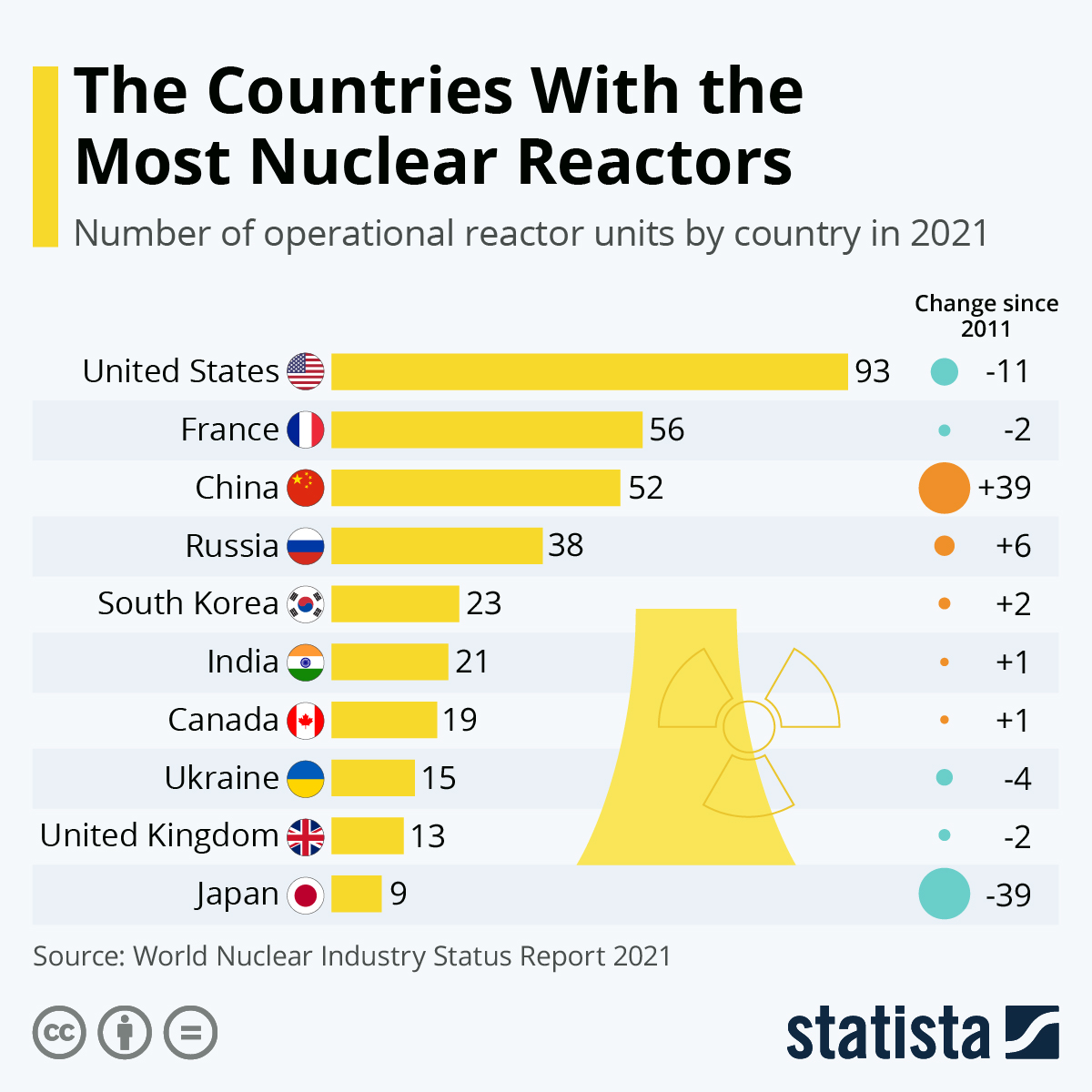
Japan has closed the same number as China has added.
Japan has closed the same number as China has added.

Don't forget that it references to 2011, the year in which Japan had the large tsunami which wiped out the Fukushima nuclear reactors. This caused Japan to stop operating its nuclear power plants countrywide for a long period.Japan has closed the same number as China has added.
Soon electricity will be generated out of Biden Kamala Harris and ocasio cortez brainpower. Oh, and also greta thunberg! Yesss! These people have so much energy, they will power the world...
Why should we pay 2x to 4x more for nuclear power than wind or solar plus storage....and that's before the cost overruns. Santee Cooper, a monopoly by the way, dropped $9B on the V.C. Summer nuclear plant expansion. Which was originally supposed to cost them $5B. And they have jack to show for it. And no, it wasn't the environmental lobby that sunk it, it was the inherent complexity of a massive project and the fact that even already built nuclear plants are now generally the second or third most expensive power in the LMP stack after coal and single cycle gas. And they can't clear capacity auctions. Same thing happened at Vogtle.52 new plants are being build worldwide, with only 2 of those in the United states. China and India have about 20 going up between them. We are behind, way behind, and need at least 50 to go up in order to meet future needs. Solar and wind won't get the job done, not even close. So we either advance to the best source, nuclear, or we keep burning coal and natural gas.
Why should we pay 2x to 4x more for nuclear power than wind or solar plus storage
?Opinion: Continuing renewable energy subsidies costs taxpayers, threatens energy markets
Gary Wolfram
View Comments
The production of wind and solar power has long been subsidized by the federal government through two tax credit programs. One is the Renewable Energy Production Tax Credit, which was originally enacted in 1992. This provides a credit per kilowatt-hour to wind operators for electricity produced during the first ten years of operation. It was set to expire in 1999, but has been extended 12 times, and will currently expire at the end of 2020 unless it is extended again.
The other major tax credit is the Solar Investment Tax Credit. This was enacted in 2006 and was extended in 2015. It is currently a 26% credit for solar systems on residential or commercial properties. The credit is scheduled to drop to 22% for projects that begin construction in 2021 and afterwards the credit ends for residential projects and drops to 10% for commercial projects.
The tax credits were originally justified as a mechanism to advance an infant technology to compete with conventional sources and result in a cleaner environment. Clearly the technology has advanced sufficiently that the credits are no longer serving this purpose and are costly to taxpayers. It is time to let them expire.
The Energy Information Administration (EIA) estimates solar and wind combined account for about 8% of electricity generation. The Pew Research Center has found that over the past decade, solar power, while still a minor share of total power production, has experienced the largest percentage growth of any U.S. energy source, with an increase of more than 45 times.
The cost of producing wind and solar power have declined substantially. A recent Lazard study estimates that the unsubsidized cost of wind power is an average of $41 per megawatt-hour, and utility solar is $37 per megawatt-hour. Natural gas, which also has been falling substantially in price, averages $56 per megawatt-hour.
Subscribe to Detroit News stories, videos, galleries and moreAlready subscribed? Sign in for full accessFrom the editor: Help us hold power to accountGot a story idea? Let us knowSubscribe for access to all Detroit News content
The most recent EIA Annual Energy Outlook estimates that, assuming the phase-outs of the credits, wind and solar generation will increase their market share from 8% today to 14% by 2025, and 23% by 2050. Wind and solar generation together are expected to supply more power in 2050 than either coal or nuclear power.
The Joint Committee on Taxation estimates that the tax expenditure of the production tax credit was $5.1 billion in 2019. The U.S. Treasury estimates that the production tax credits that remain available to those firms that began construction within the prior time limit will cost taxpayers more than $40 billion from 2018 to 2027. Extending the credit will increase these costs without further advancing the technology.
Create Account
The advancement in the technology of producing wind and solar power has had a positive effect on the energy industry and benefited the environment. However, continuing these subsidies will not only cost taxpayers billions of dollars, but will distort the electricity market and do little to further advance the technology of renewable energy.
Gary Wolfram is the
If nuclear plants only came in 30% over cost and nuclear only cost 30% more than solar or wind on a per MWH basis, then perhaps. Facts are that nuclear costs between $110 and $190 per MWH in levelized cost to produce, from existing nuclear farms without the massive development risk. Onshore wind is in the $40/MWH range in markets without tax credits or subsidies, and arms length solar PPAs are being signed in unsubsidized markets regularly for sub $20/MWH. Solar plus storage, which can dispatch energy and provide energy overnight, is coming in at sub $40/MWH. That means that private companies entirely built and paid for a solar farms and contractually agreed to sell the power from that farm for 20 years at $20/MWH without subsidies, which means they're also presumably making a profit at that price. I'd be interested in finding a single instance where a private party agreed to take on the entire development and lifetime production risk of a nuclear plant in the past decade? Do you think a 30% tax credit would change that?Could the answer have something to do with
https://www.detroitnews.com/story/o...ns-markets-solar-wind-electricity/5607327002/
?
...
It's hard to argue for $190 per MWH nuclear cost and against $20/MWH solar and because... 30% tax credit. If a 30% tax credit gets you power for 90% less, then it seems like it's not only a great idea but something that should be expanded, don't you think?
I'll start out by saying that I think you deliver well thought out, intelligent commentary pretty universally here and I enjoy reading your posts. Which is why I'm baffled that you seem to always react so reflexively and in a manner that is so at odds with all you other comments when this subject comes up. I'm not sure even you are aware of this off dichotomy. In all your other opinions, you clearly know a lot about what you're talking about and any opinions you've formed seem to have come from a position of understanding. On this, you appear to have inherited an opinion from someone and something in your brain is preventing you from actually learning anything about it.What happens when it is cloudy for a week, like it will be here in the northeast all winter?
Where does the power come from, Boris? It comes from the plug? Uh huh.
The enviornmentalists want solar, but NIMBY, and they want wind, but NIMBY.
There's a wind turbine here that has been offline for like a year, surrounded by 6 others. Probably because it needs a simple part made in China that will cost $10,000 to replace. Why is there no incentive to get the thing fixed and up and running? Because it is BS.
When the cost per KWH goes up to a buck, we'll finally see some action. Until then, go go fossil fuels, which are the primary drivers of cheap and efficient energy production.


