why do you persist in these silly posts? If you read Jem's posts, you would know what he is "saying". So why not read them, and then respond in some intelligent manner, rather than with these childish posts of yours?So you're saying that man has not caused the 40% rise in CO2 and that CO2 is not a greenhouse gas?


You are using an out of date browser. It may not display this or other websites correctly.
You should upgrade or use an alternative browser.
You should upgrade or use an alternative browser.
Correction... 2015 was not the warmest year
- Thread starter jem
- Start date
why do you persist in these silly posts? If you read Jem's posts, you would know what he is "saying". So why not read them, and then respond in some intelligent manner, rather than with these childish posts of yours?
Jem said the "the level of co2 in the atmosphere... follows natural systems and not the co2 being produced by man. "
So he does not think that the 40% rise in CO2 is due to man. That is of course wrong. Laughably so. Like he should be embarrassed to say such a stupid thing. It's a lie. He's a liar.
But maybe as a fellow denier liar you agree with him. I don't see you correcting him.
Last edited:
did you see the charts I posted on the previous page. That second one is from a peer reviewed article. If you read the paper I have posted here many times you would know the data in those charts are from your approved data sources. It is the standard data every scientist uses.
The statistical analysis shows that the level of co2 in our atmosphere follows (I recall it being a 90% correlation) the change in ocean temps by 1 year and the change in air temps by 9 months. You could run the data and the analysis yourself... that is what is notice about real scholarship and science the steps are repeatable.
Its is therefore not a lie... it is a fact given the science and the data we have.
a type of lie is when someone you makes things up with no basis in reality and asserts them as a fact or a true statement. For instance when you stated I was lying... (you were the troll liar.)
And I note... even your al gore sponsored skeptical science website... admits warming comes before the co2.
----
here is a link to the peer reviewed paper... again... for you to read.
http://www.sciencedirect.com/science/article/pii/S0921818112001658
Highlights
► Changes in global atmospheric CO2 are lagging 11–12 months behind changes in global sea surface temperature. ► Changes in global atmospheric CO2 are lagging 9.5–10 months behind changes in global air surface temperature. ► Changes in global atmospheric CO2 are lagging about 9 months behind changes in global lower troposphere temperature. ► Changes in ocean temperatures explain a substantial part of the observed changes in atmospheric CO2 since January 1980. ► Changes in atmospheric CO2 are not tracking changes in human emissions.
The statistical analysis shows that the level of co2 in our atmosphere follows (I recall it being a 90% correlation) the change in ocean temps by 1 year and the change in air temps by 9 months. You could run the data and the analysis yourself... that is what is notice about real scholarship and science the steps are repeatable.
Its is therefore not a lie... it is a fact given the science and the data we have.
a type of lie is when someone you makes things up with no basis in reality and asserts them as a fact or a true statement. For instance when you stated I was lying... (you were the troll liar.)
And I note... even your al gore sponsored skeptical science website... admits warming comes before the co2.
----
here is a link to the peer reviewed paper... again... for you to read.
http://www.sciencedirect.com/science/article/pii/S0921818112001658
Highlights
► Changes in global atmospheric CO2 are lagging 11–12 months behind changes in global sea surface temperature. ► Changes in global atmospheric CO2 are lagging 9.5–10 months behind changes in global air surface temperature. ► Changes in global atmospheric CO2 are lagging about 9 months behind changes in global lower troposphere temperature. ► Changes in ocean temperatures explain a substantial part of the observed changes in atmospheric CO2 since January 1980. ► Changes in atmospheric CO2 are not tracking changes in human emissions.
This is what you said, dont try to weasel out of it.
"the level of co2 in the atmosphere... follows natural systems and not the co2 being produced by man. "
That is a lie. You are a liar. And a weasel.
"the level of co2 in the atmosphere... follows natural systems and not the co2 being produced by man. "
That is a lie. You are a liar. And a weasel.
did you see the charts I posted on the previous page. That second one is from a peer reviewed article. If you read the paper I have posted here many times you would know the data in those charts are from your approved data sources. It is the standard data every scientist uses.
The statistical analysis shows that the level of co2 in our atmosphere follows (I recall it being a 90% correlation) the change in ocean temps by 1 year and the change in air temps by 9 months. You could run the data and the analysis yourself... that is what is notice about real scholarship and science the steps are repeatable.
Its is therefore not a lie... it is a fact given the science and the data we have.
a type of lie is when someone you makes things up with no basis in reality and asserts them as a fact or a true statement. For instance when you stated I was lying... (you were the troll liar.)
And I note... even your al gore sponsored skeptical science website... admits warming comes before the co2.
----
here is a link to the peer reviewed paper... again... for you to read.
http://www.sciencedirect.com/science/article/pii/S0921818112001658
Highlights
► Changes in global atmospheric CO2 are lagging 11–12 months behind changes in global sea surface temperature. ► Changes in global atmospheric CO2 are lagging 9.5–10 months behind changes in global air surface temperature. ► Changes in global atmospheric CO2 are lagging about 9 months behind changes in global lower troposphere temperature. ► Changes in ocean temperatures explain a substantial part of the observed changes in atmospheric CO2 since January 1980. ► Changes in atmospheric CO2 are not tracking changes in human emissions.
I just gave your peer reviewed science confirming co2 levels follow change in ocean temps.
do you deny that is what the data shows?
you are the weasel.
FOCUS JEM FOCUS!!!
We are not talking about what leads which here....
Do you believe this to be true or not? I mean YOU wrote it.
"the level of co2 in the atmosphere... follows natural systems and not the co2 being produced by man. "
not only do I believe that is the current state of science.... I just proved it to you.
co2 follows the change in ocean temperature up and down.
no scientist disputes the fact that co2 follows temperature.
no matter how much you wish it otherwise co2 follows temps.
This is why its so hard for your agw nutter guys to produce models which work on real time data. Its hard to figure out how the laggard can cause the leader to move.
you fc are the weasel apparently denying this fact without producing any science.
here is the science again... it states changes in global atmospheric co2 lag behind changes in sea surface temps... (if you read the paper you see CO2 follows with a 90 percent correlation.)
Highlights
► Changes in global atmospheric CO2 are lagging 11–12 months behind changes in global sea surface temperature. ► Changes in global atmospheric CO2 are lagging 9.5–10 months behind changes in global air surface temperature. ► Changes in global atmospheric CO2 are lagging about 9 months behind changes in global lower troposphere temperature. ► Changes in ocean temperatures explain a substantial part of the observed changes in atmospheric CO2 since January 1980. ► Changes in atmospheric CO2 are not tracking changes in human emissions.
co2 follows the change in ocean temperature up and down.
no scientist disputes the fact that co2 follows temperature.
no matter how much you wish it otherwise co2 follows temps.
This is why its so hard for your agw nutter guys to produce models which work on real time data. Its hard to figure out how the laggard can cause the leader to move.
you fc are the weasel apparently denying this fact without producing any science.
here is the science again... it states changes in global atmospheric co2 lag behind changes in sea surface temps... (if you read the paper you see CO2 follows with a 90 percent correlation.)
Highlights
► Changes in global atmospheric CO2 are lagging 11–12 months behind changes in global sea surface temperature. ► Changes in global atmospheric CO2 are lagging 9.5–10 months behind changes in global air surface temperature. ► Changes in global atmospheric CO2 are lagging about 9 months behind changes in global lower troposphere temperature. ► Changes in ocean temperatures explain a substantial part of the observed changes in atmospheric CO2 since January 1980. ► Changes in atmospheric CO2 are not tracking changes in human emissions.
Last edited:
here is a link to the peer reviewed paper... again... for you to read.
http://www.sciencedirect.com/science/article/pii/S0921818112001658
...and here are the peer reviews, which disparage and indeed reject your peer reviewed paper on basic fundamental scientific grounds. These are linked on the same page! How come you didn't check them out? Such great research you always undertake

http://www.sciencedirect.com/science/article/pii/S0921818113000908
Abstract
Humlum et al., 2013 conclude that the change in atmospheric CO2 from January 1980 is natural, rather than human induced. However, their use of differentiated time series removes long term trends such that the presented results cannot support this conclusion. Using the same data sources it is shown that this conclusion violates conservation of mass. Furthermore it is determined that human emissions explain the entire observed long term trend with a residual that is indistinguishable from zero, and that the natural temperature-dependent effect identified by Humlum et al. is an important contributor to the variability, but does not explain any of the observed long term trend of + 1.62 ppm yr− 1.
Abstract
The paper by Humlum et al. (2013) suggests that much of the increase in atmospheric CO2 concentration since 1980 results from changes in ocean temperatures, rather than from the burning of fossil fuels. We show that these conclusions stem from methodological errors and from not recognizing the impact of the El Niño–Southern Oscillation on inter-annual variations in atmospheric CO2.
Abstract
A recent study relying purely on statistical analysis of relatively short time series suggested substantial re-thinking of the traditional view about causality explaining the detected rising trend of atmospheric CO2 (atmCO2) concentrations. If these results are well-justified then they should surely compel a fundamental scientific shift in paradigms regarding both atmospheric greenhouse warming mechanism and global carbon cycle. However, the presented work suffers from serious logical deficiencies such as, 1) what could be the sink for fossil fuel CO2 emissions, if neither the atmosphere nor the ocean – as suggested by the authors – plays a role? 2) What is the alternative explanation for ocean acidification if the ocean is a net source of CO2 to the atmosphere? Probably the most provocative point of the commented study is that anthropogenic emissions have little influence on atmCO2 concentrations. The authors have obviously ignored the reconstructed and directly measured carbon isotopic trends of atmCO2 (both δ13C, and radiocarbon dilution) and the declining O2/N2 ratio, although these parameters provide solid evidence that fossil fuel combustion is the major source of atmCO2 increase throughout the Industrial Era.
not only do I believe that is the current state of science.... I just proved it to you.
You clearly believe the current state of science is what you want to believe.
The only thing you've proved, yet again, is how much you don't even really begin to understand about what science actually is.
Last edited:
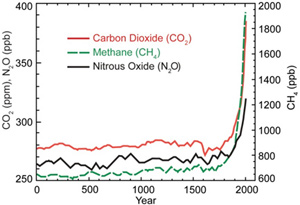
So, for the folks watching at home. Jem thinks that man has not caused CO2 levels to rise.

Reply 1.
I have checked out one or two of the comments in the past... now they are behind a paywall.
Note... none of the abstracts state that co2 levels do not trail change in temps... they just seem to prefer their own way of looking at the data.
But......That first comment is ridiculous to any trader who has modeled the markets...
Of course... using a differentiated series is different than just looking at the long term trend. Its is a far superior way to see what may be leading and what maybe trailing.
Any trader or scientist using stats and or graphs knows you use the method Humlum used to remove seasonality from the data.
That first comment you cited is quite possibly the dumbest comment I have seen since Futurecurrents made essentially the same complaint in lay terms.
you just can't help yourself and read it... and say... this comment other must be a moron or a tool.
Reply 2.
There is no doubt in my mind that the tide cycles contribute to the change in ocean temps. I have presented other peer reviewed papers here for you review on that subject.
We had been telling you nutters for years... that it was not just co2 causing warming but the sun and the tides.
3. As far as asking questions in the comments... I could answer many of them.
For instance...question from your comments... ...
"what could be the sink for fossil fuel CO2 emissions, if neither the atmosphere nor the ocean – as suggested by the authors – plays a role? "
Answer from JEM... there could be myraid other ways the earth processes the co2 one possibility is..
1. the earth could be off gassing the co2 into space as suggested by other scientists and satellite observations.
Question 2. What about ocean acidification...
1. what about it.. as the undewater vents and underwater volcanoes warm the oceans and methane and other gasses are being released... the oceans may be becoming less base... as they have in the past.
I could go on...but I would prefer you present the full comments...
I have checked out one or two of the comments in the past... now they are behind a paywall.
Note... none of the abstracts state that co2 levels do not trail change in temps... they just seem to prefer their own way of looking at the data.
But......That first comment is ridiculous to any trader who has modeled the markets...
Of course... using a differentiated series is different than just looking at the long term trend. Its is a far superior way to see what may be leading and what maybe trailing.
Any trader or scientist using stats and or graphs knows you use the method Humlum used to remove seasonality from the data.
That first comment you cited is quite possibly the dumbest comment I have seen since Futurecurrents made essentially the same complaint in lay terms.
you just can't help yourself and read it... and say... this comment other must be a moron or a tool.
Reply 2.
There is no doubt in my mind that the tide cycles contribute to the change in ocean temps. I have presented other peer reviewed papers here for you review on that subject.
We had been telling you nutters for years... that it was not just co2 causing warming but the sun and the tides.
3. As far as asking questions in the comments... I could answer many of them.
For instance...question from your comments... ...
"what could be the sink for fossil fuel CO2 emissions, if neither the atmosphere nor the ocean – as suggested by the authors – plays a role? "
Answer from JEM... there could be myraid other ways the earth processes the co2 one possibility is..
1. the earth could be off gassing the co2 into space as suggested by other scientists and satellite observations.
Question 2. What about ocean acidification...
1. what about it.. as the undewater vents and underwater volcanoes warm the oceans and methane and other gasses are being released... the oceans may be becoming less base... as they have in the past.
I could go on...but I would prefer you present the full comments...
...and here are the peer reviews, which disparage and indeed reject your peer reviewed paper on basic fundamental scientific grounds. These are linked on the same page! How come you didn't check them out? Such great research you always undertake
http://www.sciencedirect.com/science/article/pii/S0921818113000908
Abstract
Humlum et al., 2013 conclude that the change in atmospheric CO2 from January 1980 is natural, rather than human induced. However, their use of differentiated time series removes long term trends such that the presented results cannot support this conclusion. Using the same data sources it is shown that this conclusion violates conservation of mass. Furthermore it is determined that human emissions explain the entire observed long term trend with a residual that is indistinguishable from zero, and that the natural temperature-dependent effect identified by Humlum et al. is an important contributor to the variability, but does not explain any of the observed long term trend of + 1.62 ppm yr− 1.
Abstract
The paper by Humlum et al. (2013) suggests that much of the increase in atmospheric CO2 concentration since 1980 results from changes in ocean temperatures, rather than from the burning of fossil fuels. We show that these conclusions stem from methodological errors and from not recognizing the impact of the El Niño–Southern Oscillation on inter-annual variations in atmospheric CO2.
Abstract
A recent study relying purely on statistical analysis of relatively short time series suggested substantial re-thinking of the traditional view about causality explaining the detected rising trend of atmospheric CO2 (atmCO2) concentrations. If these results are well-justified then they should surely compel a fundamental scientific shift in paradigms regarding both atmospheric greenhouse warming mechanism and global carbon cycle. However, the presented work suffers from serious logical deficiencies such as, 1) what could be the sink for fossil fuel CO2 emissions, if neither the atmosphere nor the ocean – as suggested by the authors – plays a role? 2) What is the alternative explanation for ocean acidification if the ocean is a net source of CO2 to the atmosphere? Probably the most provocative point of the commented study is that anthropogenic emissions have little influence on atmCO2 concentrations. The authors have obviously ignored the reconstructed and directly measured carbon isotopic trends of atmCO2 (both δ13C, and radiocarbon dilution) and the declining O2/N2 ratio, although these parameters provide solid evidence that fossil fuel combustion is the major source of atmCO2 increase throughout the Industrial Era.
You clearly believe the current state of science is what you want to believe.
The only thing you've proved, yet again, is how much you don't even really begin to understand about what science actually is.
Last edited: