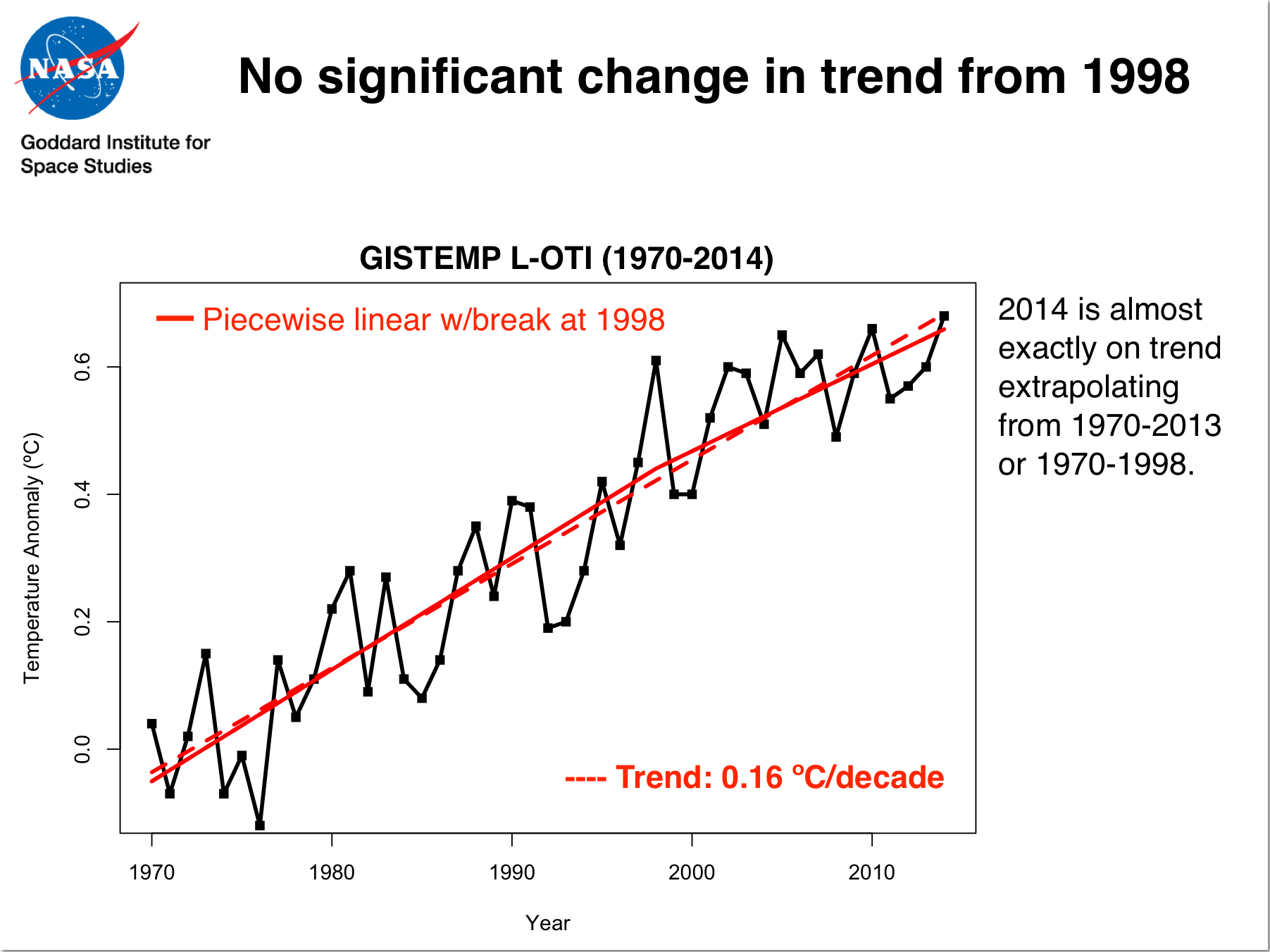
One's position with regard to scientific questions, climate change would be one of these, can be based on an hypothesis, which is nothing but an educated guess based on what makes sense at the time. As more observations and facts become available, the hypothesis may have to be rejected. A new one can be formulated that is consistent with observations. As a scientist, I don't have a choice, I must either reject Hansen's original hypothesis as being wrong, or reject the observations as being wrong.
Currently global temperature is not rising, but CO2 is. This presents a dilemma for those still adhering to the original Hansen Hpothesis, and has to be explained consistent with observation. (For example, is the missing thermal energy hiding in the deep ocean -- but as yet there are no consistent observations to support that explanation -- the explanation is itself another hypothesis! Or perhaps temperature rise, caused by rising anthropomorphic CO2, greatly lags CO2 concentration. But this is inconsistent with our observation that CO2 concentration lags temperature.)
There is, however, an alternative hypothesis that
is consistent with observation: rather than rising anthropomorphic CO2 causing temperature to increase, something else is the main driver of temperature, and CO2 concentration is mainly driven by the integrated temperature. This latter hypothesis is consistent with the observation that currently CO2 is still rising, due to anthropomorphic contribution, but the integrated temperature is not rising. Were increasing anthropomorphic CO2 the primary driver of temperature increase the integrated temperature should still rise. Sorting this out depends critically on being able to assess what part of the atmosphere's CO2 is anthropomorphic, and how that is changing over time. There are now several ways to do that. These give a consistent upper bound for estimates of Anthro CO2. This consistency of results from alternative methods gives some confidence that the estimates are correct. We have learned that simply adding up all the CO2 from Fossil fuel and assuming what goes into the atmosphere stays there, as was done in the 1980s, does not give us a correct result.
I pointed out quite awhile ago why anthropomorphic contributions to CO2 can't be calculated directly from a simple mass balance relationship, and all scientists, including Hansen, recognize that. One of Salby's contributions has been to point out ways to indirectly get at the possible range of anthropomorphic contribution, assuming his hypothesis that temperature is the main driver of atmospheric CO2 is correct..
One problem for me is that the time constants used initially -- initially they were guesses based on what they would have to be to give results approximately consistent with Hansen's hypothesis -- in the Bern Model used by the IPCC are now recognized as having been wildly off!, as shown by the Bomb C-14 CO2 decay. The model itself may not be wrong, that's still a matter of discussion. Regardless, however, of whether correct values for the Bern Model's parameters are found, we are forced to contend with the reality of observations.
There are observations inconsistent with model predictions. Some of that can be fixed in the models (perhaps). But what can't be fixed without rejecting the models entirely, is that some of our most reliable observations are wholly inconsistent with the main assumption the models are based on. A key assumption for 100% of the models is that CO2 is the main driver of surface temperature, i.e., it's the Earth's "thermostat", as FC likes to call it. The observations, however, are inconsistent with this assumption!
They are, however, consistent with integrated temperature being the main driver of CO2 concentration. Of course there is also Anthro CO2 present. It rises with world population; fossil fuel use increases with population.
Either our observations are wrong or the models that assume CO2 is the main driver of surface temperature are wrong. They can't both be right! At this point, it is looking as though Mother Nature is smarter than we are.
__________________________
Bern Model:
http://www.climate.unibe.ch/~joos/model_description/model_description.html