CNN: Milestone for Trump: 1 million new jobs in six months

CNN: Milestone for Trump: 1 million new jobs in six months
http://money.cnn.com/2017/08/04/news/economy/july-jobs-report/index.html

America has added more than a million jobs since President Trump took office.

The U.S. economy added a strong 209,000 jobs in July, more than economists had expected. The unemployment rate fell to 4.3%, matching a 16-year low. Just after the Great Recession in 2009, unemployment peaked at 10%.

"The economy is looking pretty good," said Cathy Barrera, chief economic adviser at ZipRecruiter, the job posting site.

Many economists say the United States is at or near "full employment," meaning the unemployment rate won't go down significantly more.

(More at above url)
 
Games with statistics.

The Amazon Effect: Part Time Jobs Soar By 393K, Full Time Jobs Slide


On the surface the July jobs report was solid, with 209K jobs added, more than the expected, as the recent auto sector slowdown appears to skip the labor market (for now), with Trump quick to take credit for the report.

Excellent Jobs Numbers just released - and I have only just begun. Many job stifling regulations continue to fall. Movement back to USA!

— Donald J. Trump (@realDonaldTrump) August 4, 2017

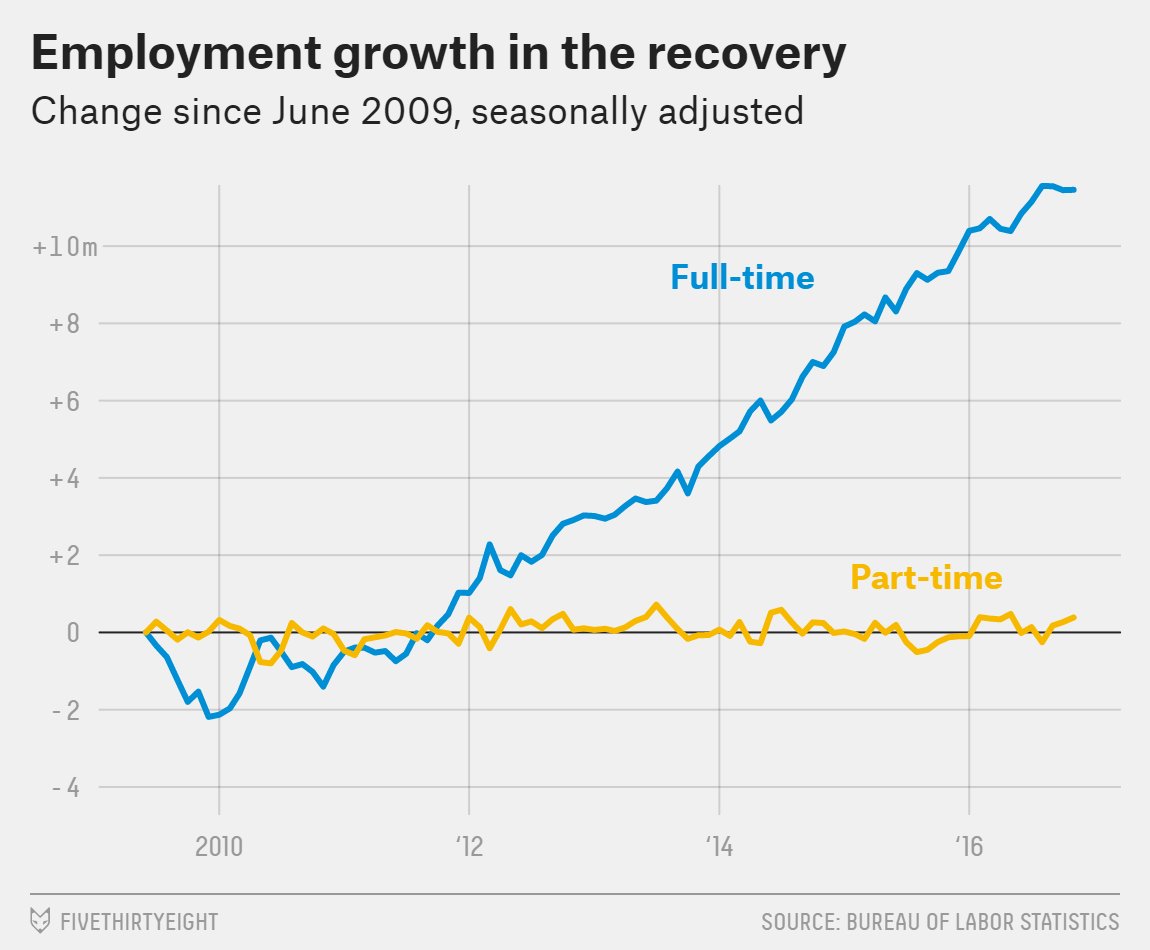
However, digging through the numbers reveals some troubling features: while the Household survey reported that an impressive 345K jobs were added, more than 50% higher than the Establishment survey, the bulk of these jobs was part-time. According to the BLS, in July 393,000 part time jobs were added, offset by a drop of 54,000 full-time workers.


This was the biggest increase in part-time jobs going back to September 2016.


Having monopolized the retail sector (and branching out to others), is Amazon - which recently hired 10 part time jobs for every full time job - starting to dominated the lobs report next?
 
Where The Jobs Were: Waiters And Bartenders Topped The List


We already showed that contrary to the strong headline payrolls print, the sole source of job gains in July was part-time jobs, which rose by 393K in the month, the biggest monthly increase since September 2016, as full-time jobs sunk by 54K. Which is why it should not surprise that of the 209K jobs added according to the Establishment survey, the sector that added the most jobs was the "food services and drinking places", i.e. "waiters and barenders" category, which added 53,000 jobs, the highest monthly increase since March 2014. There have now been 89 consecutive months without a decline for waiter and bartender jobs, the strongest sector for US employment. Needless to say, these jobs fall within leisure and hospitality, that sector pays the worst wages, an average of $13.35 an hour, and $331.08 a week.


Next was professional and business services, which added 49,000 jobs. Within this category, administrative and waste services added 30,000 jobs, while temp workers rose by 14,700. The good news here is that hourly pay for this group averaged $26.07, and weekly pay $928.09, up 2.5% from a year ago. The bad news is that most of the jobs were in administrative and temp services, the lowest paying groupings.

Health care added 39,000 jobs, with job gains occurring in ambulatory health care services (+30,000) and hospitals (+7,000). Health care has added 327,000 jobs over the past year.

Employment in mining was essentially unchanged in July (+1,000).

While no other sector made a significant contribution to the July report, it is worth pointing out that for the second consecutive month there wasn't a major job sector with a decline in jobs.

Commenting on the job distribution, Andrew Zatlin of SouthBay Research said "manufacturing hiring is settling down: oil related capex hiring is pausing and autos are hitting the brakes. This offsets other gains. That leaves services to drive the hiring, and it's mostly positive. Healthcare hiring strengthened after the ACA repeal debacle. Temp hiring is also steady."

In its observation of overall wge growth, which surprised to the upside rising 2.5% for all workers from a year ago, more than the 2.4% expected, that number can often be skewed by gains at the top. Furthermore, these are nominal numbers: assuming a 1.6% CPI as reported in June, that means "real" wage growth is roughly 1%. As the WSJ points out, "it's hard to push the economy very far when consumers are seeing only 1% wage growth."

jobs%20by%20industry%20july_0.jpg
 
Only Employment Gains In The Past Year: Those With A High School Diploma Or Lower


In its latest, July, snapshot of the US economy, the NY Fed observed something startling, and which hasn't received much discussion in the media: when looking at the June report, over the past year the only employment gains have gone to less educated Americans, or as the NY Fed puts it, "over the last year, the employment-to-population ratio has risen for the less educated." It added that "for those with less than a high school degree and for high school graduates, the employment-to-population ratio rose by 0.4 percentage point and 0.9 percentage point, respectively.

Meanwhile, "the employment-to-population ratio for the more highly educated has been on a downward trend, with the ratio for those with a college degree 0.2% percentage point lower in June relative to a year ago."


Now that we have the July data we can update the NY Fed data, and find... more of the same: as the chart below shows, while on both a 1-month and 1-year basis, the Employment-to-Population ratio for workers with "some college" or "a bachelor's degree and higher" declined or remained flat again, the biggest increase on both a 1-month and 1-year basis was for those with "less than a high school diploma" or "high school" graduates.


In retrospect, this should not come as a surprise: in an economy where wage growth is "inexplicably" failing to materialize, in which waiters and bartenders were the hottest hiring sector last month and over the past 7 years, and where part-time workers soared in July, it makes sense that the best job prospects are for those who never went to college. As for the adverse structural consequences for the US economy as a result of lack of demand for those with a college education, that is self-explanatory and is a giant hint as to the unprecedented collapse in US economic productivity in recent years.
 
But are they counting those who have stopped looking for work ? . ?


a phrase often heard during the Obama administration.o_O.

Of course they don't count those who stopped looking for work as unemployed. That's one of the problems in the way the U3 is calculated and why it's nothing but a talking point for politicians. It's not meaningful in any way.

Trump takes credit for low, bullshit unemployment numbers, just like Obama did before him.
 
Back
Top