And no matter how you say it....WeDidTodd2 is a stupid fucking name. One can just tell a moron came up with that one.

You are using an out of date browser. It may not display this or other websites correctly.
You should upgrade or use an alternative browser.
You should upgrade or use an alternative browser.
Climate Change
- Thread starter dbphoenix
- Start date

And no matter how you say it....WeDidTodd2 is a stupid fucking name. One can just tell a moron came up with that one.
Well, it is a much higher probability than 10% that everyone else besides you on this forum can read my "stupid fucking name".
Is that the libtard way of conceding? You can't make a reasonable argument so you attack my name on the forum.And no matter how you say it....WeDidTodd2 is a stupid fucking name. One can just tell a moron came up with that one.
2014 Hottest Year on Record Amidst Ocean Heat Spikes and Arctic Wildfires
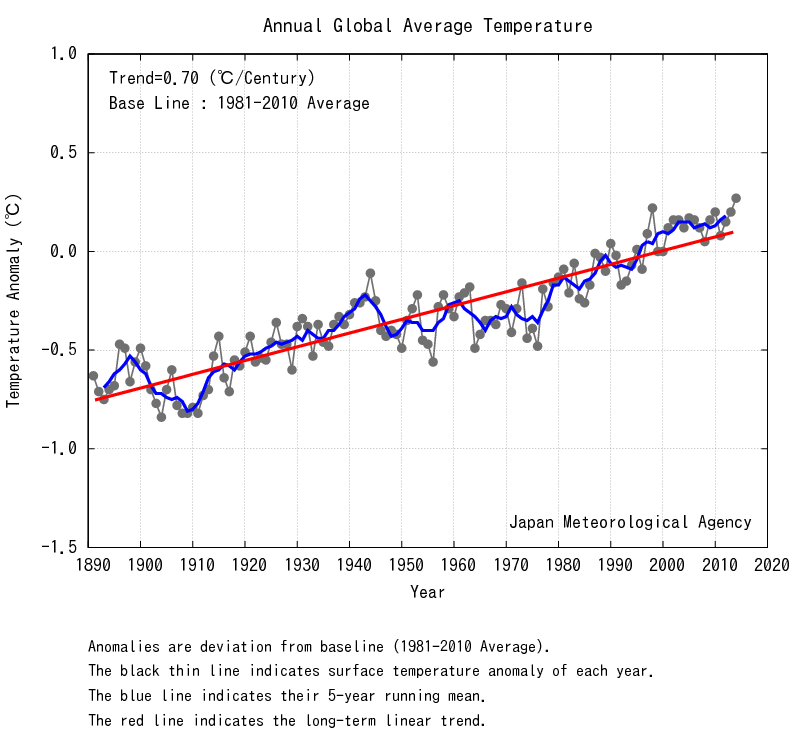
According to Japan’s Meteorological Agency, 2014 set new inauspicious marks as the hottest year in the global climate record since measures began in 1891.
Temperatures rocketed to 0.27 C above the 1981-2010 average, 0.63 C above the 20th Century average and showed a severe pace of warming of 0.70 C per Century. By comparison, the end of the last ice age featured century scale warming at the rate of 0.04 to 0.05 C every 100 years. So the current rate of warming, according to the JMA measure, is 14-17 times faster. A rapid warm-up driving increasingly severe weather and geophysical changes.
(JMA measure shows 2014 was hottest year on record. Image source JMA.)
NOAA is also expected to show 2014 as hottest year on record. NASA is likely to show 2014 as 1rst, 2nd or 3rd hottest.
2014, according to JMA, was the first record breaker since the super El Nino year of 1998 with 2014 beating out 1998 by 0.05 degrees C. However, the JMA measure also showed that all ten hottest years on record occurred since 1998. Perhaps more telling is the fact that the JMA measure reveals no hiatus in the pace of global atmospheric temperature increase with all years since 1998 at or above the trend line.
http://www.aps.org/policy/statements/upload/climate-review-framing.pdf
Bold mine.
• With uncertainty in ocean data being ten times larger than the total magnitude of the warming attributed to anthropogenic sources, and combined with the IPCC’s conclusion than it has less than 10% confidence that it can separate long-term trends from regular variability, why is it reasonable to conclude that increases in GMST are attributable to radiative forcing rather than to ocean variability?
"10% confidence"

So what is your argument dumb-name-guy? That the earth is not warming? That man's 40% increase in the GHG CO2 is not causing warming?
What the hell are you saying?
What the hell are you saying?
New research confirms numerous previous estimates that the rate of sea-level rise jumped substantially toward the end of the 20th century. The ocean now appears to be rising at a rate of about a foot per century.
That would be worrisome enough, since mere inches of sea-level rise have been enough to force governments to spend billions of dollars to fight coastal erosion. But recent research suggests that the great ice sheets in Greenland and Antarctica are starting to break up as a result of global warming, a development that will send quadrillions of additional gallons of water pouring into the ocean. Many scientists see the recent jump in the rate as the beginning of a more troubling long-term acceleration that may ultimately threaten coastal cities around the world.
Already, tidal flooding is growing worse and causing severe problems in cities like Norfolk and Miami Beach, and in whole countries like Bangladesh.
That would be worrisome enough, since mere inches of sea-level rise have been enough to force governments to spend billions of dollars to fight coastal erosion. But recent research suggests that the great ice sheets in Greenland and Antarctica are starting to break up as a result of global warming, a development that will send quadrillions of additional gallons of water pouring into the ocean. Many scientists see the recent jump in the rate as the beginning of a more troubling long-term acceleration that may ultimately threaten coastal cities around the world.
Already, tidal flooding is growing worse and causing severe problems in cities like Norfolk and Miami Beach, and in whole countries like Bangladesh.
New research confirms numerous previous estimates that the rate of sea-level rise jumped substantially toward the end of the 20th century. The ocean now appears to be rising at a rate of about a foot per century.
That would be worrisome enough, since mere inches of sea-level rise have been enough to force governments to spend billions of dollars to fight coastal erosion. But recent research suggests that the great ice sheets in Greenland and Antarctica are starting to break up as a result of global warming, a development that will send quadrillions of additional gallons of water pouring into the ocean. Many scientists see the recent jump in the rate as the beginning of a more troubling long-term acceleration that may ultimately threaten coastal cities around the world.
Already, tidal flooding is growing worse and causing severe problems in cities like Norfolk and Miami Beach, and in whole countries like Bangladesh.
The American Physical Society stated:
The observational record of sea ice during the satellite era (from 1979) is shown in the figure below depicting data from the National Snow and Ice Data Center (NSIDIC). The long-term decline of the 13-month running average in the Arctic and the slight secular increase in the Antarctic are evident.
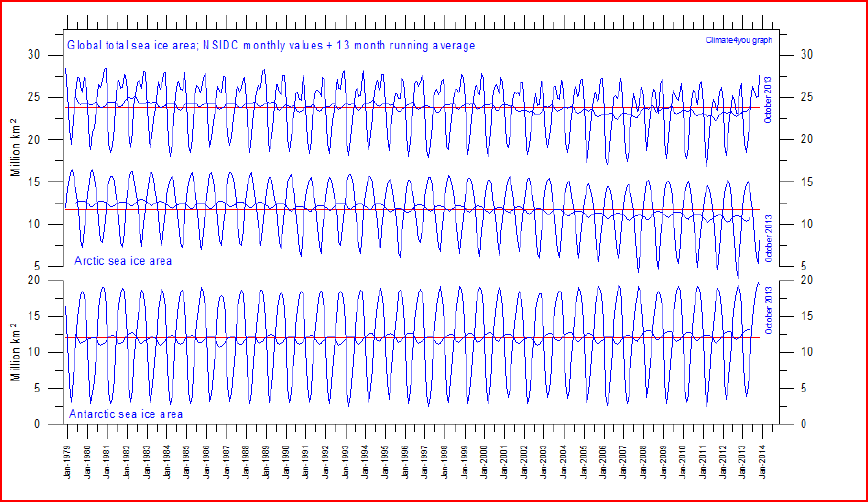
Then the American Physical Society reasonably asked:
Bold mine.
To what extent do you believe the recent Arctic decline to be unusual, given that Section 5.5.2 of the AR5 WG1 report states: “There is medium confidence that the current ice loss and increasing SSTs in the Arctic are anomalous at least in the context of the last two millennia.”?
White on rice bitch.
It's pretty funny that you think something so immaterial is so important. You obviously have no idea what it is saying.
Tell me what it is saying.It's pretty funny that you think something so immaterial is so important. You obviously have no idea what it is saying.
This is what it is saying
"The evidence is incontrovertible: Global warming is occurring. If no mitigating actions are taken, significant disruptions in the Earth’s physical and ecological systems, social systems, security and human health are likely to occur. We must reduce emissions of greenhouse gases beginning now."
"The evidence is incontrovertible: Global warming is occurring. If no mitigating actions are taken, significant disruptions in the Earth’s physical and ecological systems, social systems, security and human health are likely to occur. We must reduce emissions of greenhouse gases beginning now."