Climate Change... its the sun... again.

Yes, it's funny, that you don't even know what you are reading. It's hysterical. In a sad kind of way.
apsdoc_zpsa7de8d2e.png


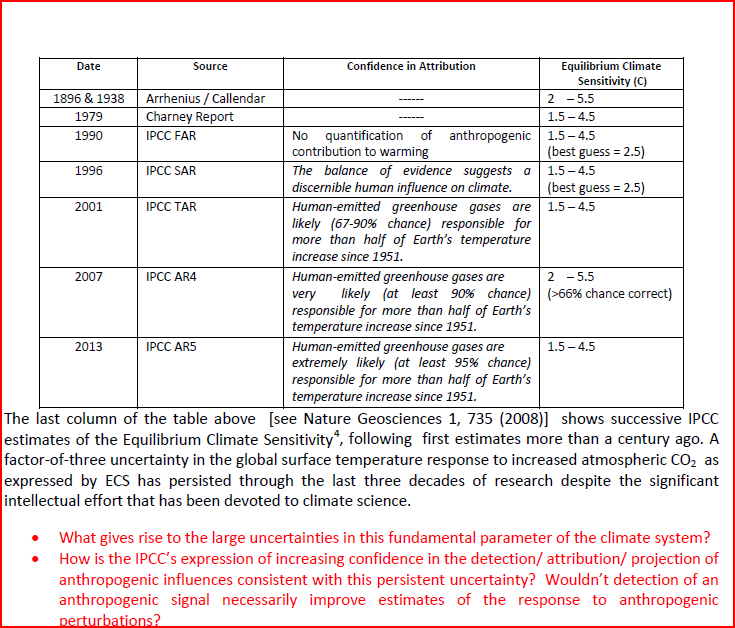
"A factor-of-three uncertainty in the global surface temperature response to increased atmospheric CO2 as expressed by ECS has persisted through the last three decades of research despite the significant intellectual effort that has been devoted to climate science."

y2Zwk.gif


And you are as confused as to what this means as Larry is. Yet you post it anyhow, hoping that maybe it supports your argument - whatever that is.
 
Yes, it's funny, that you don't even know what you are reading. It's hysterical. In a sad kind of way.

95% confidence....

The scientific opinion on climate change is that the Earth's climate system is unequivocally warming, and it is extremely likely(at least 95% probability) that humans are causing most of it through activities that increase concentrations of greenhouse gases in the atmosphere, such as deforestation and burning fossil fuels. In addition, it is likely that some potential further greenhouse gas warming has been offset by increased aerosols.[1][2][3][4] This scientific consensus is expressed in synthesis reports, by scientific bodies of national or international standing, and by surveys of opinion among climate scientists. Individual scientists, universities, and laboratories contribute to the overall scientific opinion via their peer-reviewed publications, and the areas of collective agreement and relative certainty are summarised in these high level reports and surveys.

National and international science academies and scientific societies have assessed current scientific opinion on global warming. These assessments are generally consistent with the conclusions of the Intergovernmental Panel on Climate Change, the IPCC Fourth Assessment Report summarized:

  • Warming of the climate system is unequivocal, as evidenced by increases in global average air and ocean temperatures, the widespread melting of snow and ice, and rising global average sea level.[5]
  • Most of the global warming since the mid-20th century is very likely due to human activities.[6]
  • Benefits and costs of climate change for [human] society will vary widely by location and scale.[7] Some of the effects intemperate and polar regions will be positive and others elsewhere will be negative.[7] Overall, net effects are more likely to be strongly negative with larger or more rapid warming.[7]
  • The range of published evidence indicates that the net damage costs of climate change are likely to be significant and to increase over time.[8]
  • The resilience of many ecosystems is likely to be exceeded this century by an unprecedented combination of climate change, associated disturbances (e.g. flooding,drought, wildfire, insects, ocean acidification) and other global change drivers (e.g. land-use change, pollution, fragmentation of natural systems, over-exploitation of resources).[9]
No scientific body of national or international standing maintains a formal opinion dissenting from any of these main points. The last national or international scientific body to drop dissent was the American Association of Petroleum Geologists,[10] which in 2007[11] updated its statement to its current non-committal position.[12] Some other organizations, primarily those focusing on geology, also hold non-committal positions.

I understand it. Somehow they get to a "95% confidence" even though it is heavily based on "10% confidence" and "medium confidence".

Bold mine.
To what extent do you believe the recent Arctic decline to be unusual, given that Section 5.5.2 of the AR5 WG1 report states: “There is medium confidence that the current ice loss and increasing SSTs in the Arctic are anomalous at least in the context of the last two millennia.”?

To what extent do you believe the recent Arctic decline to be unusual, given that Section 5.5.2 of the AR5 WG1 report states: “There is medium confidence that the current ice loss and increasing SSTs in the Arctic are anomalous at least in the context of the last two millennia.”?
 
your 11 year average is the cherry picked to mislead. temperature over land has gone down since 2001. Your 11 year average hides the decline.
Average temperature over 11 year periods, covering 100 years is cherry picking?

While your measurement highlighting 2 x3 years periods and one 2 year period within a 24 year period to support the phrase "It is asserted that these are caused by a solar forcing".. is not cherry picking?
 
I understand it. Somehow they get to a "95% confidence" even though it is heavily based on "10% confidence" and "medium confidence".

Bold mine.


Yeah so? Flowers bloom in the spring also. You're posting meaningless stuff and thinking it's important. AGW theory does not rely on Arctic ice loss to validate it. It's just one more piece of evidence. The Arctic ice loss right now is rapid and probably hasn't been seen in ten thousand years at least.


And even WeToddDid2 is a stupid name.
 
Yeah so? Flowers bloom in the spring also. You're posting meaningless stuff and thinking it's important. AGW theory does not rely on Arctic ice loss to validate it. It's just one more piece of evidence. The Arctic ice loss right now is rapid and probably hasn't been seen in ten thousand years at least.


And even WeToddDid2 is a stupid name.

The American Physical Society thought it was meaningful enough to ask the questions.

If you had any integrity at all, you would admit that the questions posed by the American Physical Society is the academic equivalent of punching someone in the face.

You think that you are smarter than NASA. Now do you think that you are smarter than the APS as well?

Blahahahahahahaha
 
temperature has not gone up for 19 years and going down since 2001.
so if you telling me the solar energy has been going down the last 35 years...
and then I tell you that temps leveled off over 19 years and have have down since 2001...


the only way you can argue temperature is going up is by fudging with moving averages.


Average temperature over 11 year periods, covering 100 years is cherry picking?

While your measurement highlighting 2 x3 years periods and one 2 year period within a 24 year period to support the phrase "It is asserted that these are caused by a solar forcing".. is not cherry picking?
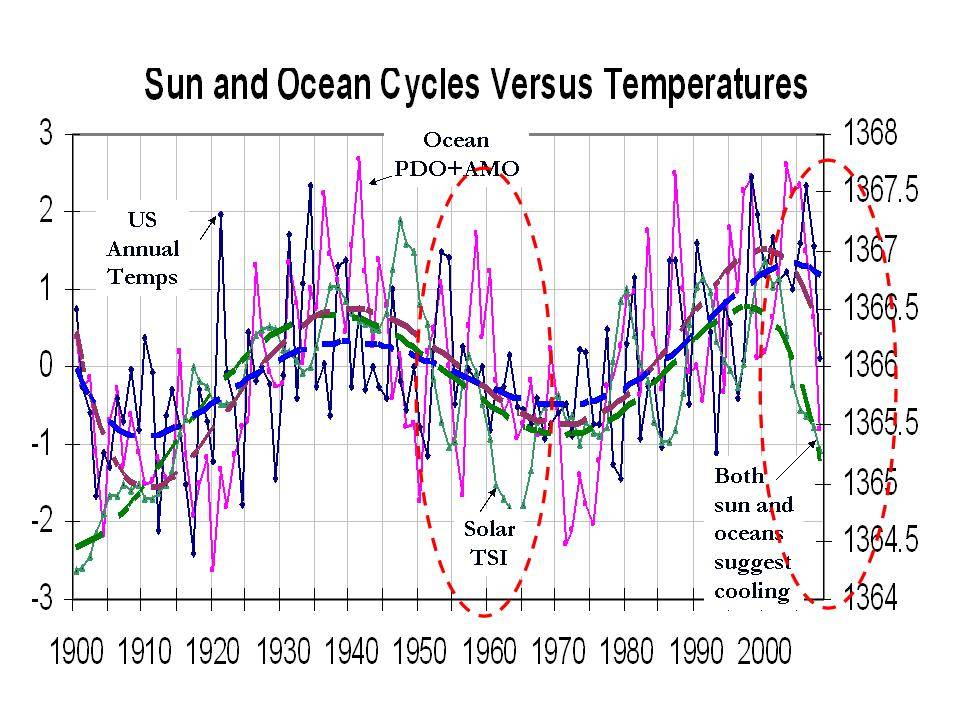
It's the sun...
"The data suggests solar activity is influencing the global climate causing the world to get warmer."

"Over the last 35 years the sun has shown a slight cooling trend. However global temperatures have been increasing. Since the sun and climate are going in opposite directions scientists conclude the sun cannot be the cause of recent global warming.

The only way to blame the sun for the current rise in temperatures is by cherry picking the data. This is done by showing only past periods when sun and climate move together and ignoring the last few decades when the two are moving in opposite directions."

Solar_vs_temp_500.jpg
 
It's the sun...
"The data suggests solar activity is influencing the global climate causing the world to get warmer."

"Over the last 35 years the sun has shown a slight cooling trend. However global temperatures have been increasing. Since the sun and climate are going in opposite directions scientists conclude the sun cannot be the cause of recent global warming.

The only way to blame the sun for the current rise in temperatures is by cherry picking the data. This is done by showing only past periods when sun and climate move together and ignoring the last few decades when the two are moving in opposite directions."

Solar_vs_temp_500.jpg


http://www.aps.org/policy/statements/upload/climate-review-framing.pdf
Are there any other possible multidecadal modes of variability? If so, how is that variability accounted for?
What do you see as the likelihood of solar influences beyond TSI? Is it coincidence that the stasis has occurred during the weakest solar cycle in about a century?
 
Back
Top