
https://www.bloomberg.com/features/2023-china-ev-graveyards/
China’s Abandoned, Obsolete Electric Cars Are Piling Up in Cities
A subsidy-fueled boom helped build China into an electric-car giant but left weed-infested lots across the nation brimming with unwanted battery-powered vehicles.
By Bloomberg News
August 17, 2023 at 7:00 PM EDT
Share this article
On the outskirts of the Chinese city of Hangzhou, a small dilapidated temple overlooks a graveyard of sorts: a series of fields where hundreds upon hundreds of electric cars have been abandoned among weeds and garbage.

Visual media produced in partnership with Outrider Foundation.
Similar pools of unwanted battery-powered vehicles have sprouted up in at least half a dozen cities across China, though a few have been cleaned up. In Hangzhou, some cars have been left for so long that plants are sprouting from their trunks. Others were discarded in such a hurry that fluffy toys still sit on their dashboards.
The scenes recall the aftermath of the nation’s bike-sharing crash in 2018, when tens of millions of bicycles ended up in rivers, ditches and disused parking lots after the rise and fall of startups backed by big tech such as Ofo and Mobike.
down from roughly 500 in 2019.
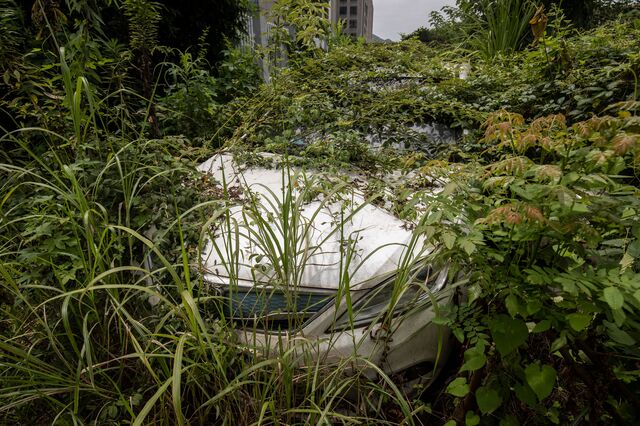
The pools of unwanted battery-powered cars are residue from rapid consolidation in the ride-hailing industry. Photographer: Qilai Shen/Bloomberg
The graveyards are a troubling consequence of that consolidation. Not only are the sites an eyesore, getting rid of EVs so quickly reduces their climate benefit considering they’re more emissions-intensive to build and only produce an advantage over combustion cars after a few years. Each of the vehicles’ spent batteries also contain precious ingredients like nickel, lithium and cobalt — metals that could be recycled to make China’s EV industry more environmentally friendly.
According to local media reports, the government of Hangzhou has vowed to dispose of the cars, which started to accumulate in 2019. But when Bloomberg News visited late last month, reporters uncovered several sites filled with abandoned EVs in the city’s Yuhang and West Lake districts after scouring satellite images and hacking through overgrown dirt paths.
cheating the subsidy program by falsifying records for non-existent EVs. For example, they could produce an empty chassis that didn’t contain a battery, or make cars with batteries that didn’t meet the correct specifications. The official People’s Daily in 2016 cited estimates that dozens of companies had fraudulently claimed more than 9.3 billion yuan ($1.3 billion) in subsidies.
local media report from 2021 said Faststep’s cars were waiting to be auctioned off. The company’s official WeChat account has not been active since 2019 and phone numbers listed on an old post are no longer working.
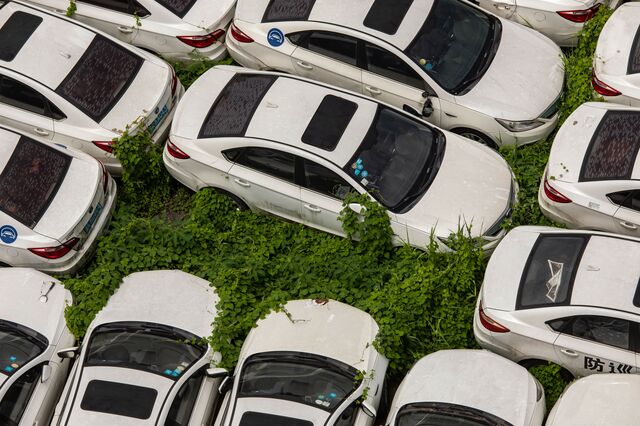
In 2019, Beijing slashed national subsidies for all electric car purchases by half, severely hitting the cash flows of ride-hailing companies. Photographer: Qilai Shen/Bloomberg
Shenzhen-based photographer Wu Guoyong was one of the first people in China to document the waste that results from frenetic development, taking striking drone shots of the piles of abandoned bicycles in 2018. In 2019, he filmed aerial footage of thousands of electric cars in empty lots around Hangzhou and Nanjing, the capital of China’s eastern Jiangsu province.
China’s capital market was small when the nation began opening up, he said in an interview, but now, unregulated financing is like a “tsunami.”
“The shared bikes and EV graveyards are a result of unconstrained capitalism,” Wu said. “The waste of resources, the damage to the environment, the vanishing wealth, it’s a natural consequence.”
—With Linda Lew, Chunying Zhang and Dan Murtaugh
Visual media produced in partnership with Outrider Foundation.
AUG. 30, 2023
The Cities Issue, a Businessweek + CityLab Collaboration
AUG. 30, 2023
Smart Ways to Make Cities Better
AUG. 29, 2023
Climate Change Is Forcing Building Materials of Cities to Evolve
AUG. 28, 2023
The Electric Vehicle That Suburbia Needs Could Be a Golf Cart
Terms of Service Trademarks Privacy Policy ©2023 Bloomberg L.P. All Rights Reserved
China’s Abandoned, Obsolete Electric Cars Are Piling Up in Cities
A subsidy-fueled boom helped build China into an electric-car giant but left weed-infested lots across the nation brimming with unwanted battery-powered vehicles.
By Bloomberg News
August 17, 2023 at 7:00 PM EDT
Share this article
On the outskirts of the Chinese city of Hangzhou, a small dilapidated temple overlooks a graveyard of sorts: a series of fields where hundreds upon hundreds of electric cars have been abandoned among weeds and garbage.
Visual media produced in partnership with Outrider Foundation.
Similar pools of unwanted battery-powered vehicles have sprouted up in at least half a dozen cities across China, though a few have been cleaned up. In Hangzhou, some cars have been left for so long that plants are sprouting from their trunks. Others were discarded in such a hurry that fluffy toys still sit on their dashboards.
The scenes recall the aftermath of the nation’s bike-sharing crash in 2018, when tens of millions of bicycles ended up in rivers, ditches and disused parking lots after the rise and fall of startups backed by big tech such as Ofo and Mobike.
down from roughly 500 in 2019.
The pools of unwanted battery-powered cars are residue from rapid consolidation in the ride-hailing industry. Photographer: Qilai Shen/Bloomberg
The graveyards are a troubling consequence of that consolidation. Not only are the sites an eyesore, getting rid of EVs so quickly reduces their climate benefit considering they’re more emissions-intensive to build and only produce an advantage over combustion cars after a few years. Each of the vehicles’ spent batteries also contain precious ingredients like nickel, lithium and cobalt — metals that could be recycled to make China’s EV industry more environmentally friendly.
According to local media reports, the government of Hangzhou has vowed to dispose of the cars, which started to accumulate in 2019. But when Bloomberg News visited late last month, reporters uncovered several sites filled with abandoned EVs in the city’s Yuhang and West Lake districts after scouring satellite images and hacking through overgrown dirt paths.
cheating the subsidy program by falsifying records for non-existent EVs. For example, they could produce an empty chassis that didn’t contain a battery, or make cars with batteries that didn’t meet the correct specifications. The official People’s Daily in 2016 cited estimates that dozens of companies had fraudulently claimed more than 9.3 billion yuan ($1.3 billion) in subsidies.
local media report from 2021 said Faststep’s cars were waiting to be auctioned off. The company’s official WeChat account has not been active since 2019 and phone numbers listed on an old post are no longer working.
In 2019, Beijing slashed national subsidies for all electric car purchases by half, severely hitting the cash flows of ride-hailing companies. Photographer: Qilai Shen/Bloomberg
Shenzhen-based photographer Wu Guoyong was one of the first people in China to document the waste that results from frenetic development, taking striking drone shots of the piles of abandoned bicycles in 2018. In 2019, he filmed aerial footage of thousands of electric cars in empty lots around Hangzhou and Nanjing, the capital of China’s eastern Jiangsu province.
China’s capital market was small when the nation began opening up, he said in an interview, but now, unregulated financing is like a “tsunami.”
“The shared bikes and EV graveyards are a result of unconstrained capitalism,” Wu said. “The waste of resources, the damage to the environment, the vanishing wealth, it’s a natural consequence.”
—With Linda Lew, Chunying Zhang and Dan Murtaugh
Visual media produced in partnership with Outrider Foundation.
AUG. 30, 2023
The Cities Issue, a Businessweek + CityLab Collaboration
AUG. 30, 2023
Smart Ways to Make Cities Better
AUG. 29, 2023
Climate Change Is Forcing Building Materials of Cities to Evolve
AUG. 28, 2023
The Electric Vehicle That Suburbia Needs Could Be a Golf Cart
Terms of Service Trademarks Privacy Policy ©2023 Bloomberg L.P. All Rights Reserved


