Chicago Boys

The Chicago Boys were a group of Chilean economists prominent around the 1970s and 80s, the majority of whom trained at the Department of Economics of the University of Chicago under Milton Friedman and Arnold Harberger, or at its affiliate in the economics department at the Pontifical Catholic University of Chile. Upon their return to Latin America they adopted positions in numerous South American governments as economic advisors, many of them reaching high positions.[1] The Heritage Foundation credits them with transforming Chile into Latin America's best performing economy and one of the world's most business-friendly jurisdictions.[2] However, critics point to drastic increases in unemployment that can be attributed to policies implemented on their advice to fight inflation. Some (such as Nobel laureate Amartya Sen) have argued that these policies were deliberately intended to serve the interests of American corporations at the expense of Latin American populations.[3][4][5] Peter Kornbluh states that in the case of Chile, American attempts to influence the Chilean economy ceased once the Chicago Boys had gained political influence; this may have been the true underlying cause of the subsequent increase in economic growth.[6][7]

https://en.wikipedia.org/wiki/Chicago_Boys
 
Based on recent trend, it looks like a national-based capitalism makes a nation (like China) strong and stronger in long run. The nation owns all the leasehold lands, receiving each lease per every say 50-year cycle. Citizens of next generation would have to work hard for renewal of a new lease. The nation has plenty of resources in developing science, technology and jobs. Whether through private-owned, or state-owned corporations. In terms of finance-power, risk-bearing-capability and visionary corporate objective. Its origin was derived from the experiment of individual-based capitalism. Probable result: Wealthy nation and Some poor citizens.

Whereas, an individual-based capitalism makes a nation weak and weaker in long run. Lands are freehold, mostly. Great-grand parents can provide two or more houses for youths living, hence allowing money for drugs. Especially, reducing taxes (causing the nation further poorer) become the best attractive way in order to keep wealthy people stay living in the country, as well as to stimulate private corporations stay operating in the country. However, they can still keep their monies saving or investing in low tax places offshore, or high-returns places offshore, where would generate domestic jobs in offshore places. Reshoring involving so many challenging aspects is not easy to do, once gone overseas. https://en.wikipedia.org/wiki/Reshoring Probable result: Some wealthy citizens and Poor Nation.

No matter what economic schools when following the individual-based capitalism philosophy would probably get similar final outcomes ultimately in long run. Whatever strategies including more wars possibly could only postpone/ delay the potential final outcomes by another decade then another decade. I am afraid. Perhaps need many more smart intelligent econometricians to produce not only national models, but also worldwide models.

Just 2 cents.
 
Last edited:

GDP growth Increase 1,6% (2017)[1]

Unemployment 6.9% (2016)[7]

https://en.wikipedia.org/wiki/Economy_of_Chile

Under the influence of the Chicago Boys the Pinochet regime made of Chile a leading country in establishing neoliberal policies. These policies allowed large corporations to consolidate their power over the Chilean economy, leading to increases in unemployment and real wages whilst failing to achieve long-term economic growth.[25] Income inequality, which had fallen during the presidency of socialist Salvador Allende, rose substantially during the reign of Pinochet as neoliberal free market policies were implemented.[26] The crisis of 1982 caused the appointment of Hernán Büchi as minister of finance and a sharp revision of economic policy. Despite a general selling of state property and contrary to neoliberal prescriptions, the regime retained the lucrative state owned mining company CODELCO which stands for about 30% of government income.
 
heisenbern,

I have unfortunately ( or fortunately) not studied economics.
Now, with your expertise, can you point ways of explaining these phenomena:
How comes that China, has managed to lift out of poverty in the last 10-20 years at least
300 MILLION people, and that , "Capitalism" has in the last 10-20 years SEEMED to have created
more poor people.

Thank you for helping me understand this question, as my lack of economics does not help
in understanding this phenomena.
 
heisenbern,

I have unfortunately ( or fortunately) not studied economics.
Now, with your expertise, can you point ways of explaining these phenomena:
How comes that China, has managed to lift out of poverty in the last 10-20 years at least
300 MILLION people, and that , "Capitalism" has in the last 10-20 years SEEMED to have created
more poor people.

Thank you for helping me understand this question, as my lack of economics does not help
in understanding this phenomena.
That is a deep question! It will take quite a bit of effort on both our parts to analyze this. To break it down scientifically. To unwind our definitions, words we think we know the meanings of. Ultimitaly, it will take us to the very core of 10,000 years of history, philosophy, and economics.

I struggle with this very question [the tension between Capitalism and who it works/worked/will work for] almost daily.
 
Last edited:
Looking backwards to dreaming those good old golden days while maintaining the same conservative religious faiths channeling a savior national CEO would help probably little.

Objectively working on econometric models in making sharp unconventional decisions, whether with drastic changes or not, could be likely a better and workable alternative. Perhaps too obvious! LOL
 
heisenbern,

I have unfortunately ( or fortunately) not studied economics.
Now, with your expertise, can you point ways of explaining these phenomena:
How comes that China, has managed to lift out of poverty in the last 10-20 years at least
300 MILLION people, and that , "Capitalism" has in the last 10-20 years SEEMED to have created
more poor people.

Thank you for helping me understand this question, as my lack of economics does not help
in understanding this phenomena.

China is capitalistic. They just do whatever works and call it communism. The guys that run their Central Bank got their experience as traders on Wall Street.
 
Chinese economic reform


https://en.wikipedia.org/wiki/Chinese_economic_reform

The success of China's economic policies and the manner of their implementation has resulted in immense changes in Chinese society. Large-scale government planning programs alongside market characteristics have greatly decreased poverty, while incomes and income inequality have increased, leading to a backlash led by the New Left. In the academic scene, scholars have debated the reason for the success of the Chinese "dual-track" economy, and have compared them to attempts to reform socialism in the Eastern Bloc and the Soviet Union; as well as the growth of other developing economies.

Prc1952-2005gdp.gif
China's nominal GDP trend from 1952 to 2005. Note the rapid increase since reform in the late 1970s.


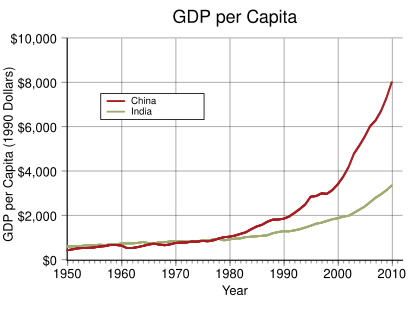
413px-GDP_per_capita_of_China_and_India.svg.png
Development trends of Chinese and Indian GDP (1950–2010)
 
Last edited:
Back
Top