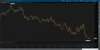
Can someone explain how the price gaps on NG work?

What's the Forest Gump route? Buy and hold? The simple route might not be a bad plan. I am doing well so far on trading NG, but I feel pretty lost sometimes like recently when the weather model flipped a 180 and I had no idea how to interpret the data...

It does seem like I am in way over my head after talking to you guys XD

Find some energy names in the equity space. Most of them are very volatile. Stuff like CHK or SWN. Trade them around your outlook for natty. Next level up might be, buy the equities and sell natty against them. Or sell the equities and buy natty. You could even do dispersion trades at a higher level. Buy CHK vol and sell Natty vol. The list is endless. I would start with the equities. They are plenty volatile, actually even more so then natty itself if you can believe that. They give you great back and forth action.
 
Interesting, I was originally trading SWN/CHK but I felt like I was exposing myself to higher risk by going through equities rather than buying the commodity itself. Like, if I felt that the price of NG would recover to somewhere around $3.50, I could be correct in my prediction but end up losing by putting my money into a company like CHK/SWN which has high debt/has to sell off assets to meet obligations and such with bankruptcy risk.

But it seems like you feel it is the safer route to invest in these companies with unsavory balance sheets. Wow!! That just tells me that I had no clue how risky trading NG was if I got the risk profiles of the two reversed like that.
 
Interesting, I was originally trading SWN/CHK but I felt like I was exposing myself to higher risk by going through equities rather than buying the commodity itself. Like, if I felt that the price of NG would recover to somewhere around $3.50, I could be correct in my prediction but end up losing by putting my money into a company like CHK/SWN which has high debt/has to sell off assets to meet obligations and such with bankruptcy risk.

But it seems like you feel it is the safer route to invest in these companies with unsavory balance sheets. Wow!! That just tells me that I had no clue how risky trading NG was if I got the risk profiles of the two reversed like that.

The high operating leverage of CHK and SWN means they are "highly" sensitive to the commodity price which is what you want. You don't want a company with no debt because then you have a company that is going to trade more on their long term cash flows which you then will have to model that.
 
Sorry to bump an old thread, but I think today is an excellent example of where I am utterly confused by pricing between months on NG.

So today the front month January is currently down ~14.4 cents, which is a bigger move than normal, even more so considering it's already steadily been selling off.

But looking at March at ~$2.76 and April at ~$2.71 the spread between the two months is almost 5 cents, which is the smallest I have ever seen it in years.

Then you look forward another year at 2019, and the March contract is trading at ~$2.99 and April is at ~2.68 which is about 30 cents difference. The difference in spread between these two months in 2018 and 2019 is almost 25 cents. Where is this gap coming from?

Based on the answers I've read here, I am still unsure of how to find the answer to explain the disparity in prices for the spread.
 
Sorry to bump an old thread, but I think today is an excellent example of where I am utterly confused by pricing between months on NG.

So today the front month January is currently down ~14.4 cents, which is a bigger move than normal, even more so considering it's already steadily been selling off.

But looking at March at ~$2.76 and April at ~$2.71 the spread between the two months is almost 5 cents, which is the smallest I have ever seen it in years.

Then you look forward another year at 2019, and the March contract is trading at ~$2.99 and April is at ~2.68 which is about 30 cents difference. The difference in spread between these two months in 2018 and 2019 is almost 25 cents. Where is this gap coming from?

Based on the answers I've read here, I am still unsure of how to find the answer to explain the disparity in prices for the spread.

Think of the HJ spread like an option. It's convex in nature. As the vol bleeds out this year that spread has been shrinking. That spread was trading over 65 cents last summer. The 2019 HJ spread is actually much tighter then the 2018 was at the same time. But the market has repriced it based on weak demand (warm winter). So if you think of 2019 as an option, there is a lot of time value left in that spread. Hence why it's still over 30 cents. If we get some VERY cold weather in the next two months that 2018 HJ spread could really explode (again the convexity at work here). The fair value for that spread is about -.05 which is probably where it will go out at the end of Feb.
 
Think of the HJ spread like an option. It's convex in nature. As the vol bleeds out this year that spread has been shrinking. That spread was trading over 65 cents last summer. The 2019 HJ spread is actually much tighter then the 2018 was at the same time. But the market has repriced it based on weak demand (warm winter). So if you think of 2019 as an option, there is a lot of time value left in that spread. Hence why it's still over 30 cents. If we get some VERY cold weather in the next two months that 2018 HJ spread could really explode (again the convexity at work here). The fair value for that spread is about -.05 which is probably where it will go out at the end of Feb.

HJ goes off the board tomorrow right near the price I predicted. Went out Friday at about -.04. This was one of the juiciest spreads last year. I got sales off in the mid 60's last summer and my last cover was last week near -.03.
 

Attachments

  • HJ.png
    HJ.png
    39.8 KB · Views: 29
Back
Top