FXCM are olay for fx broker, but real futures account next time.
Currency futures offer better bang for buck,tighter spreads and a central order book on globex.
Trade exchange listed products -- futures on AUS & CAD, or ETFs FXA and FXC. Yes, you'll pay two spreads to establish a position, but these products are all liquid. It goes without saying (but I'll say it anyway) that if you lack sufficient risk capital to trade 1-lots of futures, or a round lots of ETFs, you shouldn't be 'trading' at all.
Hi Everyone,
While I won't speak for other forex brokers, I would like to address the concerns raised here about retail spot FX in general as compared to FX futures, and FXCM specifically, since we were also mentioned.
The latest industry report for Q2 of 2016 by Finance Magnates shows daily retail forex volume to be $335 billion (to say nothing of the over $5 trillion per day traded in OTC spot FX overall according to the latest BIS survey). Even if you exclude the trading volume of smaller, less-regulated brokers, the same report shows the combined daily retail forex volume of the 20 largest forex brokers in the world is still greater than the $210 billion per day volume in FX futures on the CME.
In major financial centers around the world, retail forex is regulated by many of the same government bodies that oversee other financial markets. For example, in the US, we are regulated by the CFTC and NFA, the same two bodies that oversee futures trading on the CME. Also, in compliance with rules regarding price slippage and price re-quoting that were finalized in 2012, retail forex brokers in the US provide daily trade reports to the NFA which monitors and supervises our activity including information on the price where all client orders are filled and the corresponding price where those orders are offset with our liquidity providers.
In 2006, FXCM introduced No Dealing Desk (NDD) forex execution, and we continue to offer this to all Standard accounts. With the NDD model, we offset each client order one-for-one with the best prices sourced from multiple liquidity providers. This provides you with two key benefits as a trader. First, NDD means FXCM does not profit from your losses or lose from your profits. Instead, we make money from your trading volume. Therefore, FXCM wants you to be profitable, so you can trade more!
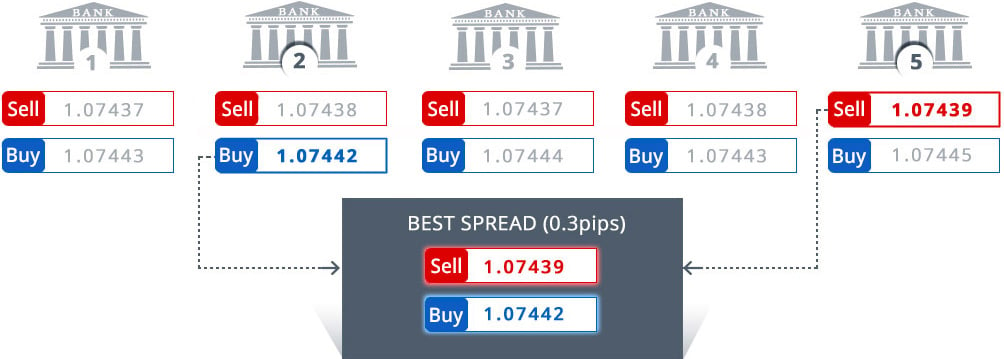
Second, NDD means competitive prices. FXCM takes the best available bid and ask prices from our liquidity providers — global banks, financial institutions and other market makers — and stream those prices to your platform. This large, diverse group of liquidity providers makes this model special: The more advantageous the prices, the more order flow the provider receives. Through competition, NDD ensures prices are market-driven and fair.
FXCM also provides Mini accounts with a dealing desk (DD) offering in which we act as the liquidity provider. This execution option is offered on smaller accounts in order to manage the risk. However, the base price used for the DD execution provided to Mini accounts before adding the fixed spread markup is identical to the base price used for our NDD forex execution on the spread + commission pricing model. That's a key reason you can have confidence trading with FXCM regardless of
your choice of execution type.
By contrast, it's important to understand how the trading environment and market participants can be very different when comparing the futures market to FXCM's NDD execution and how that could impact your trading.
Market participants in the futures market such as high frequency trading and similar highly sophisticated market makers are acting as both price makers and price takers. This can negatively impact quality of execution for a retail trader. That's because it's a speed race at the institutional level. If you break up the trading steps, at a very basic level, from receiving market data, making a trading decision and then placing the trade, institutional participants are trading in speeds measured in microseconds and even nanoseconds compared to a retail trader making trading decisions that take at least a few seconds.
HFTs on exchange spend millions of dollars on the fastest access to market data, customized computer systems for fast algo processing, and collocated servers to transmit trades as quickly as possible. You can read about the lengths institutional participants will go to by reading Flash Boys by Michael Lewis or take a look at the amounts of money being spent on telecommunications and collocation services by publicly traded market making firms such as Virtu. Institutional participants at the futures level put such a high priority on speed because in a trading venue filled with these super‐fast traders, the slowest person loses the race to be the first to trade.
Therefore, a safer route for institutional liquidity providers to take is to quote smaller sizes at wider prices to minimize margin of error of being picked off. Mistakes are very costly. If your algorithm is wrong, it's better to be wrong at a smaller amount and wider price. The risks involved make market making a fishing expedition based on speed where quality pricing and liquidity could be punished. The competition in the highly sophisticated institutional market is too great to provide the best pricing possible along with deep liquidity if the institution is exposed to the risk of being picked off by other fast and sophisticated market participants.
So if you're the average retail trader likely receiving information from a website or TV channel, over a regular cable internet line, manually placing trades from your average desktop computer, back over our internet connection with any latency involved, do you think you're going to beat the Virtu's of the world for the best price available?
How is FXCM's trading environment different?
On our NDD model for Standard and Active Trader accounts, liquidity providers are only allowed to be price makers and not price takers. Only retail clients are allowed to take pricing. The liquidity providers do not have to constantly watch their back, worrying about predatory high frequency trading because the liquidity providers are only allowed to be price makers for our retail clients. They know that liquidity provider A (who may be a predatory liquidity provider on the futures market) is not allowed to crossover and take a price from liquidity provider B. This gives our liquidity providers the ability to make a market based on quality of price and liquidity rather than speed to protect against being picked off by predatory trading from other liquidity providers.