Biden to Float Windfall Tax on Energy Producers

Diesel and home heating oil spreads are outside traditional norms as winter approaches.

US Refiners Eye Unusual Winter Windfall
Heating-oil cracks have blown out, inventories are at multidecade lows and plant outages have crimped capacity — all positive signs for profits.
https://www.bloomberg.com/opinion/a...inter-windfall-as-crack-spreads-gain-l9iefc13

Like many of us, oil refiners in the US love summer and put up with winter. Gasoline demand, which accounts for roughly half of overall oil-product consumption, rises in the warmer months as Americans head on vacation. After Labor Day, diesel and fuel oil reassert themselves, and refining margins tend to draw in along with the nights.

This winter looks very different. In the 10 years ending 2019, benchmark Nymex 3:2:1 crack spreads — a margin comparing three crude-oil contracts versus two gasoline and one diesel — averaged around $3 a barrel higher in the second quarter than in the fourth. This year, futures imply that relationship will flip. More important are the absolute numbers: Winter cracks average almost $41 a barrel, more than double last year’s level.

This is all distillate. While margins on gasoline collapsed in August as demand faltered in the face of high pump prices, heating-oil cracks blew out this month to more than $80 a barrel (the front-month spread is around $74 currently). Inventories are at multidecade lows and the closure of refining capacity during the Covid crisis, exacerbated by a spate of recent outages, has created a perfect storm.

Refiners stateside are also benefiting from whiplash in the natural gas market, where benchmark Henry Hub prices have almost halved since hitting double digits in August, reducing the cost of a key input. At the same time, even though panic in Europe has eased somewhat, the benchmark Dutch TTF gas price is still almost seven times Henry Hub. That nets US refiners a competitive advantage and, as European consumers seek alternatives to expensive natural gas, creates extra demand for diesel across the Atlantic.

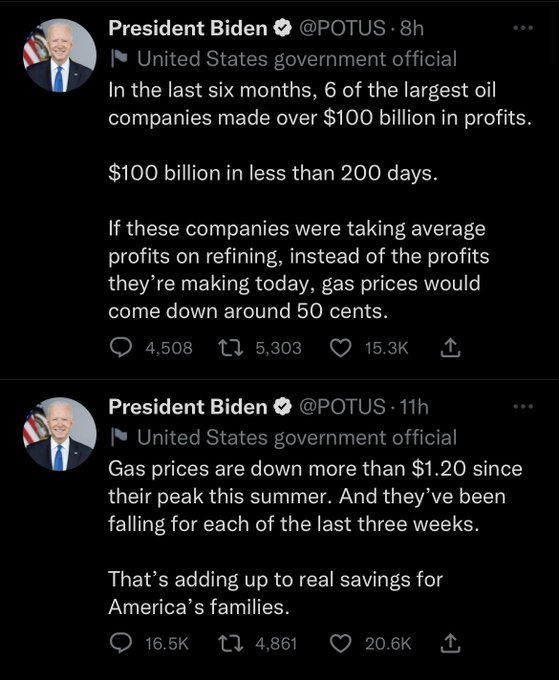
The wildcard here is politics. US President Joe Biden specifically called out refiners in his latest attempt this week to jawbone energy prices down, even if he did focus on more election-adjacent gasoline. Amid midterms and proxy war, export bans still can’t be ruled out. In the meantime, however, refiners are heading into an unusual year-end windfall.

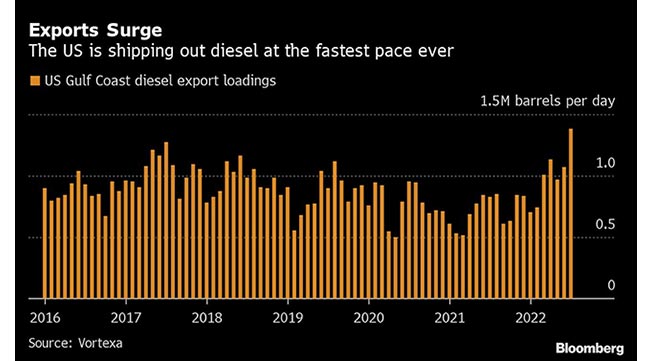
Heating oil and diesel are very closely linked.
diesel-chart-650.jpg
 
Seriously though, how do you know he’s wrong and you’re right? Could Biden be right about the excess profits and the market not working as it should?

I don't think I'd argue about the market not working as it should. I've said many times that the amount of speculation in the market is too great and should be curbed somewhat (I'm reminded of the 2007 timeframe when speculation in CL was ridiculous). But Biden's point isn't that the market is not working as it should as much as he is insinuating that companies like Exxon and Shell are manipulating prices at the pump, which is really ridiculous. And that is what I personally have an issue with.

He's doing it to be political.
 
The reason the oil markets don't work as they should is OPEC. That doesn't mean that the oil market would never have imbalances from where they want to be, but it would be similar to other commodities where there isn't a cartel controlling 70% of the supply. If you want to put price controls on oil there will be shortages. If you tax the oil companies on profits you're not encouraging the market to solve the problems (getting the refineries back up, opening more drilling, more competition, etc). Oil does not have the same problem that the pharmaceutical industry has (monopoly). There is competition. There's no evidence in collusion to rig the gasoline prices. The problem is, it's a very unpredictable business that deals with massive demand fluctuations and tons of both foreign and domestic regulation.
 
Seriously though, how do you know he’s wrong and you’re right? Could Biden be right about the excess profits and the market not working as it should?

Because Oil is a free market and a small OPEC prodn drop ( after many increases ) is not the reason for higher prices. In fact, the most manipulative aspect in Oil markets right now is Biden draining US emergency reserves. There is a cost to drilling and building new supply and the economic case just isn't there to produce more Oil right now. Most Oil companies work for their shareholders. Biden's actually risking creating a huge spike in price once he is forced to remove his measures. The government shouldn't interfere in markets like this unless there is a real emergency need to do so.

Oil has to actually be at quite at a high price for the Saudi's to make money. There is no motivation for them to take measures to make it a money losing business as it was not so long ago. Some producers went out of business in 2020, some got sick of banks and govt squeezing them on credit, some decided they needed to slash their debt for a rainy day. Shareholders want their dividends back and some assurance they won't face possible liquidation or jacked up loans from banks blaming "dirty oil" in the future.
 
The reason the oil markets don't work as they should is OPEC. That doesn't mean that the oil market would never have imbalances from where they want to be, but it would be similar to other commodities where there isn't a cartel controlling 70% of the supply. If you want to put price controls on oil there will be shortages. If you tax the oil companies on profits you're not encouraging the market to solve the problems (getting the refineries back up, opening more drilling, more competition, etc). Oil does not have the same problem that the pharmaceutical industry has (monopoly). There is competition. There's no evidence in collusion to rig the gasoline prices. The problem is, it's a very unpredictable business that deals with massive demand fluctuations and tons of both foreign and domestic regulation.

It's not because of OPEC. Many OPEC countries literally can't even keep up with mandated production increases. There is only 2 or 3 countries that can turn on the taps and increase production and why should they make their main business a losing one ? If prices are too high then some marginal producers will have a case to produce. However, it takes time and there just aren't enough longer term guarantees to support the business case for doing so.
 
It's not because of OPEC. Many OPEC countries literally can't even keep up with mandated production increases. There is only 2 or 3 countries that can turn on the taps and increase production and why should they make their main business a losing one ? If prices are too high then some marginal producers will have a case to produce. However, it takes time and there just aren't enough longer term guarantees to support the business case for doing so.
OPEC completely distorts the market and makes it harder for companies in free markets to operate. They cannot just ramp up oil production to help bring supply up to demand, because OPEC can decide to increase production themselves. As a result it would drive the free market oil companies into the red.
 
Back
Top